




Table of Contents- convert it into sticky anchor navigation below the introductory sections. (Desktop: Horizontal sticky menu. Mobile: Dropdown reading “Jump to a section.”)
Celebrating 40 Years of Compliance Leadership
Pre-Employment Drug Testing for More Informed Hiring
DISA Global Solutions drug testing helps you screen candidates for selected substances before they start work, based on your written policy, role requirements, testing methodology, and applicable requirements.



Table of Contents- convert it into sticky anchor navigation below the introductory sections. (Desktop: Horizontal sticky menu. Mobile: Dropdown reading “Jump to a section.”)
When workforce safety, DOT obligations, contractor access, or internal hiring standards are tied to substance abuse screening, your team needs more than a standalone test. DISA helps HR, recruiting, compliance, safety, and risk teams manage applicant testing as part of a complete drug and alcohol testing program.
Whether you need a pre-employment drug screen as a standalone service or as part of a broader hiring and compliance workflow, DISA can support configurable panels, multiple testing methodologies, alcohol testing, electronic scheduling, eCCF capabilities, MRO review, national collection access, and ongoing program management.
DISA also works with five primary lab partners (Labcorp, Quest, Abbott Toxicology, CRL, and Psychemedics), while most third-party administrator (TPAs) work with roughly three. Our broader lab partner ecosystem gives our clients more flexibility when configuring pre-employment drug screening programs across different testing methods, policies, populations, and workforce needs.

Urine testing is commonly used for employment drug testing and is often selected for both regulated and non-regulated programs.

Oral fluid testing may support observed collections and may be useful when recent-use detection, collection convenience, or on-site collection is important.

Hair testing may provide a longer lookback window for certain substances, depending on the lab process and test configuration, and is increasingly used by employers due to its higher detection rate.
3.5M+ drug tests annually • Nationwide collection network • 5 primary laboratory partners • DOT and non-DOT support

Pre-employment drug testing is a hiring-stage screening process used to check whether an applicant’s specimen indicates use of selected drugs or alcohol, depending on the test type, panel, policy, and applicable requirements. Employers often use pre-employment drug tests to support workplace safety, hiring consistency, DOT or non-DOT program requirements, contractor onboarding, and safety-sensitive workforce management. We help employers manage pre-employment drug screening as part of a broader drug and alcohol testing program, instead of just as a one-time applicant test.

Screen candidates for selected drugs or alcohol before employment begins

HR teams, recruiters, compliance teams, safety teams, risk teams, and hiring managers
Safety-sensitive hiring, DOT-covered roles, contractor onboarding, industrial worksites, healthcare hiring, high-volume hiring, and corporate policy programs
Urine, hair, oral fluid, alcohol testing, blood testing, and configurable panels depending on policy and program needs

Applicant information, employer policy, testing reason, panel, specimen type, collection location, chain-of-custody documentation, lab workflow, and MRO review process

DISA works with a broad lab partner ecosystem including Labcorp, Quest, Abbott Toxicology, CRL, and Psychemedics. Most TPAs work with roughly three primary lab partners.

Helps support safer hiring, consistent screening practices, documented workflows, and broader workplace drug and alcohol program management

DISA can support pre-employment testing as part of an end-to-end drug and alcohol program across multiple policies, testing reasons, methodologies, lab workflows, and workforce types

Pre-employment drug testing is an employment screening process used before a candidate starts work. This process helps employers review whether a candidate’s specimen indicates use of selected drugs or alcohol, based on the employer’s policy, the test panel, the testing method, and applicable requirements.
Pre-employment drug testing is a screening process where job applicants are tested for the presence of drugs or alcohol in their system.
A pre-employment drug test is typically ordered during the hiring process, often after a conditional job offer and before the candidate begins work. The test may involve urine, hair, oral fluid, alcohol testing, or another configured methodology depending on the employer’s program and the role.
For your team, pre-employment drug testing can be especially important when one of your positions involves safety-sensitive duties, regulated work, contractor access, transportation, patient care, machinery, public trust, or internal policy requirements.

Pre-employment drug testing and pre-employment drug screening are often used interchangeably, as both terms generally refer to the process of checking a candidate for selected substances before employment begins.
The more important distinction, instead, is between a single pre-employment drug test and a complete workplace drug testing program. Pre-employment testing is just one testing reason of many: A broader drug and alcohol program may also include random testing, post-accident testing, reasonable suspicion testing, return-to-duty testing, follow-up testing, DOT testing, consortium programs, and corporate policy testing.
Some employers only need a simple pre-employment drug test. Others, including those who operate in safety-sensitive industries, need a full program that supports different employee populations, testing reasons, policies, and regulatory obligations.
This is where DISA’s approach stands out. DISA can help employers manage the custody and control of a drug and alcohol testing program across multiple workflows, including pre-employment, random, post-accident, reasonable suspicion, return-to-duty, DOT, consortium, and non-DOT corporate programs.
Choose the Testing Approach That Fits Your Program
Pre-employment drug testing can include different specimen types, testing panels, collection workflows, alcohol testing, laboratory review, MRO review, and reporting processes. The right configuration depends on the employer’s policy, industry, role, location, regulatory environment, and risk profile.
Employers may use different drug testing methodologies depending on their workforce and program needs.
Urine testing is commonly used for employment drug testing and is often selected for both regulated and non-regulated programs.
Oral fluid testing may support observed collections and may be useful when recent-use detection, collection convenience, or on-site collection is important.
Hair testing may provide a longer lookback window for certain substances, depending on the lab process and test configuration, and is increasingly used by employers due to its higher detection rate.
DISA supports multiple testing methodologies, and we help employers configure pre-employment drug screening around policy requirements (and even dual-methodology programs, which have a 214% higher positivity detection rate over programs that use short-term testing alone) instead of forcing every workforce into one testing model.
Customized Solutions

A pre-employment drug test may use a standard panel or a more customized panel, and depending on the employer’s program, that panel may detect substance families such as marijuana, cocaine, amphetamines, opioids, PCP, or other substances.
The right panel may vary by role and policy. A DOT-covered driver, industrial contractor, healthcare worker, corporate employee, offshore worker, and high-volume warehouse candidate may all have different testing needs.
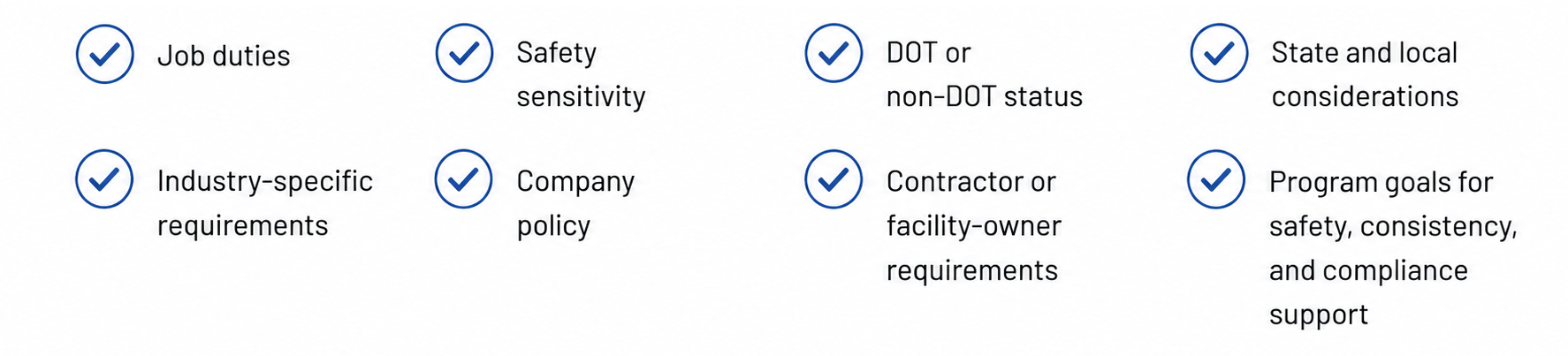
DISA can support extensive panel options and configurable programs, helping employers align testing with the following variables:
{{Would like to see this checklist as a 4 column-two row checklist as shown in image below}}
More testing flexibility with DISA's broad lab network

DISA’s pre-employment drug testing program is supported by five primary lab partners (while most competitors work with roughly three):
Because different employers may need different methodologies, panels, collection workflows, turnaround considerations, and program configurations (a safety-sensitive employer may need DOT-aligned urine testing; an industrial employer may use hair testing for a longer detection window; a healthcare or high-volume hiring program may prioritize speed, candidate experience, and collection access), DISA’s ability to support multiple lab workflows helps employers configure pre-employment drug screening around the needs of the program rather than relying on a single testing path.

Pre-employment drug testing can help company apply a consistent screening step before your candidates begin work, with results that can help your HR team review whether a candidate satisfies your policy's drug and alcohol testing requirements.
For recruiting and HR teams, a structured workflow can also reduce manual coordination. Instead of managing collection instructions, candidate scheduling, paper chain-of-custody forms, result follow-up, and exception handling separately, your team can use a managed process that supports ordering, collection, documentation, review, and reporting.
Pre-employment drug testing results depend on the specimen type, panel, detection window, collection process, laboratory workflow, cutoff levels, MRO review, and applicable program requirements.
A drug test reviews the selected specimen for the substances included in the ordered panel; it should not be treated as a guarantee of future behavior or, in every circumstance, a direct measure of current impairment. Detection windows can vary by substance, test method, frequency of use, individual factors, and laboratory process.
Employers should interpret results according to their written policy, applicable law, and compliance guidance, and consider those results as one part of the broader hiring and screening process.
The pre-employment drug testing process generally includes program setup, applicant authorization, test ordering, collection site selection, specimen collection, chain-of-custody documentation, laboratory analysis, review, and reporting. However, the exact workflow may vary by employer policy, test type, location, regulatory requirements, and customer configuration.

Drug testing process interactive timeline example (would be full width)
Before ordering a pre-employment drug test, employers should define how testing fits into their screening program.
Your team may need to answer the following questions:
For employers with multiple job types or locations, this policy step is critical. One employer may need different testing rules for CDL drivers, field technicians, industrial contractors, corporate staff, healthcare workers, and temporary employees.
Employers are generally responsible for providing required disclosures, notices, and authorization before screening begins. If drug testing is ordered as part of a broader consumer report or employment background screening process, FCRA requirements may apply.
Once the needed information is available, your team can then order the appropriate pre-employment drug test based on the candidate, role, testing reason, panel, and methodology.
The candidate will then receive instructions for completing the collection. Depending on the workflow, this list of instructions may include collection site selection, scheduling instructions (if applicable), check-in instructions, identification requirements, timing expectations, and next steps.
During collection, chain-of-custody documentation helps track the specimen through the testing process. When available and appropriate, an electronic Custody and Control Forms (eCCF) can reduce paper-based friction and support a more standardized workflow.
After collection, the specimen is processed through the applicable laboratory. Some results may require Medical Review Officer review, depending on the program, result type, and applicable requirements.
After the review process is complete, results can be viewed through the client portal, which provides easy access to all pre-employment screening reports and related documentation. Your team can then follow its written policy and requirements before making an employment decision.
For employers managing more than one testing reason, this same program foundation can also support random testing, post-accident testing, reasonable suspicion testing, return-to-duty testing, follow-up testing, and DOT or consortium program requirements.
Employers use pre-employment drug testing to help support workplace safety, hiring consistency, risk management, regulatory obligations, contractor access, and policy enforcement. For many organizations, the larger goal is not just to run one test, but to build a manageable, holistic drug and alcohol testing program.

Employers use pre-employment drug testing to help support workplace safety, hiring consistency, risk management, regulatory obligations, contractor access, and policy enforcement. For many organizations, the larger goal is not just to run one test, but to build a manageable, holistic drug and alcohol testing program.
Pre-employment drug testing can help employers review whether candidates meet the drug and alcohol testing requirements for a role before work begins.
This can be especially useful in roles involving the following:







For employers, pre-employment drug testing is both a compliance process and a part of a broader cost-control and risk-management strategy.
Would love to see a live calculator module in here.

Across all industries, the average employee with an untreated substance abuse disorder costs an employer an average of $8,800 per year in excess healthcare expenses, absenteeism, and turnover costs. And in specifically safety-sensitive industries, the cost of substance abuse by an employee at an individual company spiked to $43,000, or five times the all-industry average.
This potential cost, of course, can be significantly higher when a single incident creates downtime, injury, litigation, replacement costs, or facility disruption. The total cost of a substance-abusing employee in a safety-sensitive industry could range from $164,270 on the low end to $1,721,800 in one year, depending on the circumstances and incident impact.
The goal for employers, then, should be to support a more consistent hiring process, reduce avoidable exposure, and connect applicant screening with a broader drug and alcohol testing strategy.
Drug testing requirements can vary significantly based on the role, jurisdiction, industry, and policy, as well as whether the program is DOT-regulated or non-DOT.
DOT-regulated employers may have specific requirements under DOT agency rules and 49 CFR Part 40. DOT-regulated employers must comply with 49 CFR Part 40 and applicable DOT agency regulations, as well as maintain workplace drug and alcohol programs include clear policies, education and training, testing, and referral for evaluation and treatment when necessary.
Non-DOT employers, conversely, may need to consider federal, state, and local laws, including restrictions on timing, testing methods, marijuana testing, notices, adverse action, and disability-related issues.
While employers remain ultimately responsible for determining their policy, legal obligations, and employment decision process, DISA can provide comprehensive support throughout your testing, compliance, and hiring workflow.
Key Employer Differences
| Category | DOT Pre-Employment Testing | Non-DOT Pre-Employment Testing |
|---|---|---|
| Who it applies to | Safety-sensitive transportation roles covered by DOT agency regulations. | Roles not covered by DOT drug and alcohol testing regulations. |
| Regulatory basis | Governed by DOT testing procedures under 49 CFR Part 40 and applicable agency rules. | Based on employer policy, industry needs, and applicable state or local law. |
| When testing occurs | Before the individual first performs a DOT-covered safety-sensitive function, unless an exception applies. | Typically after a conditional offer and before work begins, depending on policy and law. |
| Test panel | Must follow DOT-required testing rules and procedures. | Can be customized based on policy, role risk, industry, and applicable law. |
| Chain of custody | Must follow DOT-compliant chain-of-custody and procedural requirements. | Still recommended; requirements may vary by provider, policy, and jurisdiction. |
| Medical review | Requires Medical Review Officer review under DOT procedures. | Strongly recommended and may be required by policy, law, contract, or industry standard. |
| Policy flexibility | Less flexible because employers must follow applicable DOT agency rules and procedures. | More flexible, but policies should be applied consistently and legally reviewed. |
| Employer goal | Meet federal safety and compliance obligations before covered duties begin. | Support workplace safety, hiring consistency, risk management, and customer requirements. |
A structured pre-employment drug testing program can help employers address common operational and compliance risks, including the following:

DISA Advantage
This is one of DISA’s strongest differentiators. We support your pre-employment drug test, and we can help you manage the comprehensive program around it.
Pre-employment drug testing is often the first testing event in the employee lifecycle, but it is rarely the only testing need for employers with regulated, safety-sensitive, distributed, or contractor-based workforces.
DISA can help employers manage drug and alcohol testing across different testing reasons and policies, including the following:

DISA helps safety-sensitive employers stay DOT compliant with expert drug testing services, including random testing, MRO review, and return-to-duty support.

Learn how to build an effective, compliant random drug testing policy with best practices, common questions, and industry tips.

Understand the Return-to-Duty (RTD) drug testing process after policy violations. Learn steps, SAP role, and follow-up requirements.
Get Started
To start a pre-employment drug test, employers generally need a defined policy, applicant authorization, candidate information, test configuration details, and a workflow for collection, review, and reporting. Specific requirements may vary by program, jurisdiction, role, and testing method.
[ ] Callout box
DISA Global Solutions helps employers comply with state drug-testing laws by developing and reviewing policies, managing testing programs, providing training, conducting audits, and sharing regulatory updates.
To start a pre-employment drug test, your team may need the following:
Complete and accurate information can help reduce delays and minimize follow-up.
Turnaround Times
Several factors can affect the completion of pre-employment drug screening:
Your team should avoid assuming every pre-employment drug test will follow the same path or return results in the same timeframe.
DOT and non-DOT testing should be configured carefully. DOT programs may have specific requirements for testing procedures, forms, result handling, and employer responsibilities.
Non-DOT programs may allow more employer configuration but can still be affected by state and local requirements.
For employers with both DOT and non-DOT populations, DISA can help structure the workflow so that different employee groups, policies, and testing reasons are managed appropriately.
Pre-employment drug testing turnaround times vary by test method, collection timing, lab workflow, result type, MRO review, candidate responsiveness, and program configuration. Most pre-employment drug screenings take a few minutes at the collection site, and negative results [NT1] are typically available within 1–3 business days, depending on the method used.
What can speed up the process
Pre-employment drug testing may move faster when the following happens:
Electronic scheduling, online check-in, eCCF-capable collection facilities, and clear candidate instructions can help reduce avoidable delays.
[NT1]I would say “Negative results” not just “results”. Non-negative results typically take longer than 3 days.

Turnaround times may be longer, however, when the following occurs:
Employers should build enough time into their hiring workflow to account for possible follow-up.
DISA supports pre-employment drug testing with electronic scheduling (when available), online check-in options (when available), eCCF workflows (which can speed up turnaround times by up to 25%), MRO services, national collection access, a five-lab partner ecosystem, and program-level reporting.
Our collection site network includes more than 1,900 eCCF-capable collection facilities, and more than 95% of DISA’s DOT and non-DOT customers have access to eCCF-capable facilities near them.
Those capabilities are especially useful for employers managing high-volume hiring, multi-location programs, regulated workforces, contractor onboarding, or safety-sensitive environments where testing delays can affect start dates, worksite access, and operational continuity.
Pre-employment drug testing is most effective when it is aligned with the employer’s industry, risk profile, policy, testing reason, and broader screening program. DISA supports employers across safety-sensitive, regulated, high-volume, and multi-location hiring environments.
Common use cases for DISA's customizable packages may include the following:
DISA helps employers manage pre-employment drug testing as part of a complete drug and alcohol testing program, not just as a standalone applicant test.
As an industry leader and the largest TPA for drug testing in the world, DISA processes more than 3.5 million drug tests annually, provides access to 6,000+ collection sites nationwide, and is trusted by 55,000+ clients, including 30% of the Fortune 500. As part of our comprehensive screening solution, we’re also processing more than 20 million background checks each year.
Where many providers treat drug testing as an add-on to a broader background screening platform, DISA’s drug testing workflows are built around complex program management, which means we can help employers configure programs by policy, testing reason, panel, methodology, workforce type, DOT or non-DOT status, random pool requirements, return-to-duty workflows, consortium needs, and ongoing compliance obligations. For employers that need more than a one-time pre-employment drug test, we offer programs that can support the full employee lifecycle.
DISA can manage the full custody and control of your drug and alcohol testing program, regardless of methodology or policy type. Through our platform, eCCF capabilities, reporting workflows, national collection access, select DISA-owned clinics, MRO support, and lab partner relationships, we can reduce unnecessary handoffs and gain better visibility into your program's performance. Plus, our methods evolve as requirements change across federal, state, and local environments.
DISA’s differentiator is not just the pre-employment drug test per se: It is the ability to support the policy, methodology, lab workflow, collection process, chain of custody, review, reporting, and ongoing program management behind the test.
Pre-employment drug testing is a hiring-stage screening process used to check whether a candidate’s specimen indicates use of selected drugs or alcohol. The test type, panel, timing, and review process depend on the employer’s policy, role, jurisdiction, and applicable requirements.
A background check does not automatically include pre-employment drug testing. Employers may order drug testing as a separate service or include it as part of a broader employment screening package.
A pre-employment drug test may show whether the selected specimen indicates use of substances included in the ordered panel. Results depend on the specimen type, panel, detection window, lab process, cutoff levels, and review workflow.
Timing varies by test method, collection site availability, candidate scheduling, lab processing, and MRO review needs. Results are typically available within 1–3 business days, depending on the method used.
Yes. Alcohol testing may be included depending on the employer’s policy, role, industry, testing reason, and applicable requirements. Alcohol testing is especially common in certain DOT, safety-sensitive, post-accident, or company policy programs.
Employers commonly need applicant authorization, candidate contact information, testing reason, role or policy group, DOT or non-DOT status, test panel, specimen type, collection location, and reporting contacts.
DOT pre-employment drug testing must follow applicable DOT agency rules and 49 CFR Part 40 procedures. Non-DOT testing is based on employer policy and applicable federal, state, and local requirements. Employers with both DOT and non-DOT populations should keep those workflows properly configured.
DISA can support pre-employment drug testing as part of a full drug and alcohol program.
We use multiple methodologies, extensive panel options, alcohol testing, national collection access, eCCF capabilities, MRO services, DOT and non-DOT program support, consortium experience, broader employment screening services, and a five-lab partner ecosystem.
DISA works with Labcorp, Quest, Abbott Toxicology, CRL, and Psychemedics as primary lab partners, while most competitors work with roughly three primary lab partners.
Pre-employment drug testing is often the first step. DISA can help you build the broader program behind it, from applicant testing to ongoing workforce compliance support.
Employees generally receive a notification if results are positive, negative, or require further review by a Medical Review Officer (MRO).




Make the most informed employment decisions possible with DISA's pre-employment screening solutions.