At-Will Employment: A legal doctrine where either the employer or employee can terminate the employment relationship at any time, for any legal reason, or for no reason at all, without notice
Off-Duty Conduct: Behavior or actions taken by an employee outside of their scheduled working hours and away from the physical premises of their employer.
Protected Concerted Activity: A legal right under the National Labor Relations Act allowing employees to discuss pay, benefits, and working conditions with coworkers for their mutual aid or protection.
Hostile Work Environment: A situation where an employee's working conditions are altered by severe or pervasive harassment, making enduring the conduct a condition of continued employment.
Social Media Policy for Employees: A formal employer document detailing the expectations, boundaries, and potential consequences regarding an employee's public online behavior and digital footprint.
Social Media Screening: A structured, compliant process used by employers or third-party agencies to review publicly available online information to assess potential workplace risks.
In This Article
Glossary of Key Terms
Why the Workplace No Longer Stops at the Office Door
Can Employers Discipline Employees for Off-Duty Conduct?
When Off-Duty Conduct Becomes Workplace Harassment or Employer Risk
What an Employee Social Media Policy Should Cover Now
Where Employers Can Overreach
Frequently Asked Questions
How DISA Can Help
A viral confrontation at a baseball game may count as off-duty conduct, but it can still become an on-duty employment issue by the next morning.
Historically, employers drew a firm line between a person's professional responsibilities and their private life. However, modern labor laws, harassment regulations, and employer policies increasingly treat some off-duty conduct as inherently workplace relevant. When conduct outside of work begins to affect coworkers, working conditions, or an organization’s reputation, the boundary between private behavior and employer liability becomes deeply intertwined.
Why the Workplace No Longer Stops at the Office Door
Online speech now happens in mainstream public spaces, which can turn private moments into public spectacles instantly. As of 2025, 84% of U.S. adults use YouTube, 71% use Facebook, and 50% use Instagram. Furthermore, 53% of U.S. adults report getting their news from social media at least sometimes.
Because these platforms act as major news sources, without a clear employee social media policy and a consistent response process, off-duty conduct can move from a brief personal lapse in judgment to a significant employer problem at unprecedented speeds.
When Off-Duty Conduct Goes Viral
A recent incident perfectly illustrates this shift. Following a heated exchange during a major league baseball playoff game, a video of the confrontation spread rapidly online, eventually gathering more than 2 million views on social media.
As public pressure mounted, one company confirmed that their associate general counsel, who was involved in the dispute, was placed on immediate leave and subsequently was no longer with the organization.
This high-profile situation served as a stark reminder that off-duty employee misconduct can quickly evolve into a pressing workplace risk when it affects public perception, internal trust, or employer reputation.
Can Employers Discipline Employees for Off-Duty Conduct?
Why private employers often have broad discretion
In most U.S. jurisdictions, employment is fundamentally "at-will." This policy generally gives private employers wide latitude to terminate or discipline employees for off-duty conduct, provided the reasoning does not violate specific anti-discrimination laws or protected rights.
Why public-employer and state-law cases can be different
While private organizations have broad discretion, however, public employers navigate a different landscape governed by constitutional protections, including First Amendment rights.
Additionally, several state-specific regulations shield lawful off-duty conduct, with some states prohibiting employers from disciplining workers for consuming legal products, engaging in lawful recreational activities, or participating in political speech while off the clock. (Note that federal regulations explicitly preempt state-level "lawful conduct" protections regarding controlled substances.)federal regulations explicitly preempt state-level "lawful conduct" protections regarding controlled substances.)
Why consistency matters as much as the conduct itself
When organizations enforce standards around off-duty conduct, consistency is key: Disciplining one employee for a controversial post while ignoring similar behavior from another invites claims of discrimination and bias.
When Off-Duty Conduct Becomes Workplace Harassment or Employer Risk
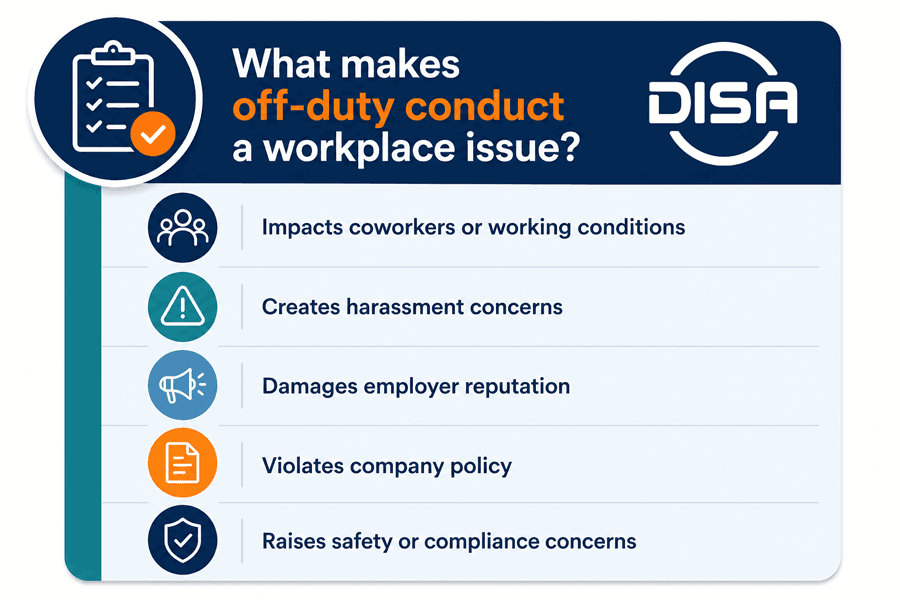
Working conditions and coworker impact
Some off-duty conduct becomes a workplace issue simply because it damages the working environment: If an employee engages in intimidating or toxic behavior online, that animosity can spill into the physical workplace, affecting team cohesion and productivity, and employee well-being. Organizations have an obligation to provide a safe working environment.
Hostile work environment outside the workplace
The legal definition of the workplace is expanding. In a leading circuit-level precedent coming down in July 2024, the Ninth Circuit Court of Appeals ruled in Okonowsky v. Garland that the totality of circumstances in a hostile-work-environment claim can absolutely include off-duty social media conduct. Importantly, the court explicitly rejected the outdated notion that only conduct occurring inside the physical bounds of the workplace can be actionable.
Reputation, trust, and leadership roles
Individuals in leadership, public-facing, or executive roles carry the organization's reputation with them at all times. Therefore, when a leader acts poorly off-site, it compromises the trust of clients, shareholders, and internal teams.
What an Employee Social Media Policy Should Cover Now
Public posts, videos, comments, livestreams, and screenshots
A defensible social media policy for employees should explicitly address the reality of the modern digital footprint. It is not enough to mention social media platforms generally; the policy should comprehensively cover public posts, live streams, comment sections, the sharing of screenshots, and even deleted content (which users can screenshot and repost).
Off-site events and employer affiliation
Policies should clarify expectations regarding employer affiliation: If an employee's public profile prominently lists their employer, or if they are wearing company apparel in a viral video, their off-duty conduct is inextricably linked to the brand. Organizations should consider providing clear guidelines on how employees represent themselves online when their employer is identifiable.
Reporting, escalation, documentation, and investigation
When an employee is fired for social media posts, the termination should be the result of a documented process, not a knee-jerk reaction. An effective employee social media policy details exactly how coworkers or the public can report concerning off-duty conduct, outlines an objective investigation framework that dictates how evidence is gathered and documented, and previews how these cases escalate to human resources or legal teams.
Disciplinary guardrails and anti-retaliation language
Clear disciplinary guardrails protect both the employer and the employee. The policy should state the potential consequences for policy violations (which can range from mandatory coaching to termination). Crucially, it should contain strong anti-retaliation language to ensure that employees who report workplace harassment outside of work in good faith are protected from professional backlash.
Where Employers Can Overreach
Protected concerted activity and employee complaints
Employers cannot freely police all off-duty behavior. Employees have the legal right to discuss pay, benefits, and working conditions with their coworkers on platforms like Facebook and YouTube. Employers cannot lawfully discharge or discipline employees for these protected online discussions.
However, the law does not protect employees who engage in mere individual griping, make knowingly and maliciously false statements, or engage in egregiously offensive conduct.
Public content versus private account access
There is a distinct legal boundary between reviewing public information and invading an employee's privacy. More than half of U.S. states have enacted laws that prohibit employers from requesting usernames or passwords to personal social media accounts (though many of these laws contain exemptions that allow employers to request access during specific investigations into workplace misconduct).
Why ad hoc searches create bias and consistency risk
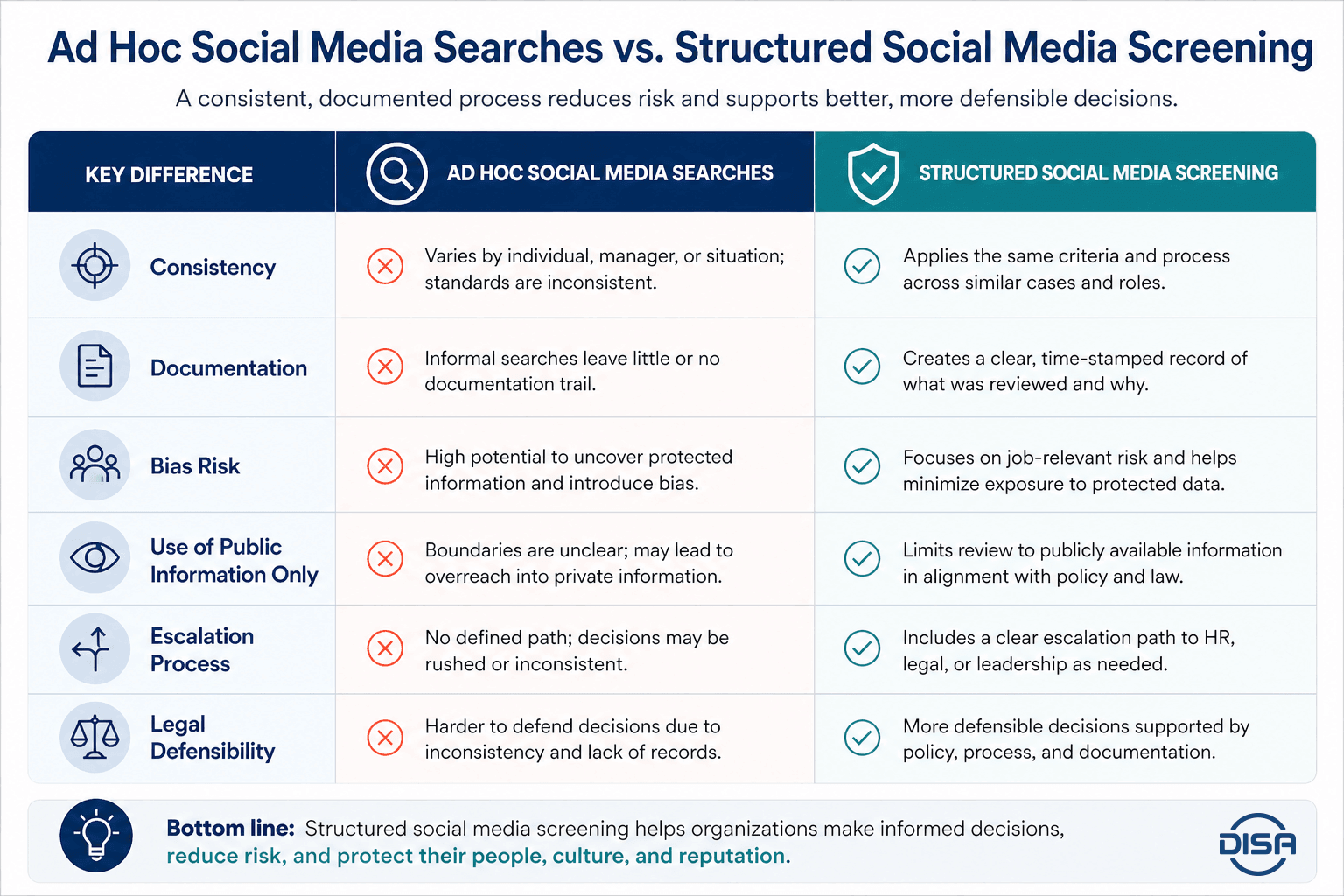
One reason why structured social media screening is often more defensible than informal searching: Some managers informally scroll through their employees’ social media feeds, but ad hoc searching can expose employers to protected class information (such as an employee's religion, medical history, or sexual orientation), which can trigger discrimination claims if disciplinary action follows.
Why Structured Social Media Screening Matters
Structured social media screening helps employers review publicly available online content in a more consistent and defensible way. Unlike ad hoc manager searches, a defined screening process can reduce bias, improve documentation, and focus attention on job-relevant risk.
For employers, social media screening should be limited to publicly available information and applied consistently across comparable situations. A structured process can also help separate relevant public conduct from protected personal information that may increase discrimination risk.
When supported by clear policy, documentation standards, and escalation procedures, social media screening can help employers assess off-duty conduct without overreaching.
Frequently Asked Questions
Yes, in most at-will employment states, you can be fired for off-duty conduct if that behavior violates company policy, harms the employer's reputation, or disrupts the working environment. However, employers must still navigate protections regarding concerted activity and state-specific off-duty conduct laws.
Absolutely. Recent federal court rulings confirm that hostile work environment claims can include off-duty social media conduct. If online hostility targets a coworker and alters their working conditions, it is treated as a workplace issue.
A robust social media policy for employees should outline behavioral expectations, clarify how off-site events tie back to employer affiliation, detail reporting and investigation procedures, and strictly outline disciplinary guardrails. It should also affirm protections for concerted activity.
Yes. More than half of U.S. states legally restrict employers from asking for passwords or demanding access to private personal social media accounts. Screening should only ever involve publicly available information.
How DISA Can Help
At DISA Global Solutions, we help employers address off-duty conduct risk with a more structured approach to social media. We offer robust social media screening solutions that maximize efficiency in reporting by isolating relevant public data from protected personal information. We provide the resources you need to optimize your operations, reduce compliance risks, and improve workplace safety.
With DISA's comprehensive support, you can confidently navigate the complexities of employee conduct and protect your business from liability. Contact us today to learn more about how we can help your organization achieve compliance and operational excellence.
DISA Global Solutions aims to provide accurate and informative content for educational purposes only and does not constitute legal advice. The reader retains full responsibility for the use of the information contained herein. Always consult with a professional or legal expert.
Lanson Hoopai
Content Analyst II
DISA Global Solutions
Lanson Hoopai brings almost a decade of writing and editing experience to the Content Analyst II role at DISA Global Solutions.
Discover how integrating compliance into HR systems streamlines hiring, improves accuracy, and ensures workforce compliance for safer, smarter recruitment....
Maximize your holiday retail hiring success with expert HR strategies. Discover top tips for speeding up recruitment and securing talent for the festive season....
Explore the top HR conferences of 2026 featuring global events on HR technology, leadership, talent strategy, and employee screening. Plan your year here....
The hiring process requires more than just finding the right candidate: it means adhering to federal regulations to protect your organization and your applicant...





 May 26, 2026
 8
min read
8
min read