Federal regulators have renewed their focus on English language proficiency for commercial motor vehicle drivers. For fleets, this new emphasis raises important questions about hiring, driver qualification, training, documentation, and daily operations.
To be clear, the underlying requirement is not new: Commercial motor vehicle (CMV) drivers operating in interstate commerce have long been required to read and speak English well enough to complete several safety-related tasks.
What has changed is the federal enforcement approach... and the possibility that a driver who does not meet the standard may be placed out of service.
Glossary of Key Terms
Commercial motor vehicle: A vehicle that meets the federal definition of a CMV based on factors such as weight, passenger capacity, or the transportation of placarded hazardous materials.
Driver qualification: The federal standards a person must meet before a motor carrier may allow that person to operate a commercial motor vehicle in interstate commerce.
Driver qualification file: A collection of records showing that a driver meets applicable licensing, medical, driving-history, and qualification requirements.
ELP: English language proficiency. In this article, ELP refers to a driver’s ability to meet the English language requirements in 49 CFR 391.11(b)(2).
FMCSA: The Federal Motor Carrier Safety Administration, the federal agency responsible for regulating and overseeing the safety of commercial motor vehicles.
Motor carrier: A company or individual responsible for operating commercial motor vehicles or directing drivers to operate them.
Official inquiry: A question or direction from an inspector or other government official. During an inspection, this may involve the driver’s route, hours of service, license, shipping papers, or vehicle.
Out-of-service order: An order that temporarily prevents a driver or vehicle from operating because of an identified safety or qualification issue.
Roadside inspection: An examination conducted by an authorized safety official to review a driver’s credentials, records, vehicle, or compliance with federal and state safety rules.
MUTCD: The Manual on Uniform Traffic Control Devices, which establishes national standards for traffic signs, signals, pavement markings, and other traffic-control devices. The English proficiency standard is found within the federal rules covering general driver qualifications. (eCFR)
What Changed in Federal ELP Enforcement for Commercial Drivers?
The regulation itself is not new and remains in place. The major change is how roadside inspectors are directed to evaluate and handle possible violations.
In April 2025, an executive order directed FMCSA to replace its earlier enforcement approach and support the addition of English language proficiency violations to the out-of-service criteria. FMCSA issued new instructions in May 2025, and the Commercial Vehicle Safety Alliance (CVSA) added ELP noncompliance to its North American Standard Out-of-Service Criteria, effective June 25, 2025.
Then, on April 16, 2026, FMCSA revised its roadside enforcement policy again. The updated policy replaced the May 2025 memo, refined the highway-sign portion of the assessment, and clarified how the policy applies within certain commercial zones near the U.S.-Mexico border.
Three important things to note from all the regulatory adjustments:
The FMCSA regulation establishes the driver qualification requirement.
The FMCSA guidance explains how federal inspectors should assess compliance.
The CVSA out-of-service criteria help inspectors determine whether a violation should prevent the driver from continuing to operate.
What Does 49 CFR 391.11 Require?
The law in question, 49 CFR 391.11, requires an interstate CMV driver to read and speak English well enough to carry out specific safety and recordkeeping duties.
Under that law, a driver must be able to specifically do the following:
Converse with the general public
Understand highway traffic signs and signals in English
Respond to official questions
Make entries on reports and records
The same regulation states that a motor carrier may not require or permit an unqualified person to operate a commercial motor vehicle.
Practically, under this law, a driver must be able to independently complete the communication tasks connected to the job. Can the driver explain where a shipment started and where it is going? Answer questions about hours of service? Understand a written highway message? Read and complete required records?
Regulatory History: How ELP Enforcement Changed Over Time
Though the English proficiency rule for truck drivers has existed for decades, its treatment under roadside enforcement policies has changed over time.
2005: CVSA added violations of 49 CFR 391.11(b)(2) to its out-of-service criteria.
2007 and 2008: FMCSA issued policies for evaluating communication with inspectors and understanding highway signs.
2015: CVSA removed the provision from its out-of-service criteria.
2016: FMCSA adopted a softer enforcement approach. Inspectors could cite a violation, but the policy did not direct them to place the driver out of service.
2025: FMCSA withdrew the 2016 policy and issued new inspection procedures. CVSA restored ELP noncompliance as an out-of-service condition effective June 25, 2025.
2026: FMCSA replaced its 2025 memo with revised guidance. The April 16, 2026, policy clarified the sign assessment and the treatment of trips involving U.S.-Mexico border
How the Two-Step Roadside Inspection Process Works
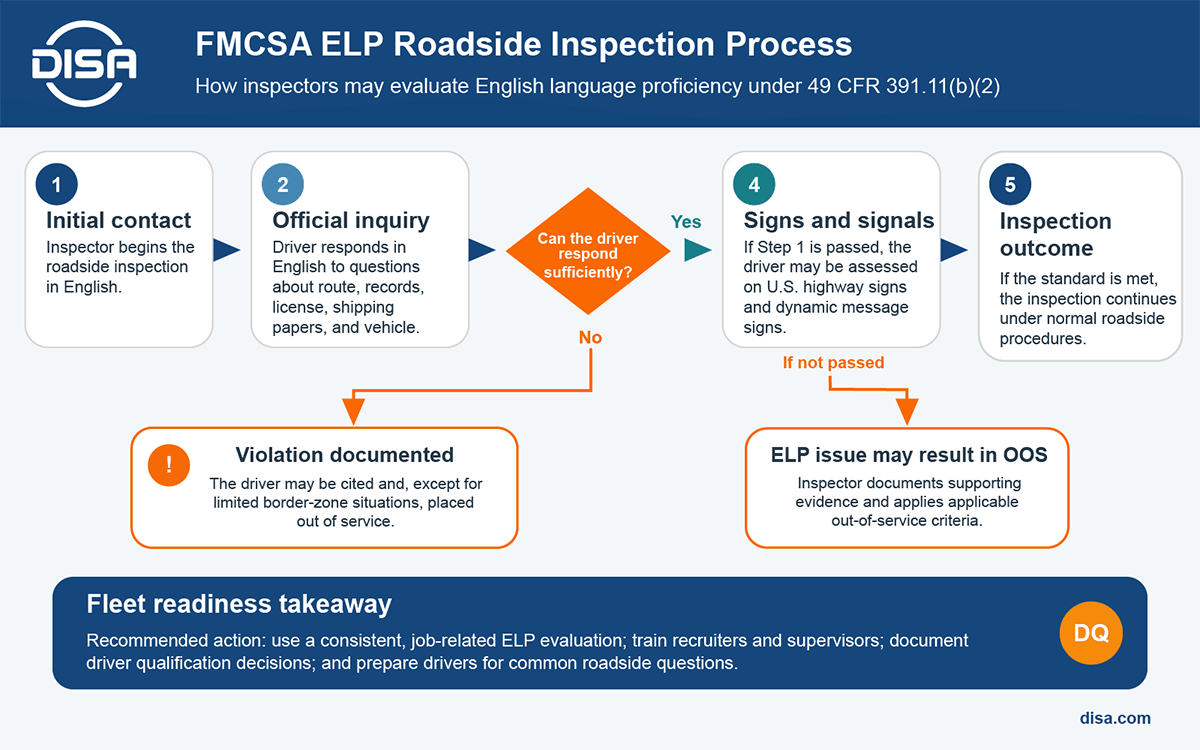
FMCSA’s current federal policy directs inspectors to begin roadside inspections in English. If the driver’s response to the initial contact suggests that the driver may not understand the inspector’s directions, the inspector may conduct a two-step ELP assessment.
Step 1: The Official Inquiry Assessment
The inspector will first evaluate whether the driver can respond sufficiently to official questions and directions in English.
The questions the inspector asks may cover common inspection topics, such as the following:
The driver’s starting point and destination
Hours of service and the record of duty status
Information on the driver’s license
Shipping papers
The vehicle or equipment being inspected
The driver is expected to respond in English during this part of the assessment, and per the FMCSA’s policy, inspectors should not use interpreters, translation applications, cue cards, “I-Speak” cards, or telephone interpretation services during the ELP interview (as the use of these devices may obfuscate the driver's actual working English proficiency).
What Happens if the Driver Does Not Pass Step 1?
When the inspector determines that the driver cannot respond sufficiently to official inquiries in English, the inspector will cite the violation and stop the ELP assessment. The driver does not move on to second step.
Step 2: Understanding Highway Signs and Signals
A driver who successfully completes Step 1 may move on to the highway traffic sign recognition assessment, which evaluates whether the driver can understand U.S. highway traffic signs and electronic or dynamic message signs that may appear along the road.
The examples shown to them will be based on signs that follow the Federal Highway Administration’s Manual on Uniform Traffic Control Devices. The purpose of this test is to see whether the driver in question both recognizes a sign’s color or shape and understands the meanings and appropriate responses to those signs.
Can a Driver Be Placed Out of Service for ELP Issues?
A documented failure to meet the ELP standard can result in the driver being placed out of service.
An inspector who cites an ELP violation will document the evidence supporting their decision, including the driver’s responses or lack of response. Except in a limited border commercial zone situation, will then place the driver out of service.
A driver who has been placed out of service may not continue operating a CMV in interstate commerce until the condition has been corrected (via any needed training, reassessment, and documentation of the driver’s ability to respond to official questions, understand highway signs, communicate with the public, and complete records).
(There is a limited exception for certain trips conducted entirely within designated commercial zones along the U.S.-Mexico border. A driver may still be cited, but not placed out of service, when the current trip remains within one of those zones.)
Five Steps Fleet Managers Should Take Now
In response to the new enforcement policy, operators should implement a proactive, fair, and repeatable qualification process based on the real duties of a commercial driver.
Use this checklist to help drivers, safety teams, and compliance managers prepare for English language proficiency enforcement during roadside inspections.
Data table
Step
Action
Why It Matters
1
Review driver qualification policies for 49 CFR 391.11(b)(2).
FMCSA’s English language proficiency requirement is tied to driver qualification standards under 49 CFR 391.11(b)(2).
2
Train drivers on roadside inspection communication.
Drivers may need to respond to official inquiries and directions during roadside inspections. FMCSA’s ELP guidance addresses roadside enforcement and out-of-service handling for 49 CFR 391.11(b)(2) violations.
3
Practice traffic sign and instruction recognition.
The regulation requires drivers to read and speak English well enough to understand highway traffic signs and signals.
4
Document training and coaching efforts.
Documentation can help fleets show that they are taking reasonable steps to manage driver qualification and compliance risk. Recommendation based on the article’s compliance-preparation focus.
5
Monitor enforcement updates and inspection outcomes.
CVSA added English language proficiency to its out-of-service criteria, meaning inspectors may place a driver out of service if the driver cannot demonstrate required English proficiency.
1. Review Driver Qualification Procedures
Identify who is responsible for evaluating ELP within your company (whether that be your recruiters, safety managers, terminal managers, trainers, or HR staff), and confirm that your written hiring and qualification process covers all relevant parts of 49 CFR 391.11, including the English language proficiency standard.
2. Add a Consistent, Job-Related ELP Assessment
FMCSA does not require employers to use one specific language test. Carriers may use different methods, as long as drivers can communicate with law enforcement and understand highway signs.
A practical employer assessment may include the following:
Conducting part of the driver interview in English
Asking about a recent or planned route
Reviewing a sample record of duty status
Discussing information on a driver’s license
Asking questions about shipping papers
Discussing vehicle equipment
Reviewing written and dynamic highway signs
3. Train Recruiters, Supervisors, and Evaluators
A candidate should not receive different results simply because one manager speaks quickly while another provides more coaching.
Fleet operators and owners should train all evaluators to do the following:
Speak clearly and at a natural pace
Use the same core job-related questions
Avoid questions unrelated to driving duties
Focus on functional communication rather than accent
Record results consistently
Refer uncertain results to a compliance or safety leader
A common process gives evaluators clearer direction and helps the company make more consistent decisions.
4. Prepare Drivers for Roadside Communication
Drivers should understand what may happen during an FMCSA ELP roadside inspection, with preparation focusing on practical communication rather than on memorized answers.
Review common subjects such as the following:
Routes and destinations
Hours of service
Driver licenses
Shipping documents
Vehicle equipment
Inspection instructions
Work-zone signs
Dynamic highway messages
Drivers should also know that they may not be allowed to use a translation application or call a dispatcher during the English interview portion of an inspection.
5. Document and Connect the Process
The regulation does not create a separate employer-issued ELP certificate. Still, clear documentation can show that the company uses a planned and consistent qualification process.
Consider recording the following:
The assessment date
The evaluator’s name or role
The job-related subjects covered
Whether the driver met the company’s standard
Any training or reassessment provided
The version of the assessment procedure used
Also review whether your drivers can independently understand and complete the records they use (including records of duty status, inspection reports, shipping papers, and other required documents).
How Fleets Can Support Drivers While Reducing Compliance Risk
As far as practical training is concerned, consider regular practicum vocabulary exercises related to inspections, shipping papers, hours of service, vehicle parts, emergency instructions, and highway messages. Drivers can also practice realistic roadside conversations in a respectful setting.
Have your managers communicate all company expectations early; a driver who needs improvement should have time to build useful job-related skills before a roadside inspection exposes the gap.
Avoid relying on translation tools, memorized scripts, or last-minute coaching as substitutes for qualification. Your drivers must be able to complete the tasks covered by the regulation when those skills are needed.
How DISA Can Help
English language proficiency, while important, is simply one piece of a larger driver qualification and transportation compliance strategy. Hiring procedures, background screening, qualification records, drug and alcohol testing, driver monitoring, and fleet reporting must all work together.
DISA Global Solutions helps transportation employers create more consistent pre-hire and post-hire compliance workflows. Our available services include background checks, driver qualification file management, MVR reporting, previous-employer checks, DOT drug testing, continuous driver monitoring, and fleet management support.
By bringing these functions into a connected process, we can help your fleet reduce administrative work, improve record readiness, and give safety and compliance teams a clearer view of driver status.
Talk with us about strengthening your DOT compliance and driver qualification program today.
DISA Global Solutions aims to provide accurate and informative content for educational purposes only and does not constitute legal advice. The reader retains full responsibility for the use of the information contained herein. Always consult with a professional or legal expert.
Chris Eichenberg
Vice President of Transportation Sales
DISA Global Solutions
Chris Eichenberg is the Vice President of Transportation Sales at DISA Global Solutions, Inc., where he plays a critical role in advancing the company's position as a leader in safety and compliance solutions for the transportation industry.
DOT has proposed adding fentanyl to its drug-testing panel. Learn what employers should review now for DOT policies, training, MRO verification, and readiness....





 July 31, 2026
 10
min read
10
min read