A missed annotation, repeated log edit, unresolved unassigned driving time, or device issue may seem small in the moment. But when those issues start to pile up, they can turn into a larger Electronic Logging Device (ELD) compliance problem during a roadside inspection, safety audit, or internal review.
The good news is that DOT-regulated fleets do not need to treat every HOS issue like fraud. But they do need a clear process for finding problems, reviewing them, coaching drivers, and documenting what happened next.
Glossary of key terms
Hours of service, or HOS: Federal rules that limit how long certain commercial drivers may drive and remain on duty before they must take required rest.
FMCSA HOS rules: The Federal Motor Carrier Safety Administration rules that govern driving time, on-duty time, rest breaks, and records of duty status for regulated motor carriers and drivers.
ELD: An electronic logging device that records driving time and helps track records of duty status.
ELD compliance: The process of using a properly registered device, keeping accurate records, resolving exceptions, and following FMCSA requirements.
HOS violations: Failures to follow hours of service limits or recordkeeping requirements.
ELD violations: : Issues related to the device, data transfer, records, edits, malfunction handling, or ELD rule requirements.
ELD tampering: Actions that interfere with accurate electronic logging records, such as misusing accounts, disconnecting devices, hiding driving time, or making deceptive edits.
Unassigned driving time: Driving time recorded by the ELD that has not been assigned to a specific driver.
Log falsification: A false or misleading record of duty status. In log falsification trucking cases, the issue may involve a driver, a supervisor, or a carrier accepting records that appear false.
ELD malfunction: A legitimate device issue that triggers specific response steps. A malfunction is not the same thing as electronic logging device fraud.
Why HOS enforcement feels more aggressive now
Some carriers have described today’s hours of service enforcement as “aggressive”; in most cases, this aggressiveness boils down to enforcement teams' and auditors' having better access to cleaner, more actionable data, on account of higher-tech electronic logging devices.
ELDs are designed to make it easier and faster to track, manage, and share data on driving and off-duty time, which in turn makes it easier to regulate motor carriers and drivers who are required to maintain records of duty status.
A single mistake may be easy to explain. A pattern of repeated HOS violations, missing notes, or unsupported changes is harder to defend.
Electronic records create more visible gaps
A fleet may have hundreds or thousands of logs moving through its system, with any number of simple mistakes (such as a driver forgetting to log in, selecting the wrong duty status, or missing an annotation). But too many of these may make DOT suspicious of potential fraud.
This is why the DOT takes discrepancies in the data so seriously, and why ELD compliance is more than having a device in the truck. To avoid audits due to oversights, regulated employers should have a process in place to manually review their ELD data for gaps, explain exceptions, and document the company's follow-up actions.
Less tolerance for sloppy processes
“Aggressive enforcement” often means less tolerance for weak internal controls.
A sloppy process may look like any of the following:
Drivers who do not understand the FMCSA HOS rules.
Supervisors who approve edits without checking the reason.
Unassigned driving time that sits unresolved.
Supporting documents that do not match logs.
Devices that are not checked against the FMCSA ELD list.
Corrective action that is not documented.
A strong process helps show that the company takes HOS compliance trucking and potential warning signs seriously.
What counts as ELD fraud, tampering, or falsification?
ELD fraud is not the same thing as a normal mistake: the latter may happen when a driver forgets to change duty status or enters the wrong note. The former, however, involves a deliberate effort to hide, change, or misrepresent hours of service records (which can include false logs, deceptive edits, misuse of driver accounts, attempts to avoid automatic driving records, or false supporting documents).
Legitimate edits vs. suspicious edits
Driver and authorized carrier staff can make limited edits to correct mistakes or add missing information, and edits must be annotated.
A legitimate edit explains what changed and why. A suspicious edit, however, looks different. For example, a pattern of edits that always reduces violations, always happens after dispatch pressure, or lacks a clear reason may raise concern.
Unassigned driving time and unsupported changes
Unassigned driving time should never be ignored. While the gap may be due to a simple login issue, in cases of attempted fraud, it can also signal device misuse or hidden driving time.
Common red flags for DOT inspections include the following:
Driving time that does not match fuel, toll, gate, payroll, or dispatch records.
Repeated personal conveyance use with weak explanations.
Off-duty time recorded during loading, unloading, inspections, or other work.
Unassigned driving time that is cleared without a clear reason.
Edits made after a violation appears, with little or no support.
When these patterns appear, make sure to review the facts with your driver and all involved parties.
Device misuse and document mismatches
ELD tampering can involve more than physically changing a device: tampering can also include sharing driver logins, using the wrong account, disconnecting equipment, failing to report malfunctions, or trying to work around automatic driving records.
If the supporting documentation (bills of lading, dispatch records, fuel receipts, toll records, and payroll records) do not match the ELD logs, consider reviewing the issue, speaking with the driver, documenting the outcome, and (if necessary) correcting your processes.
Common HOS and ELD Compliance Mistakes That Fleets Make
Most fleets do not set out to create HOS problems; rather, they occur because of small habits (a missed note getting overlooked, a supervisor clearing an exception without review, a non-compliant device being used because it was compliant last year) that snowball into serious DOT HOS violations.
Here are some of the most common reasons why HOS violations happen:
Poor driver training
Drivers need more than a quick reminder to “follow the rules”: They need practical training on how the FMCSA HOS rules apply during real trips, including when to change duty status, how to use personal conveyance or yard move correctly, how to certify logs, how to handle unassigned driving time, and how to respond to a carrier-suggested review.
ELD edits, after all, aren't there simply to hide driver mistakes. They are, rather, designed to better reflect the driver's actual workday.
Overworked drivers
Fleets should always provide their drivers with adequate rest time, and avoid trying to cut corners or speed up their operations at the expense of their truck operators. HOS compliance starts with ensuring drivers are properly rested, alert, and able to drive safely.
Weak review of exceptions
A good HOS program needs routine review. Not every issue will require follow-up action or discipline, but your fleet should know which issues are one-time mistakes, which are repeated training gaps, and which may point to intentional falsification.
Outdated device oversight
ELD compliance also depends on device governance. FMCSA’s ELD program includes a list of regularly updated registered and revoked devices, which means that a fleet's ELD review should not be a one-time check. DOT-regulated trucking companies should routinely confirm that their ELDs remain on the registered list and have a plan for replacing devices if a device is removed.
Waiting until an audit
If your first serious review happens during an audit, you're already behind.
Routine HOS auditing will help you find problems earlier, as well as give your managers time to coach drivers, fix device issues, document exceptions, and adjust internal controls.
How to reduce exposure before enforcement finds the problem
The best time to fix HOS problems is before the inspection, before the audit, and before a pattern becomes part of the company’s safety record. Therefore, your program should include routine auditing, clear escalation, driver coaching, and audit-ready documentation.
Review logs on a routine schedule
Routine log reviews help fleets catch problems while they are still manageable; look for any HOS violations, repeated ELD violations, unresolved unassigned driving time, missing annotations, unusual personal conveyance use, and gaps between logs and supporting documents.
Build a clear escalation path
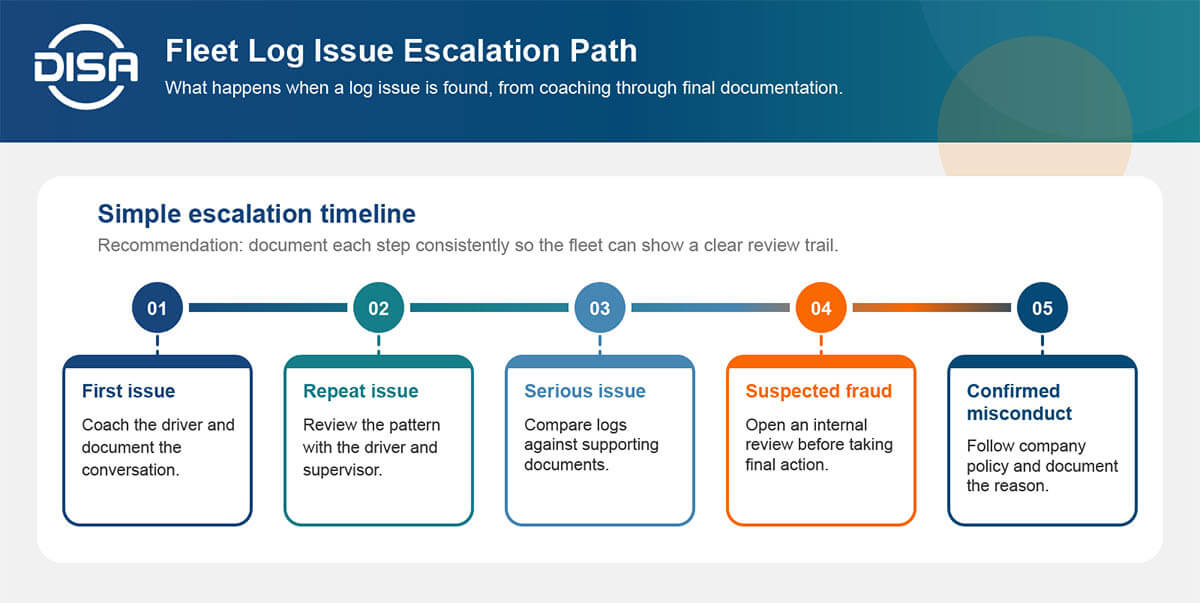
Every fleet should define what happens when a log issue is found. A simple escalation path may look like this:
First issue: coach the driver and document the conversation.
Repeat issue: review the pattern with the driver and supervisor.
Serious issue: compare logs against supporting documents.
Suspected fraud: open an internal review before taking final action.
Confirmed misconduct: follow company policy and document the reason.
Recommended escalation path for fleet log issues, from first coaching conversation through confirmed misconduct documentation.
Coach drivers with real examples
Coaching should much more specific than simply telling a driver to “do better on your logs.”
A stronger coaching conversation sounds like this:
On Tuesday, your log showed off-duty time during a customer unloading window. The bill of lading and gate record show you were still on site. Let’s review how to record that time correctly and what note should be added.
That kind of coaching is practical, fair, and easier to document.
Hold supervisors accountable
Drivers are not the only part of the process. If dispatch or operations teams pressure drivers to keep moving when they are out of hours, the problem turns into a broad company risk.
Supervisors can coach drivers, but they themselves need to understand what the rules say, when to escalate issues, and what unsupported edits look like.
When possible ELD fraud should trigger an internal review
Not every issue needs an investigation, but some patterns should trigger a closer look.
Patterns that deserve immediate attention
A fleet should consider an internal review when it sees any of the following:
Repeated edits that reduce or erase violations.
Unassigned driving time tied to the same driver, truck, route, or terminal.
Personal conveyance use that does not match company policy.
Yard move entries used outside expected locations.
Supporting documents that conflict with recorded duty status.
A driver using another person’s account.
Device disconnections or repeated malfunction claims with no clear cause.
Supervisors approving weak edits without review.
Separate training gaps from misconduct
Start with the facts: Look at the log, edit history, annotation, supporting documents, dispatch notes, location data, and prior coaching. Then talk with the driver and supervisor.
A new driver who made one mistake may need training. A long-time driver with repeated unsupported edits may need a stronger response. A terminal where many drivers show the same issue may have a management, technical, or process problem.
Document before corrective action
Before discipline or corrective action, document the specific records reviewed, the rule or policy involved, the driver’s explanation, the supervisor’s role, the supporting documents, and the reason for the final decision.
This step-by-step process helps the company act fairly, as well as shows that the fleet took a measured, defensible approach.
Frequently asked questions about HOS enforcement and ELD fraud
ELD tampering is any action meant to interfere with accurate electronic logging records. It may include disabling a device, using the wrong account, avoiding automatic driving records, making deceptive edits, or hiding information needed to verify duty status.
Fleets should compare ELD logs against supporting documents such as bills of lading, trip records, dispatch records, itineraries, schedules, expense receipts, fuel or toll receipts, electronic mobile communication records, payroll records, settlement sheets, and other documents that show the driver, vehicle, date, time, and location. These records can help confirm whether the driver’s ELD activity matches the trip, work assignment, stops, and paid time.
FMCSA’s supporting document rules specifically identify categories including bills of lading or equivalent trip documents, dispatch or trip records, expense receipts, electronic mobile communication records, and payroll or settlement records.
Yes. FMCSA guidance says a carrier is liable for drivers submitting false documents and for the carrier accepting false documents. This is why carriers should review logs, question suspicious patterns, and document corrective action.
If an ELD is removed from FMCSA’s registered list, carriers should act quickly to replace the out-of-date ELD with a compliant one.
Fleets should review the pattern, coach the driver, check for supervisor or dispatch pressure, compare the log against supporting documents, and document corrective action. Repeated HOS violations should not be treated as random events.
Fleets should assign the time to the correct driver when possible. If the time cannot be assigned, the carrier should document why. Unassigned driving time should not be ignored or cleared without support.
How DISA Can Help
Surviving HOS enforcement pressure takes more than a compliant device. It takes a full process: the right records, trained drivers, clean documentation, strong review habits, and a clear plan for exceptions.
DISA helps fleets connect the pieces of a stronger compliance program. Our FMCSA compliance support helps fleets simplify their safety requirements tied to driver file management, MVR checks, drug testing, physical exams, and related compliance needs.
DISA also supports fleet risk management through continuous driver monitoring, which helps employers gain driver risk visibility by consistently monitoring their motor vehicle record for negative events. If you need help maintaining compliance with your DOT-regulated fleet, contact us and learn how we can help.
DISA Global Solutions aims to provide accurate and informative content for educational purposes only and does not constitute legal advice. The reader retains full responsibility for the use of the information contained herein. Always consult with a professional or legal expert.
Kristi Spehr
Driver Qualification Manager
DISA Global Solutions
Kristiana "Kristi" Spehr has been with DISA Global Solutions since 2006 and currently holds the role of Driver Qualification Manager.
Vice President of Operations for Transportation Compliance
DISA Global Solutions
Ray Proctor is the Vice President of Operations for Transportation Compliance at DISA Global Solutions, where he utilizes his knowledge and experience in FMCSA DOT compliance, transportation management, and logistics to spearhead operational improvements and regulatory adherence.
Learn what DOT-regulated employers must do now that marijuana is being rescheduled to Schedule III — including drug testing rules, policy impacts, and complianc...
Driver fatigue may not solely result from long working hours; it could also stem from insufficient sleep, potentially indicating an issue such as sleep apnea....
DISA Global Solutions, Inc., a leading provider of employee screening and transportation services, is now an endorsed partner for the Mississippi Trucking Assoc...






 July 24, 2026