The Federal Motor Carrier Safety Administration (FMCSA) future is now.
As of May 14, 2026, the FMCSA said its legacy registration systems would yield to the new Motus: USDOT Registration System, which has made the FMCSA Motus transition an active compliance task for all safety-sensitive carriers. If you are a DOT-compliant company who has delayed in any of the following steps, you may face access issues or slower registration actions.
In This Article
What Changed When FMCSA Launched Motus
What Carriers Should Have Completed Before Motus Went Live
What Happens If Carriers Missed the Motus Transition Steps
What to Check Now in the FMCSA Portal and Motus
How DISA Helps Carriers Stay Ahead of FMCSA Compliance Changes
Bottom Line: Motus Is Not the Future Anymore
Frequently Asked Questions About FMCSA Motus
Glossary of Key Terms
Motus: FMCSA’s new online system for USDOT registration actions, company accounts, and updates.
MCS-150 update: The Motor Carrier Identification Report used to update an existing USDOT number company record.
FMCSA biennial update: The required update that entities under FMCSA jurisdiction file every two years, even when company information has not changed.
Portal Company Official: The person tied to the company’s FMCSA Portal authority.
What Changed When FMCSA Launched Motus
Motus replaces legacy registration workflows
FMCSA describes Motus as the modernized motor carrier registration system that will replace outdated systems and serve as the home base to apply for and manage registrations, view and update information, and control authorized access to a company account. Per an April notice, Motus will become the unified registration system and replace URS, registration components of MCMIS, and the former ICC Licensing and Insurance system.
Why FMCSA modernized registration
The FMCSA registration modernization effort is meant to streamline processes, strengthen oversight, reduce fraud, improve efficiency, and improve the user experience for motor carriers, brokers, freight forwarders, and supporting companies. However, the first release does not include safety registration, MC/FF docket number elimination, or BOC-3 filing process changes.
What Carriers Should Have Completed Before Motus Went Live
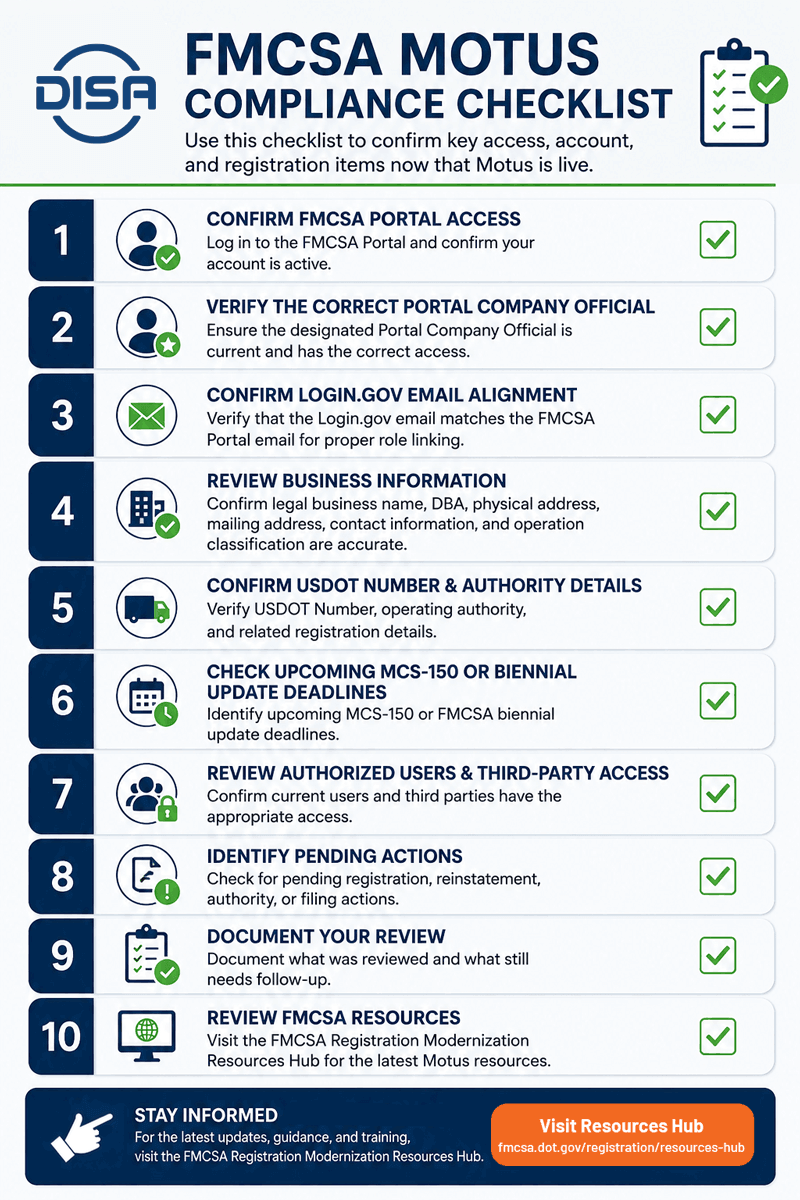
Activated and confirmed FMCSA Portal access
Before launch, FMCSA asked registrants to log into the FMCSA Portal and confirm that the account was active by May 14, 2026.
Confirmed the correct Portal Company Official
Only a designated Portal Company Official in each organization, using the same FMCSA Portal Login.gov email, would be permitted to claim the account in Motus for the first time. This account setup step connected the company’s identity, authority, and registration access.
Updated company and registration information
FMCSA instructed carriers to confirm company information, operation classification, contact information, and authorized users in the FMCSA Portal before the transition. Wrong business data can slow motor carrier registration update and confuse the system.
Prepared for Login.gov and identity verification
Users of the new registration system need Login.gov credentials, which the new system will use for multi-factor authentication under federal cybersecurity requirements.
What Happens If Carriers Missed the Motus Transition Steps
Access and account delays
If the right person cannot log in or claim the company record, the carrier may need extra time to restore access, align emails, or contact FMCSA. Support registration actions were affected beginning May 14, 2026, at 8:00 p.m. ET.
Slower MCS-150, biennial, and authority workflows
FMCSA requires entities under its jurisdiction to update MCS-150 information every two years, and failure to complete a biennial update results in USDOT number deactivation and possible civil penalties.
Without an active Motus account, carriers could experience issues updating their MCS-150 registration information, name changes, address changes, reinstatement of operating authority, voluntary suspension or revocation, USDOT reactivation, or biennial updates.
What to Check Now in the FMCSA Portal and Motus
Portal access and company official designation. Confirm who can access the FMCSA Portal, who can access Motus, and who is connected to the Portal Company Official role. (According to the FMCSA, historical licensing and insuring and FMCSA Portal records will remain available for viewing and verification, even as update tools change.)
Business information accuracy. Review your company’s legal business name, principal place of business, mailing address, operating classification, contact information, vehicle and driver data, and authorized users.
Upcoming MCS-150 or FMCSA biennial update needs. Check the next MCS-150 update or FMCSA biennial update deadline.
Bottom line for DOT employers: Motus is already here, and carriers that have not reviewed access, company information, user authority, and near-term filings should consider doing so as soon as possible.
Frequently Asked Questions About FMCSA Motus
Motus is FMCSA’s new USDOT registration system for registration actions, company accounts, user access, filings, and registration record updates, according to FMCSA’s Move into Motus page.
FMCSA said legacy registration systems would yield to Motus starting May 14, 2026, on the agency’s registration page. FMCSA also said registration options in the FMCSA Portal would no longer be available beginning May 14, 2026, at 8:00 p.m. ET, in its portal FAQ.
Carriers should consider checking portal and Motus access, the Portal Company Official, Login.gov access, company information, authorized users, upcoming MCS-150 update deadlines, FMCSA biennial update deadlines, and any operating authority update needs.
How DISA Helps Carriers Stay Ahead of FMCSA Compliance Changes
Motus is just one piece of the larger compliance picture. Carriers are also managing drug and alcohol testing, driver qualification files, MVR monitoring, medical certification changes, safety audits, and reporting tasks. DISA can help support you through your Motus-specific transition, while keeping you in broader compliance by monitoring changes across DOT and FMCSA programs.
Contact DISA today to learn how we can help your fleet strengthen compliance and operational readiness.
DISA Global Solutions aims to provide accurate and informative content for educational purposes only and does not constitute legal advice. The reader retains full responsibility for the use of the information contained herein. Always consult with a professional or legal expert.
Lanson Hoopai
Content Analyst II
DISA Global Solutions
Lanson Hoopai brings almost a decade of writing and editing experience to the Content Analyst II role at DISA Global Solutions.
Vice President of Operations for Transportation Compliance
DISA Global Solutions
Ray Proctor is the Vice President of Operations for Transportation Compliance at DISA Global Solutions, where he utilizes his knowledge and experience in FMCSA DOT compliance, transportation management, and logistics to spearhead operational improvements and regulatory adherence.
Learn how AI streamlines Driver Qualification File management, improves DOT compliance, and reduces audit risk—plus the limits fleets must understand....
Discover CDC-recommended COVID-19 safety measures for truck drivers and employers. Learn essential practices like PPE use, disinfecting routines, and workplace ...





 June 19, 2026
 5
min read
5
min read