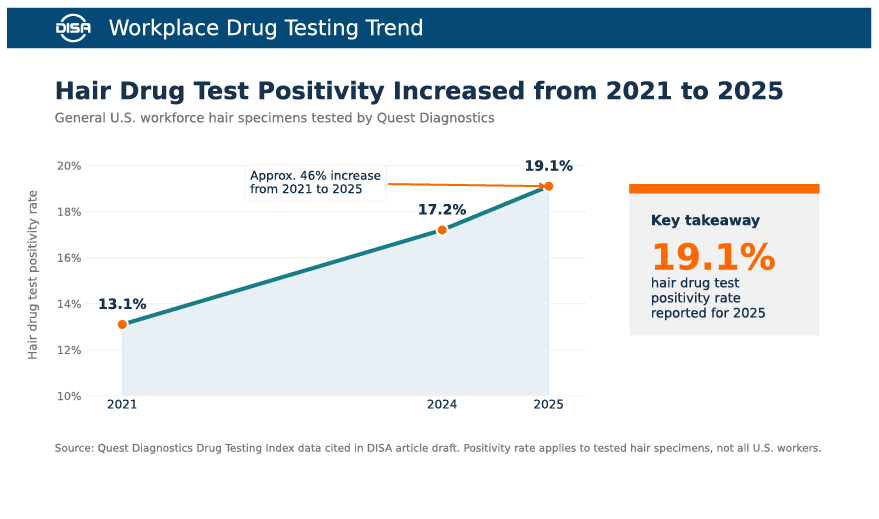
Nearly one in five hair specimens collected from workers in the general U.S. workforce tested positive for drugs in 2025.
More specifically, the 2026 Quest Diagnostics Drug Testing Index reported a 19.1% hair drug test positivity rate for tests administered in 2025. However, if you are an employer, you need to understand what the number measures before using it to make workplace drug-testing decisions.
Glossary of Key Drug-Testing Terms
Chain of custody: The documented process used to track a drug-testing specimen from collection through transportation, laboratory testing, review, and reporting. The process helps protect the specimen’s identity and integrity
Detection window: The period when a testing method can effectively identify evidence of substance use.
Drug test positivity rate: The percentage of tested specimens that receive a confirmed positive result under the applicable laboratory criteria. A positivity rate applies to the population, specimen type, and testing period being studied.
Dual-methodology drug testing: A program design that uses both long-term and short-term testing methods, such as hair plus urine.
Medical Review Officer (MRO): A licensed physician who reviews laboratory-confirmed drug test results. The MRO considers medical information, communicates with the donor when required, and determines how the result should be reported.
Metabolite: A substance produced when the body processes a drug. Many workplace drug tests identify drug metabolites rather than the original substance.
Nearly one in five hair specimens collected from workers in the general U.S. workforce tested positive for drugs in 2025.
More specifically, the 2026 Quest Diagnostics Drug Testing Index reported a 19.1% hair drug test positivity rate for tests administered in 2025. However, if you are an employer, you need to understand what the number measures before using it to make workplace drug-testing decisions.
What the 19.1% Hair Drug Test Positivity Rate Really Means
The finding does not mean that exactly one in five American workers uses drugs, nor that they were actively impaired at work. Instead, it applies to the population whose hair specimens were tested by Quest Diagnostics.
Importantly to clients of DISA Global Solutions, this statistic also does not apply strictly to safety-sensitive industries; Quest's data was taken from the broader US workforce.
Still, the increase deserves attention. A positive hair drug test means that a substance or its metabolites were identified under the applicable testing criteria, and in this context, hair-test positivity rose from 13.1% in 2021 to 17.2% in 2024 and then to 19.1% in 2025, which represents an increase of about 46% in five years.
Marijuana Drove Much of the Increase in Hair-Test Positivity
Marijuana was the largest contributor to positive hair drug test results in 2025.
According to the data, marijuana positivity in hair specimens reached 15.1%, up from 9.5% in 2021. Marijuana also represented 52.5% of positive hair-test results in 2025.
The positivity rate for marijuana did, however, vary by the testing reason: Random screening positivity, for instance, reached 21.0%. Meanwhile, the pre-employment screening numbers reached 15.1%.
Why Hair and Urine Drug-Test Positivity Rates Differ
Quest reported a 19.1% positivity rate for general-workforce hair specimens in 2025. By comparison, the general-workforce positivity rate for urine was 4.3%.
That difference does not mean one testing method is accurate and the other is not. Rather, hair and urine drug testing provide information about different periods of substance use, test difference substance panels, and have different cut off levels.
Hair testing provides a longer detection window
A standard head-hair sample can often provide a detection window of up to approximately 90 days. As a result, hair drug testing may identify repeated or longer-term patterns of substance use that are no longer visible through a shorter-window method. However, hair testing is not designed to identify recent substance use and has different drug testing panels.
Urine testing focuses on a more recent period
Urine drug testing, in contrast, generally detects evidence of substance use within the preceding several days. However, the exact detection window can vary based on several factors, including
the substance;
the person’s pattern of use;
metabolism;
hydration; and
the laboratory cutoff.
Urine testing is widely used for pre-employment, random, post-accident, reasonable suspicion, return-to-duty, and other workplace programs. It can also support a broad selection of testing panels.
Like a positive hair result, a positive urine result identifies a substance or metabolite under the applicable testing criteria. But neither it nor hair testing inherently prove that the person was impaired at the time of collection.
Comparing Workplace Drug-Testing Methods
Data table
Method
Primary purpose
Key strengths
Important limitations
Hair testing
Provides a longer historical view, often up to approximately 90 days
Directly observed collection, difficult to substitute, may identify repeated or longer-term use
Does not identify recent use, panel options may be more limited, and it is not approved for federally mandated testing
Urine testing
Identifies use during a more recent window
Widely accepted, supports broadest panels, and is used for regulated programs
Provides a shorter detection window, and collection is not directly observed by default
Oral-fluid testing
Focuses on relatively recent use
Directly observed and convenient to collect
Has shortest detection window, and panel or regulated-program availability may vary
Hair plus urine
Combines longer-term and recent-use detection
Provides two detection windows and reduces single-method blind spots
Can increase program cost and complexity and must be permitted by law and policy
No testing method answers every workplace safety question. Therefore, employers should begin with the purpose of their program and then choose the method (or combination of methods) that supports that purpose.
Why Dual-Methodology Drug Testing Can Reduce Blind Spots
Hair and urine drug testing should not always be viewed as an either-or choice. A dual-methodology program can pair a longer historical view with better detection of recent-use and a wider drug testing panel.
Because hair drug tests provide a longer view of possible substance-use patterns, and urine drug testing helps identify use within a more recent period, each method can help cover a detection period that the other may miss.
Hair plus urine programs identified 40 positive results per 1,000 tests.
Urine-only programs identified 12 positive results per 1,000 tests.
Oral-fluid-only programs identified 8 positive results per 1,000 tests.
Dual-methodology programs identified 214% more positives than programs using short-term methodologies alone.
A single testing method provides only one view of possible substance-use patterns. A true dual-methodology program, such as those offered by DISA, can help catch a higher number of risks to a safety-sensitive workforce.
When Employers May Consider Adding Hair Testing
Hair drug testing may be worth considering when an employer needs a longer historical view of possible substance use, including in safety-sensitive or high-consequence work environments like the following:
Construction
Oil and gas
Industrial operations
Manufacturing
Warehousing
Certain transportation and logistics positions
Questions Employers Should Ask Before Choosing a Methodology
Before selecting your drug screening program, ask yourselves these practical questions.
Federally regulated testing programs must follow the methods and procedures required by the applicable agency. Non-regulated employers may have more flexibility, although state and local laws may still limit available options.
The most appropriate testing panel may depend on industry risks, job duties, regional trends, contract requirements, and applicable regulations.
Workplace drug-testing laws vary. Some locations regulate when testing may occur, which substances may be included, and what actions employers may take after a positive result.
Employers should have a clear process for laboratory confirmation, Medical Review Officer review, employee notification, documentation, and follow-up actions.
A growing trend among organizations is to pair hair and urine drug testing because together they provide a broader screening signal than either method alone. However, dual-methodology drug testing should reflect the employer’s actual risks, objectives, budget, policies, and legal obligations.
The answers may differ between job groups. For instance, a corporate office position may not require the same program design as a role involving heavy equipment, hazardous materials, commercial vehicles, patient care, or access to an industrial site.
What Employers Should Take Away From the 2025 Results
The 19.1% hair test positivity rate is an important workplace drug-testing trend, and employers should use this data to select a drug-testing methodology based on 1) the available data, and 2) their program goals.
A thoughtful approach considers job risk, workforce type, applicable law, written policy, testing purpose, panel design, review procedures, and the period of substance use the employer needs to identify.
The trend? Organizations are increasingly combining hair and urine testing to provide a broader and more useful screening signal.
FAQ: Hair Drug Test Positivity and Workplace Testing
No. A positive hair test identifies a substance or metabolite under applicable testing criteria, but it does not prove impairment during a specific shift.
A standard head-hair sample can often provide a detection window of up to approximately 90 days, depending on the substance, pattern of use, cutoff, and other factors.
Hair and urine testing examine different detection windows. Using both methods may help employers reduce blind spots when the approach is permitted by law and aligned with policy.
How DISA Can Help
DISA helps employers develop and manage workplace drug-testing programs that reflect their workforces, safety risks, policies, and compliance responsibilities.
And just as importantly, we can help employers evaluate which drug-testing methods support their objectives. That process may include examining the detection window the organization needs, the positions being tested, regulated-program requirements, relevant substances, testing frequency, and the laws that apply in each location.
A single testing method provides only one view of possible substance-use patterns. But by evaluating hair, urine, oral-fluid, and dual-methodology testing together, we can help you build a program around the risks and detection windows that matter most to your workforce.
Speak with a DISA expert about hair, urine, oral-fluid, and dual-methodology drug-testing options.
DISA Global Solutions aims to provide accurate and informative content for educational purposes only and does not constitute legal advice. The reader retains full responsibility for the use of the information contained herein. Always consult with a professional or legal expert.
Mia Hicks
Manager of Risk and Compliance
DISA Global Solutions
Mia Hicks is the Manager of Risk and Compliance at DISA Global Solutions, where she expertly leverages her extensive background in operations management and quality assurance to uphold the highest standards of compliance and risk mitigation.





 October 12, 2026