Every hiring team wants to move quickly, especially when a strong candidate is ready to accept an offer. But when companies rush their employment background screening process, that speed can create the very problems you're trying to avoid: missed information, avoidable rework, poor documentation, and preventable compliance risk.
The goal, then, shouldn't be to build a process that's as fast as possible, at the expense of all else; it should be to build a background screening workflow that moves as fast as the facts allow.
In This Article
This article explains why speed is only one part of a reliable background screening program, what can go wrong when background checks are rushed, why some checks take longer than others, and how employers can improve background check turnaround time without sacrificing accuracy, compliance, or candidate experience.
Glossary of Key Terms
Employment background screening: Employment background screening is the process employers use to review job-relevant background information before or during employment. It may include criminal history searches, employment verification, education verification, license checks, driving records, sanctions searches, and other role-based checks.
Pre-employment background check: The initial screening snapshot that takes place before employment begins.
Background check errors: Background check errors are inaccurate, incomplete, or mismatched pieces of information that may require review or correction. They can be caused by incomplete candidate data, source limitations, or records that need additional verification.
Background check turnaround time: Background check turnaround time is the amount of time it takes to complete the ordered screening package. Timing depends on the checks ordered, the sources involved, and whether manual review is needed.
Background screening compliance: Background screening compliance means following applicable federal, state, local, and industry rules when ordering, reviewing, and using background information. Strong screening compliance also includes clear documentation, consistent decision-making, and appropriate candidate notices.
Why Speed Is Only One Part of a Good Background Screening Program
Why employers feel pressure to move faster
Time-to-hire does matter; candidates may be considering multiple offers, recruiters may have urgent staffing goals, and hiring managers may need roles filled before business needs become more difficult to manage.
While the pressure to move faster is understandable, however, speed alone is not the complete picture. A quick report that requires follow-up, a correction only noticed down the line, or a candidate dispute can slow the process down later and create a (needlessly) longer timeline overall.
What fast does and does not mean in background screening
In the world of HR, there's a significant difference between "fast" and "rushed."
Fast screening means the workflow is efficient, that the candidate's information was collected correctly, the right searches were ordered, automation handled repeatable tasks appropriately, and human review was used where judgment mattered.
Then there's rushed screening, which means corners were cut: an under-scoped package, skipped employment verification or education verification, reliance on incomplete candidate data, or decisions made before mismatched information was reviewed.
Background check turnaround time is important, but it should be reviewed with other measures, such as
report accuracy;
verification completion;
dispute volume;
candidate communication; and
whether the program applied consistent decision rules.
FAST VS. RUSHED BACKGROUND SCREENING
Fast Background Screening
Candidate data is collected correctly
Checks match the role and its risk level
Automation supports repeatable steps
Human review is used where needed
Verifications are completed
Documentation is clear and consistent
Candidate communication is timely
Turnaround expectations are realistic
Quality and compliance stay in focus
The process is efficient and defensible
Rushed Background Screening
Candidate data is incomplete or inaccurate
Checks are under-scoped
Speed overrides process control
Records are reviewed without enough context
Verifications are skipped or left incomplete
Documentation is weaker
Candidate follow-ups become reactive
Timelines ignore outside-source delays
Completion speed becomes the only metric
The process creates rework, added risk, and a potentially longer timeline overall
What Can Go Wrong When Background Screening Is Rushed
Background check errors and incomplete context
Background check errors can happen when candidate identifiers are incomplete, records are not matched carefully, or results are reviewed without enough context.
A rushed process may also make it harder to separate relevant information from information that needs more verification. Even small errors in a name, date of birth, address history, or Social Security number can create delays or require additional review.
Missed verifications for employment, education, or licenses
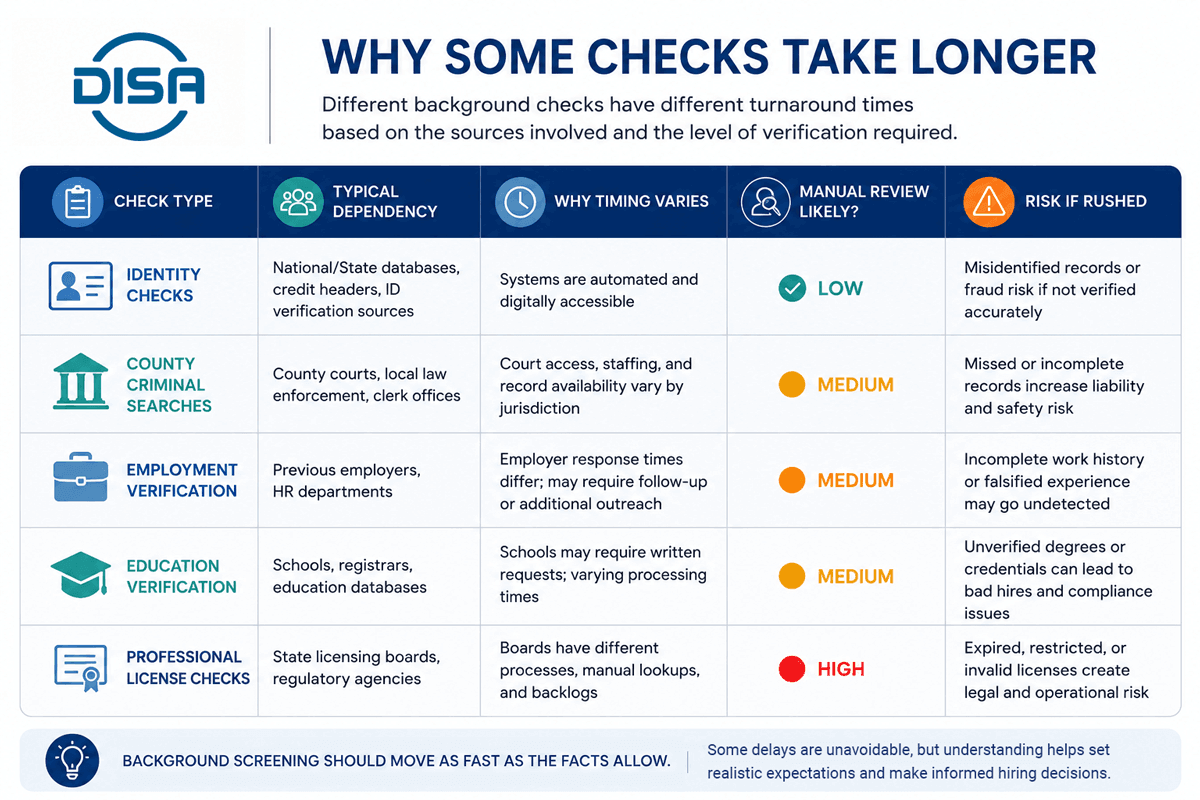
Employment verification, education verification, and license verifications often depend on outside sources. A past employer may need time to respond, a school may require written consent, or a licensing board may have its own verification process. And of course, for roles that require a license or credential, skipping verification can create risk.
Candidate identity issues and data-entry mistakes
A faster workflow still depends on accurate candidate data. Missing middle names, outdated addresses, name changes, or incorrect dates can lead to extra review. These issues can make the candidate experience worse because applicants may receive follow-up requests after they thought the process was complete.
Why Some Background Checks Take Longer Than Others
Different checks have different turnaround times
Not every search moves at the same speed. While basic identity checks may finish quickly, county criminal searches, employment verification, education verification, or professional license checks may take longer because they depend on courts, employers, schools, or licensing agencies.
Some records require source-level review. A court may have limited digital access, a clerk may need to confirm details, or a record may need manual handling before it can be reported. Though these steps support more reliable results, these steps can also add significant amounts of time to the process.
The same idea applies to employment and education history. If a previous employer or institution does not respond quickly, the screening provider may need to follow up.
Why complex roles need more thorough screening
A cashier, a commercial driver, a healthcare worker, and a finance employee may not need the same level of screening. Roles involving driving, patient care, access to sensitive data, financial responsibility, or regulated duties may call for more thorough background screening. When a job affects the safety or lives of individuals, employers must do their due diligence to safeguard their clients, the people they serve, and workforce, even if it means a slower hiring timeline.
How Employers Should Balance Speed, Accuracy, and Compliance
Build role-based screening packages
A role-based program helps employers avoid two common problems: over-screening lower-risk roles and under-screening higher-risk roles. Instead of using one package for every position, employers should consider matching checks to each position's job duties, work environment, regulatory needs, and access level.
Set realistic turnaround expectations with hiring teams
Recruiters and hiring managers should understand what can be completed quickly and what may depend on outside sources. This categorization can reduce frustration, prevent rushed decisions, and improve candidate communication.
Use automation where it helps and human review where it matters
Automation can help collect information, route orders, flag missing fields, and reduce manual work. But human review still matters when records need context, identities need confirmation, or compliance questions need careful handling.
Employers using third-party algorithmic scores, background dossiers, or other third-party consumer reports for employment decisions should also consider applicable FCRA obligations to remain in compliance with federal law.
Track quality, not just completion speed
Consider tracking background check turnaround time alongside quality metrics, which may include dispute rates, incomplete verification rates, candidate drop-off, rework, and the number of reports requiring manual escalation. A faster process is valuable only when the results are accurate, job-relevant, and documented.
When Fast Screening Is Appropriate and When It Is Risky
Lower-risk roles and simpler screening packages
Fast background checks may be appropriate when the role has limited risk, the screening package is narrow, and the candidate data is complete. For example, a limited package with clean candidate information may return faster than a package involving multiple jurisdictions and several verifications.
Regulated and safety-sensitive roles
Fast screening becomes riskier when employers hire for regulated or safety-sensitive roles. Transportation, healthcare, education, energy, and financial roles may require more careful documentation, verification, and screening compliance.
Healthcare employers, for example, may need background screening, drug testing, occupational health, and credentialing workflows that support patient safety and hiring consistency.
High-volume hiring without sacrificing screening quality
High-volume hiring teams need speed, but they also need repeatable process controls. A strong workflow can help employers move many candidates through the process without treating screening as an instant transaction.
Best Practices for a Faster Background Screening Without Cutting Corners
Start with complete candidate data
Accurate candidate information is one of the easiest ways to support faster results. Employers should consider using forms that prompt applicants for full legal name, prior names, date of birth, address history, and complete employment or education details.
Clear instructions help candidates provide better information the first time.
Use clear disclosures and authorization steps
Before using a third-party background report for employment purposes, employers should follow applicable disclosure and authorization requirements. Employers using consumer reports need to get written permission and follow required notice steps when report information may lead to an adverse decision.
Verify critical claims directly
Some claims matter more than others. If a role requires a degree, license, clean driving history, or certain work experience, consider verifying the claims directly with the institution or source in question, rather than relying only on application materials.
Plan for escalation when records do not match
A reliable background screening program should include an escalation path when records do not match cleanly. That may include reviewing identifiers, requesting more candidate information, or waiting for source confirmation before making a decision.
Frequently Asked Questions About Background Screening Speed
There is no single timeline for every background check. A simple check may return quickly, while a package involving county records, employment verification, education verification, or licenses may take longer because outside sources need to respond.
Not always. Fast screening can work well when the process is efficient and the right checks are used. The risk increases when speed leads to under-scoped searches, incomplete verification, poor documentation, or skipped compliance steps.
Common causes include incomplete candidate information, court access limits, source response times, manual record review, and employment or education verification delays. Some delays are avoidable, while others depend on outside record sources.
Employers can improve turnaround time by collecting complete candidate data, using role-based packages, setting clear expectations with hiring teams, using automation for repeatable steps, and keeping human review in place for records that need context.
An efficient process removes wasted steps while keeping the right checks, documentation, and review controls. A rushed process prioritizes speed in ways that can increase background check errors, rework, candidate frustration, or compliance risk.
How DISA Can Help
Fast hiring works best when employment background screening is built for both speed and accuracy, with the right balance of background check turnaround time, verification quality, and screening compliance. DISA Global Solutions helps employers create configurable screening programs that support pre-employment background checks, criminal background searches, employment verification, education verification, professional license checks, drug testing, occupational health, I-9 and E-Verify workflows, and other workforce compliance needs.
DISA’s integrated platform and configurable packages help employers move efficiently without treating screening as a one-size-fits-all transaction. If you want to improve your turnaround time while protecting verification quality, documentation, and hiring confidence, contact us; we can help you build a screening process that is efficient, accurate, and defensible.
DISA Global Solutions aims to provide accurate and informative content for educational purposes only and does not constitute legal advice. The reader retains full responsibility for the use of the information contained herein. Always consult with a professional or legal expert.
Lanson Hoopai
Content Analyst II
DISA Global Solutions
Lanson Hoopai brings almost a decade of writing and editing experience to the Content Analyst II role at DISA Global Solutions.
Discover the significant financial and reputational costs that businesses incur due to workplace violence incidents. Invaluable insights and best practices can ...





 July 15, 2026