What Changed (and Why Delta-8/THCA Were a "Gray Area")
What the New Federal Law Bans
When It Takes Effect and Enforcement Outlook
Federal Ban vs. State Cannabis Laws
Workplace Drug Testing Impact
Employer Policy Update Checklist
Frequently Asked Questions (FAQ)
How DISA Can Help
Glossary of Key Terms
Delta-8 THC: An intoxicating cannabinoid commonly manufactured from hemp-derived CBD.
Delta-9 THC: The primary intoxicating compound traditionally associated with cannabis and marijuana.
THCA: A precursor compound that is non-intoxicating in its raw form but converts to intoxicating Delta-9 THC when exposed to heat.
Total THC: A regulatory measurement that combines multiple forms of THC to determine a product's true intoxication potential.
Confirmatory Testing: An advanced laboratory analysis used to verify the presence of specific substances after an initial drug test.
What Changed (and Why Delta-8/THCA Were a "Gray Area")
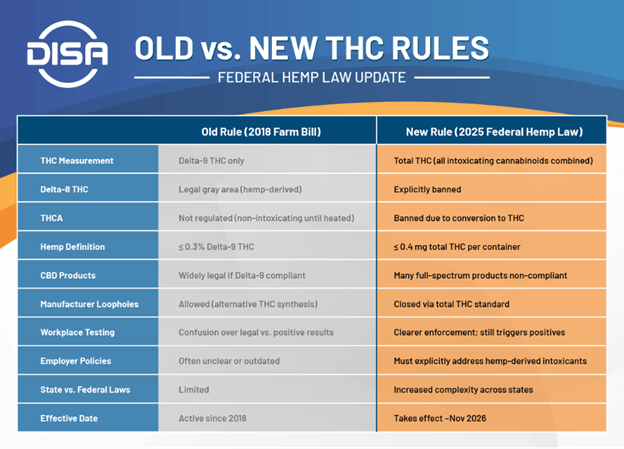
While legislatively significant, the 2018 Farm Bill created significant loopholes regarding the definition of "hemp:” The bill legally defined hemp almost exclusively by its Delta-9 THC concentration. Under this narrow definition, manufacturers could legally produce and sell other intoxicating products. And because other laws only restricted Delta-9 THC, other intoxicating cannabinoid products went largely unregulated.
These legal loopholes created substantial challenges for traditional employers, as they faced growing challenges over workforce impairment from supposedly legal products. Workers could purchase items marketed as legal hemp, consume them, and then trigger an unintended positive result on a workplace drug test.
To address these workplace and public safety concerns, lawmakers took definitive action by introducing a new federal hemp law and, with it, a new reworked ban.
What Does the New Federal Law Affect?
In terms of federal hemp rules, the new law affects several compounds:
Delta-9 vs. Total THC
The new federal hemp law shifts the way the government measures legal hemp: now, instead of measuring only Delta-9 concentration, the regulations test "total THC." This legislative update means that manufacturers can no longer bypass restrictions by synthesizing different THC variations.
Delta-8 THC
Additionally, the new law bans Delta-8 THC, which is an intoxicating compound that manufacturers typically synthesize from legally derived CBD. Previously, because Delta-8 was derived from legal hemp rather than from marijuana, companies marketed it heavily as a legal alternative. The new federal law now explicitly categorizes Delta-8 as a restricted substance.
THCA
Similarly, the legislation establishes a clear THCA ban. THCA is non-intoxicating on paper in its raw, unheated form, but it becomes intoxicating in practice through a process called decarboxylation, which occurs when the substance is heated or smoked.
Cap on Total THC
Additionally, the vast majority of commercially successful CBD products are formulated as "full-spectrum" extracts, which purposefully retain trace amounts of THC to stimulate the endocannabinoid system via the entourage effect. However, the new law sets a strict cap on hemp-derived consumer products of no more than 0.4 milligrams of total THC per container.
Because the restriction applies to the entire container regardless of volume, a legally compliant 4-ounce bottle of full-spectrum CBD topical lotion or a multi-serving bag of CBD gummies will almost universally exceed the 0.4 milligram aggregate limit; the practical reality is that an enormous percentage of the existing consumer CBD market will be federally reclassified as Schedule I marijuana.
When It Takes Effect + What Enforcement May Look Like
Public Law 119-37 was officially approved on November 12, 2025, but the restrictions (as of writing) have not yet taken effect. The amendment notes that the changes to the hemp definitions take effect 365 days after enactment, which gives employers a transition period extending until November 2026 to update their employer drug testing policy (pending legislation that would extend the implementation deadline; H.R. 7024, for instance, would extend this enactment date from 365 days to three years).
Despite the clear timeline, some are unclear on how enforceable the new law will be: Enforcement agencies will likely need time to develop comprehensive protocols for the new federal hemp law, and the implementation of these rules will require clear FDA guidance to regulate the marketplace effectively. Because the market is vast, regulatory bodies may prioritize enforcement against large-scale manufacturers before focusing on individual consumers.
Federal Ban vs. State Cannabis Laws
Organizations with distributed workforces also need to consider the potential conflicts between the new federal hemp law and already-existing state laws. Some states currently permit intoxicating hemp products, actively regulating and taxing their sale. Other states have already taken independent action to restrict or ban these substances entirely. This patchwork of regulations creates a difficult environment for maintaining consistent workplace drug testing protocols.
Multi-state employers should establish a comprehensive decision tree to address these conflicts and help HR teams establish a strong corporate policy baseline.
Consider also prioritizing federal guidelines while remaining aware of local worker protection laws. If an employee resides in a state that permits intoxicating hemp, the employer’s drug testing policy should clearly articulate the company's stance in light of the new federal ban.
Workplace Drug Testing Impact (What Changes, What Doesn't)
The primary question for many HR leaders is whether Delta-8 or THCA will show up on a standard THC test. The short answer is yes; these substances frequently trigger positive results on routine screening panels, and because the chemical structures are so similar to Delta-9 THC, initial drug testing panels often cannot distinguish between the different compounds.
For organizations adhering to Department of Transportation regulations, DOT drug tests leave no room for ambiguity: The DOT has consistently maintained that the use of any THC product, including CBD or intoxicating hemp products, is not a valid medical explanation for a positive drug test.
If an applicant or employee returns a positive test and claims they only used legally purchased THCA, HR teams also need established guidelines to respond. Employers should consider how they will handle medical cannabis cards and potential accommodation requests while keeping state-specific caveats in mind.
Employer Policy Update Checklist
To prepare for the effective date, employers should consider taking proactive steps to update their programs. The following checklist provides actionable guidance for adapting your workplace drug testing framework:
Update prohibited substances language: Review your current drug testing policies and explicitly include wording that prohibits THC.
Communicate to employees: Distribute clear, written guidance to your workforce detailing the specific types of cannabinoid products to avoid.
Implement supervisor training: Ensure managers are trained on documenting reasonable suspicion and identifying physical signs of impairment.
Assess secondary agreements: Where applicable, evaluate your procedures for re-testing, return-to-duty processes, and last-chance agreements to ensure they align with the new federal hemp rules.
Frequently Asked Questions (FAQ)
Yes, under the new federal hemp law, Delta-8 is classified as a restricted substance. The law, enacted in late 2025, uses a "total THC" standard that eliminates the loophole that previously allowed vendors to sell Delta-8 legally.
Yes, Congress bans Delta-8 and THCA under the new legislation. Because THCA converts to intoxicating Delta-9 THC when heated, it falls under the newly established total THC restrictions.
No, pure, non-intoxicating CBD is not inherently banned by this update. However, it does exclude any final hemp-derived product containing "greater than 0.4 milligrams combined total per container" of total THC or other cannabinoids with similar effects. In practice, an enormous percentage of the existing consumer CBD market will be federally reclassified as Schedule I marijuana.
Employers should consider reviewing and updating their workplace drug testing protocols. Consider specifically addressing hemp-derived intoxicants to clarify expectations for employees.
State laws vary widely, but federal law now prohibits these substances. Employers should consider building a multi-state compliance strategy that establishes a firm company baseline while consulting legal counsel regarding specific state-level employee protections.
Maintain Drug Testing Compliance With DISA Global Solutions
At DISA Global Solutions, we understand the complexities of managing compliance and safety in the transportation industry and across diverse corporate landscapes. As federal regulations surrounding intoxicating hemp products evolve, maintaining a secure and compliant environment is critical.
DISA offers policy review support, extensive program management, and access to a massive, reliable testing network. We provide the resources you need to optimize your operations, review your drug testing panels, and improve workforce safety.
With DISA's comprehensive support, you can confidently navigate the complexities of drug screening, adapt to the new federal hemp law, and protect your business from liability. Talk to an expert today to learn more about how we can help your organization achieve compliance and operational excellence.
DISA Global Solutions aims to provide accurate and informative content for educational purposes only and does not constitute legal advice. The reader retains full responsibility for the use of the information contained herein. Always consult with a professional or legal expert.
Lanson Hoopai
Content Analyst II
DISA Global Solutions
Lanson Hoopai brings almost a decade of writing and editing experience to the Content Analyst II role at DISA Global Solutions.
California has long been at the forefront of marijuana legalization in the United States. With the passing of AB 2188 in September of last year, employers must ...
Learn why adding fentanyl to workplace drug tests is critical for improving safety, reducing liability, and staying ahead of 2025 compliance changes....





 March 30, 2026
 9
min read
9
min read