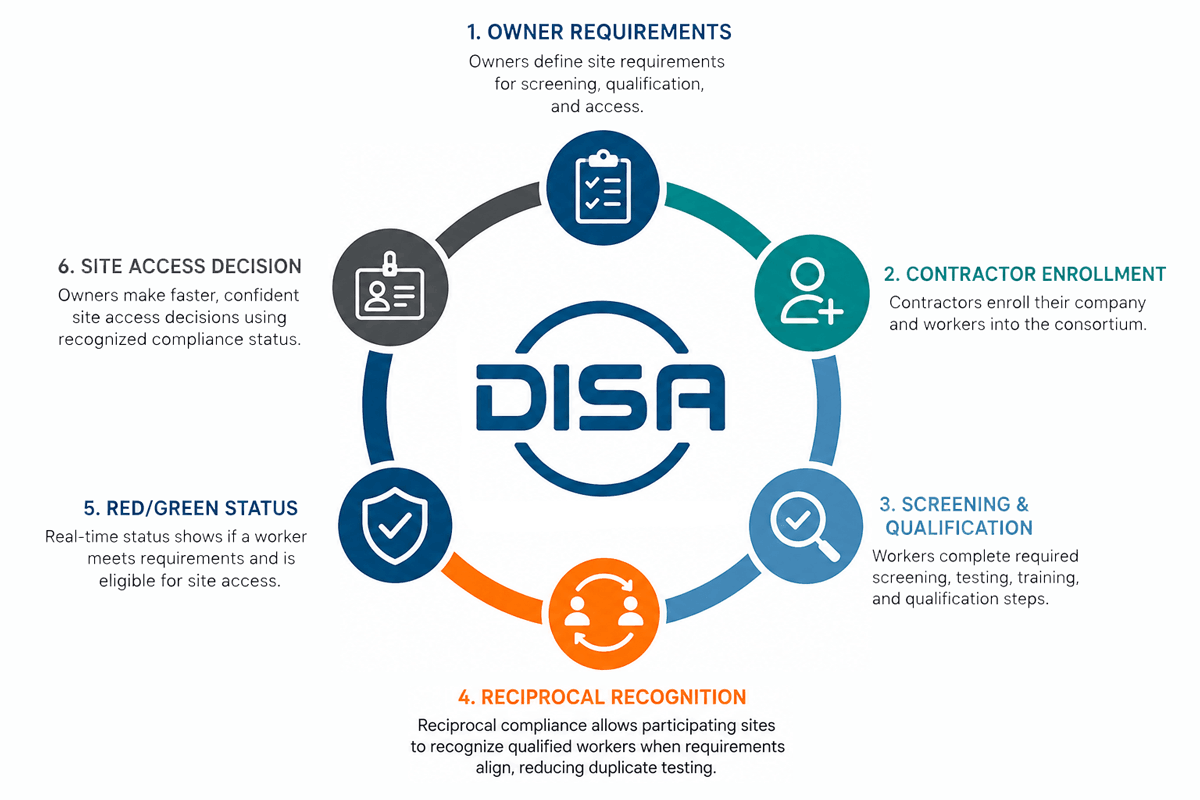
A contractor consortium is a shared compliance model that helps facility owners and contractors work from one coordinated set of screening, qualification, and site-access rules. Instead of having contractors repeatedly meet separate requirement at each site they visit, a consortium (like DISA Global Solutions' Contractor Consortium) helps qualified workers meet recognized requirements once and move across multiple participating locations with less delay. Contractor consortiums are especially useful in safety-sensitive environments where screening and access requirements may vary by facility.
In This Article
What are Contractor Consortiums and how do they work?
Why Contractor Consortiums Exist
How Contractor Consortiums Reduce Duplicate Testing and Expedite Site Access
Benefits of Contractor Consortiums for Contractors
Benefits of Contractor Consortiums for Owners
Why Companies Choose DISA’s Contractor Consortium
Glossary of Key Terms
Frequently Asked Questions
How DISA Can Help
Glossary of Key Terms
Contractor consortium: A shared compliance framework for screening, qualification, and site access across participating owners, facilities/sites, and contractors.
Reciprocity: Recognition of a worker’s compliant status across other consortiums when requirements are the same or more stringent. Note: Only available by some TPAs/CRAs.
Red/green status: A simple access indicator showing whether a contractor or employee currently meets the owner’s site requirements.
Random pool: A group of covered workers eligible for random testing under the applicable policy or regulation.
Site access: The process of confirming the systems, protocols, and verifications required before a worker, contractor, or visitor is allowed to enter a hazardous zone
What are Contractor Consortiums and How Do They Work?
A simple definition
Contractor consortiums are shared compliance programs that give owners a clearer way to check whether a contractor or employee meets the site’s requirements, while giving contractors a simpler path to meet compliance requirements and ensure that their workers are work-ready. Put in the simplest terms, consortiums are a shared system for confirming whether a contractor has meet site compliance requirements before entering participating sites.
How a contractor consortium differs from one-off screening
One-off screening, in contrast, happens for one employer, one site, or one job. And each time a contracted employee leaves that site or job, they need to undergo another set of screening requirements.
That is not the case for facilities in the same contractor consortium. Contractors who are enrolled in a consortium benefit from easier compliance, fewer testing events taking them off site, and streamlined site-access across multiple work sites.
Why Contractor Consortiums Exist
The challenge of site-by-site requirements
Many industrial sites have their own safety policies, contractor background screening requirements, drug testing rules, occupational health requirements, and badging workflows. These requirements often vary by owner, site, role, and regulatory exposure.
This variance from location-to-location can create friction for industrial contractor compliance and contractor safety. While a worker may be fully qualified and ready to go, if each site runs a separate process, the same worker can face duplicative tests, repeated background checks, and repeated waiting periods.
Duplicate testing also increases cost for employers, pulls workers away from productive work, and slows worker mobilization. But a contractor consortium can reduce this repeated testing by placing eligible workers into a shared random pool, reducing the need for separate background screens, and simplifying compliance requirements when the owner’s share requirements.
How Contractor Consortiums Reduce Duplicate Testing and Expedite Site Access
Shared requirements and reciprocal recognition
A consortium starts with defined requirements, which may include policies around drug and alcohol testing, background screening, occupational health, training documentation, or other contractor qualification program rules.
Reciprocity means a site participating in one consortium may recognize a worker’s compliant status from another consortium when the requirements match or the second site’s rules are less strict. (For instance: DISA’s Contractor Consortium supports reciprocal policies for owners, operators, safety councils, and regulatory agencies.)
This shared recognition brings practical value for owners and employers: qualified workers can move faster because the system has already verified that they meet the core requirements.
Participating owners, contractors, and site-access workflows
Owners set the requirements for their own sites; contractors enroll workers, complete required screening, and monitor status. Consortiums help connect those steps so site teams can make faster site-access decisions using DISA’s red/green status.
Benefits of Contractor Consortiums for Contractors
Less duplicate testing and lower administrative burden
Think of a 20-person crew that rotates among four participating owner sites with a 50% random rate. Without a shared model, that crew would need to enroll into four site-specific programs. Over the span of 2 years, that’s the difference between averaging 20 random selections in a shared consortium or 80 random selections in separate programs. Shared consortium models minimize this overlap: one recognized pool can reduce repeated selections when the requirements align. This keeps workers ready, on-site, and working more often.
One practical example: DISA reported that its Contractor Consortium helped participating contractors avoid 178,600 redundant tests in 2025 and save $21.9 million annually. That doesn’t even include costs associated with lost productivity or travel. Additionally, their reciprocal requirements helped eligible workers access DISA’s network of more than 420 participating facilities without waiting for a new drug test or background check to complete.
Faster movement across participating sites
Contractor mobility matters when turnarounds, outages, maintenance projects, and emergency work create tight labor windows. Contractor consortiums also help qualified workers protect their productive labor time by letting them move where they are needed. Their compliance status follows them across participating sites.
Benefits of Contractor Consortiums for Owners
Standardized requirements and stronger visibility
For facility owners, contractor consortiums create a more consistent way to administer site requirements. Owners can define screening rules, check company- and employee-level status, and reduce their compliance burden, instead working from DISA’s red/green compliance status.
Easier auditing and program administration
A consortium can support auditing because records are centralized and easier to review. It also helps address job-hopping concerns: When a worker is marked non-compliant under a shared model, participating owners can see that status instead of relying only on their specific site’s records.
Why Companies Choose DISA’s Contractor Consortium
DISA’s Contractor Consortium was founded in 1992 and built around a coordinated model for owners and contractors. DISA helps owners strengthen facility owner contractor compliance, reduce administrative work, and make clearer access decisions, while helping contractors reduce redundant testing and mobilize qualified employees faster.
DISA also supports connected compliance ecosystems through integrations and partnerships to help simplify contractor compliance, accelerate worker qualification, and connect screening results with compliance monitoring.
Frequently Asked Questions
Contractor consortiums are shared compliance programs that help owners and contractors manage screening, qualification, and site access across participating locations. They reduce repeated work by using common requirements and reciprocal recognition where appropriate.
They reduce duplicate testing by placing eligible workers into a shared or standardized program instead of separate site-by-site testing pools. This can reduce repeated random selections that would happen if enrolled in separate programs and help workers stay available for productive work.
No. A consortium helps administer requirements, but employers and owners should still understand their obligations under applicable law, contract terms, and site policy. DOT rules, for example, allow employers to use service agents while stating that employers remain responsible for compliance.
Owners should consider network size, participating sites, customizable requirements, audit support, data integrations, worker-level visibility, and whether the program supports drug testing, background screening, occupational health, and site-specific requirements. DISA’s article on employee background check timing can also help teams understand why screening timelines vary.
Facility owners should consider joining a contractor consortium when they rely on outside contractors, operate safety-sensitive worksites, or need a clearer way to verify whether workers meet site-access requirements before they enter the facility.
Contractor companies should also consider joining when their employees work at participating owner sites, move between multiple facilities, or need to meet drug testing, background screening, or other workplace screening requirements across different locations.
Contractor consortiums are most common in safety-sensitive and multi-employer industries where owners need to manage large contractor workforces, repeated site access, and consistent screening requirements.
In practical terms, these programs are often used by facilities and contractors that support refineries, chemical plants, manufacturing sites, construction projects, utilities, infrastructure operations, and other work environments where contractor safety compliance and fast workforce verification are important.
How DISA Can Help
At DISA Global Solutions, we understand the complexity of managing contractor compliance in safety-sensitive environments. DISA’s Contractor Consortium helps owners and contractors work from a coordinated compliance model that supports screening, reciprocity, auditing, and site access. For owners, DISA helps reduce administrative burden and provides clearer red/green decisions. For contractors, DISA helps reduce duplicate work and supports faster movement for qualified employees across participating sites.
DISA’s services include drug and alcohol testing, background screening, occupational health, transportation compliance, and contractor compliance monitoring, and we support data flow through direct integrations, flat files, and workforce compliance connections that help site teams make informed access decisions. Contact us to learn more about how DISA’s Contractor Consortium helps simplify contractor compliance, screening, and site access for owners and contractors.
DISA Global Solutions aims to provide accurate and informative content for educational purposes only and does not constitute legal advice. The reader retains full responsibility for the use of the information contained herein. Always consult with a professional or legal expert.
Lanson Hoopai
Content Analyst II
DISA Global Solutions
Lanson Hoopai brings almost a decade of writing and editing experience to the Content Analyst II role at DISA Global Solutions.
DISA is committed to developing solutions to make the complex screening process easier and more efficient. The immense volume of paper required for the Chain of...






 June 24, 2026