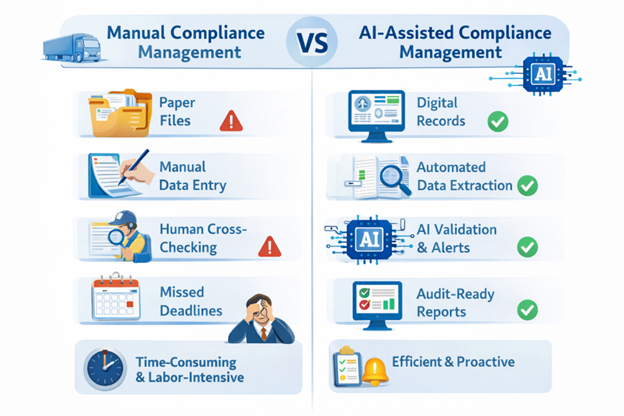
In the trucking industry, mounting regulatory pressure is being answered by technological innovation. The process of managing Driver Qualification (DQ) Files has become increasingly complex for motor carriers, with progressively restrictive regulations requiring meticulous documentation of each commercial driver's credentials, health history, and safety record. And because these files form the backbone of DOT compliance, any mistakes in the manual process can lead to costly violations and administrative burdens.
Enter artificial intelligence: a technology that promises to revolutionize how carriers manage these critical compliance tasks.
Why Driver Qualification File Compliance Is Critical
The Federal Motor Carrier Safety Administration (FMCSA) requires every motor carrier to maintain complete DQ files for each driver. Missing or incomplete documentation can trigger violations during DOT audits, which can downgrade a carrier's safety rating and expose the company to scrutiny during crash litigation.
With over 9,000 audit violations issued over a five-year period, the failure to maintain proper Motor Vehicle Records represents one of the most common DQ violations. For carriers operating on tight margins, these violations translate directly to fines, operational disruptions, and increased insurance costs.
How AI Improves Driver Qualification File Management
Artificial intelligence excels at repetitive, data-intensive, pattern-based tasks, precisely the characteristics that DQ file management tends to require. Modern AI-powered document processing systems can automatically classify documents, extract key data fields, and populate databases without manual data entry, while advanced Optical Character Recognition (OCR) technology can handle semi-structured forms and even handwritten text with increasing accuracy.
For motor carriers, this means AI can scan driver's licenses and medical examination forms and automatically extract names, dates, license numbers, and expiration dates into structured digital records. Plus, AI’s pattern recognition capabilities allow it to cross-verify information across multiple documents to flag inconsistencies (for instance, when a past employer or violation mentioned in one record is missing from another).
Perhaps most valuable is AI's ability to automate workflow reminders and alerts. These systems can track qualification data and automatically notify drivers and safety managers when medical cards or licenses approach expiration, which can help carriers shift from reactive to proactive compliance management.
Several major transportation companies have already integrated AI features into their platforms to aid in driver recruitment, compliance tracking, and file management.
Risks and Limitations of AI in DOT Compliance
Despite its promise and potential, AI is no silver bullet; the technology carries significant limitations that motor carriers must understand before they implement AI systems into their workflow.
For one thing, AI systems lack human judgment and contextual understanding. They cannot interpret nuances or handle edge cases that fall outside their training. For instance, where a human compliance manager may know the reasonable explanation for a gap in employment history, an AI might flag it as non-compliant.
Artificial intelligence also has occasional issues producing reliable outputs with variable data quality. On average, 85% of AI projects deliver erroneous outcomes due to poor data quality or insufficient data, so if documents are poorly scanned or data formats vary significantly across states, the AI’s accuracy will suffer. The technology is only as reliable as its starting information.
The "black box" problem continues to pose particular risks in regulated and compliance-heavy industries: Many advanced AI models cannot explain their reasoning in understandable ways. When an AI flags a file as non-compliant or identifies a driver as high-risk, carriers must be able to explain why the system threw up that flag, especially during audits or litigation. "The computer said so" is not a good enough explanation for regulators or juries.
Most concerning is the potential for over-reliance. If safety managers trust AI systems blindly and stop actively reviewing files, they may miss critical issues that a human would have caught. Human oversight remains essential, particularly given the high-consequence nature of DOT compliance.
Best Practices for Using AI in DQ File Compliance
Motor carriers considering AI adoption must establish clear boundaries. For instance:
Human oversight should remain mandatory for all compliance determinations, with AI serving to assist rather than replace human judgment. Background check and compliance service providers like DISA Global Solutions can help companies bridge this gap by combining AI-powered automation with expert human review.
Every AI-driven action requires a clear, explainable audit trail that non-technical stakeholders can understand. Carriers who work with external background screening services like DISA can help make sure that their paper trail includes not just the AI's output but also the necessary human verification steps and regulatory interpretations.
Carriers must ensure document quality, consistent formatting, and accurate record-keeping before expecting AI systems to deliver reliable results.
Safety must always remain the guiding principle. Compliance exists to ensure qualified drivers operate safely, not just to satisfy paperwork requirements. AI should enhance this mission by freeing compliance teams to focus on higher-value safety initiatives rather than replacing human relationships, contextual awareness, and regulatory accountability.
The Future of AI in Driver Qualification File Management
Artificial intelligence offers genuine opportunities to streamline DQ management, reduce administrative burdens, and improve compliance consistency. Early adopters are already seeing benefits in faster document processing, proactive expiration tracking, and more efficient audits, but stakeholders need to maintain realistic expectations about AI's capabilities and limitations.
The technology works best when it augments human expertise rather than replacing it. Carriers that implement AI tools with strong governance frameworks, quality data, and mandatory human oversight can achieve meaningful efficiency gains while maintaining the accountability and defensibility that regulators and the courts demand.
As the trucking industry continues to face evolving compliance requirements, AI represents a valuable tool... but only when deployed thoughtfully, with safety as the ultimate objective.
Full White Paper: “Leveraging AI for Driver Qualification File Management”
The white paper "Leveraging AI for Driver Qualification File Management" provides comprehensive analysis of how artificial intelligence is reshaping compliance workflows in the trucking industry. Whether you're evaluating AI solutions for the first time or optimizing existing systems, the full white paper offers detailed frameworks and real-world examples to guide your decision-making.
DISA Global Solutions aims to provide accurate and informative content for educational purposes only and does not constitute legal advice. The reader retains full responsibility for the use of the information contained herein. Always consult with a professional or legal expert.
Lanson Hoopai
Content Analyst II
DISA Global Solutions
Lanson Hoopai brings almost a decade of writing and editing experience to the Content Analyst II role at DISA Global Solutions.
Discover CDC-recommended COVID-19 safety measures for truck drivers and employers. Learn essential practices like PPE use, disinfecting routines, and workplace ...





 February 17, 2026
 6
min read
6
min read