To keep their fleet operations safe, trucking companies develop policies and internal regulations that address impaired driving… but for transportation companies, impairment goes beyond the traditional understanding of drug and alcohol use. It also encompasses fatigue, medical conditions, and mental distress; in other words, any factor that compromises a driver’s ability to operate a vehicle safely.
Impaired Driving
Impaired driving occurs when a commercial driver operates a vehicle while affected by drugs, alcohol, fatigue, illness, or any condition that reduces alertness or cognitive function. Under FMCSA regulations, operating a commercial vehicle while impaired is strictly prohibited.
In This Article
What qualifies as impairment under FMCSA regulations
DOT drug and alcohol testing requirements for CDL drivers
How the FMCSA Clearinghouse impacts fleet compliance
Oral fluid testing updates and implementation status
Supervisor reasonable suspicion training requirements
A practical compliance checklist for fleet managers
What is Impairment Under FMCSA Regulations?
In the context of fleet management, impairment is defined as any condition that reduces a driver’s alertness or cognitive function. Substance abuse, of course, sits at the top of the list of impairments.
However, the Federal Motor Carrier Safety Administration (FMCSA) regulations (specifically, 49 CFR Part 392) strictly prohibit driving while impaired by fatigue, illness, or any other cause that makes the vehicle unsafe to operate.
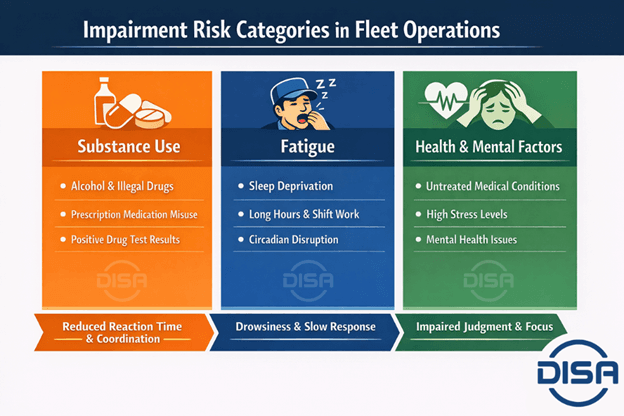
Any comprehensive safety policy must address three main categories of impairment:
Substance Use: Illegal drugs, alcohol, and misuse of prescription medications.
Fatigue: Sleep deprivation, circadian rhythm disruptions, and long shifts.
Health and Mental Factors: Untreated medical conditions (like sleep apnea) or high levels of stress.
DOT Impaired Driving Regulations Explained
DOT impaired driving regulations prohibit commercial drivers from operating a vehicle while affected by drugs, alcohol, fatigue, illness, or any condition that makes the vehicle unsafe to operate. Under 49 CFR Part 382, employers must implement drug and alcohol testing programs for safety-sensitive employees, which should include pre-employment, random, post-accident, reasonable suspicion, and return-to-duty testing requirements.
Impaired driving prevention is both a regulatory requirement and a critical liability safeguard. A single serious commercial vehicle accident can lead to substantial legal exposure, rising insurance premiums, operational disruption, and reputational harm.
Plus, carriers that fail to identify post-hire violations may face negligent retention claims if an impaired driver causes injury.
Drug and Alcohol Testing Requirements for CDL Drivers
Drug and alcohol testing is the foundation of impaired driving prevention. According to the National Highway Traffic Safety Administration (NHTSA), 12,429 people died in alcohol-impaired driving crashes in 2023 alone.
However, pre-employment urine tests (one of the most widely used drug screening methodologies for employers) are not sufficient by themselves to mitigate risk. Modern fleet safety programs utilize a mix of testing methodologies and database checks to ensure continuous compliance.
The Role of the FMCSA Clearinghouse
The FMCSA Drug and Alcohol Clearinghouse has played a crucial role in identifying drivers with past violations. Employers must conduct Clearinghouse queries on all prospective CDL drivers to ensure they are not prohibited from performing safety-sensitive functions.
Recent regulatory updates have strengthened this system: As of November 2024, drivers with a "prohibited" status in the Clearinghouse face an automatic downgrade of their Commercial Driver’s License (CDL) and removal from the road until they complete the Return-to-Duty process.
Oral Fluid Testing Updates
To detect recent drug and alcohol use more effectively, the Department of Transportation (DOT) has authorized oral fluid testing as an alternative to urine testing. However, as of February 2026, this testing method is not operational because no laboratories have received the required HHS certification.
Once fully implemented with certified laboratories, oral fluid testing will offer a shorter window of detection, which can assist in post-accident scenarios where authorities need to determine immediately if a subject is impaired.
Fatigue Risk Management Strategies
Fatigue is a silent threat in transportation, slowing reaction times and degrading decision-making skills in a manner similar to alcohol intoxication.
Hours-of-Service (HOS) and Beyond
Compliance with HOS regulations is mandatory, but compliance alone does not guarantee a driver is well-rested. Fleet managers can enhance their drivers’ safety by using Electronic Logging Devices (ELDs) to monitor HOS compliance and identify patterns of violations that may indicate fatigue.
Human Performance Monitoring
Forward-thinking fleets are moving from reactive measures to proactive monitoring. By utilizing predictive analytics (which measures performance against a driver’s personal baseline), companies can assess a driver's cognitive alertness, fatigue levels, or distress before a shift even begins.
Continuous Monitoring and Supervisor Training
Preventing impaired driving is an ongoing process that extends throughout a driver's tenure. Continuous monitoring (through, for instance, regular MVR checks and DOT physicals) can help employers detect any changes in a driver’s status that could lead to impairment.
Supervisor Training
Technology cannot replace human judgment. Supervisors need to recognize the physical, behavioral, and performance indicators of impairment and must receive reasonable suspicion training to this end. This type of training empowers supervisors to intervene when they observe signs such as slurred speech, erratic behavior, or the odor of alcohol.
Fleet Manager Compliance Checklist
Conduct pre-employment DOT drug testing
Run FMCSA Clearinghouse full queries before hire
Enroll drivers in a compliant random testing program
Conduct annual Clearinghouse limited queries
Maintain documented Return-to-Duty procedures
Monitor MVRs for post-hire violations
Provide reasonable suspicion supervisor training
Document all compliance actions and investigations
Building a Safety-First Fleet Culture With DISA Global Solutions
An effective impaired driving prevention program requires clear policies and open communication. DISA Global Solutions provides the tools and data necessary to build a comprehensive impaired driving prevention program without overburdening your administrative teams.
Our services streamline the compliance process for transportation companies. We manage all aspects of drug and alcohol testing, helping your fleet meet current federal requirements. We also integrate continuous monitoring solutions, such as automated Motor Vehicle Record (MVR) checks and DOT physical tracking, to help fleet managers identify potential safety risks before they result in an incident.
With our services, employers gain clear, data-driven insights into their workforce’s safety metrics and compliance standing.
Frequently Asked Questions
Under Federal Motor Carrier Safety Administration (FMCSA) regulations, impaired driving goes beyond just drug and alcohol use. Under federal regulations, no driver should operate a commercial motor vehicle if their ability or alertness is impaired, or likely to become impaired, through fatigue, illness, or any other cause that makes it unsafe to drive.
Yes. The Department of Transportation (DOT) explicitly recognizes fatigue as a form of impairment. Fleet managers must monitor compliance with Hours of Service (HOS) rules and implement comprehensive fatigue risk management to prevent fatigue-related impairment.
State Driver Licensing Agencies (SDLAs) are now required to remove the commercial driving privileges of drivers with a “prohibited” Clearinghouse status. This procedure results in an automatic downgrade of their Commercial Driver's License (CDL) or Commercial Learner's Permit (CLP) until the driver successfully completes the DOT Return-to-Duty (RTD) process.
While the DOT published a final rule authorizing oral fluid testing as an alternative to urinalysis in 2023, the testing method is not yet operational for DOT-mandated programs. The DOT requires the Department of Health and Human Services (HHS) to certify at least two laboratories (one for primary testing and a second for split specimen testing) before employers can utilize this method. As of early 2026, no U.S. laboratories have met these HHS certification requirements.
Reasonable suspicion training is a mandatory educational requirement for anyone designated to supervise CDL drivers. Employers must ensure supervisors receive at least 60 minutes of training on alcohol misuse and an additional 60 minutes of training on controlled substances use, which helps equip supervisors to recognize the physical, behavioral, speech, and performance indicators of probable drug use or alcohol misuse.
DISA Global Solutions aims to provide accurate and informative content for educational purposes only and does not constitute legal advice. The reader retains full responsibility for the use of the information contained herein. Always consult with a professional or legal expert.
Lanson Hoopai
Content Analyst II
DISA Global Solutions
Lanson Hoopai brings almost a decade of writing and editing experience to the Content Analyst II role at DISA Global Solutions.





 March 13, 2026
 6
min read
6
min read