




 April 03, 2026
 6
min read
6
min read


Transportation Compliance
FRA Compliance
Read More...
Celebrating 40 Years of Compliance Leadership
The CVSA’s International Roadcheck runs from May 12 to May 14, 2026. During this three-day period, CVSA-certified inspectors across the U.S., Canada, and Mexico dramatically increase their roadside enforcement efforts. The inspectors will specifically target Level I inspections to assess the compliance of both the driver and the vehicle.
Fleet operators should consider preparing for targeted scrutiny on Electronic Logging Device (ELD) tampering and cargo securement. Because log issues and securement problems consistently generate high citation rates, roadside inspectors will examine them under a magnifying glass.
Electronic Logging Device manipulation is the primary driver focus for 2026. Enforcement personnel frequently discover patterns of log falsification, which originate from both deliberate tampering and a lack of regulatory understanding. And whether done intentionally or accidentally, these logging failures can cost organizations heavily.
Inspectors look for specific indicators of log manipulation, so drivers should expect follow-up questions if their records show driving time while disconnected from the system. Unexplained edits without proper annotations can trigger immediate scrutiny. Additionally, enforcement officials will verify that supporting documents align precisely with the recorded logs.
Hardware and operational issues further complicate the ELD inspection process: If a device appears disconnected or improperly used (or if a driver is unwilling or unable to transmit their ELD data upon request), the investigator may conduct a deeper investigation.
The financial penalties for these recordkeeping failures escalate rapidly: Inaccurate or false required records carry maximum civil penalties of up to $1,584 per day, and depending on the specific details of the violation, these fines can reach a maximum of $15,846.
The CVSA reported 18,108 violations in 2025 related to cargo not secured to prevent leaking, spilling, blowing, or falling. Furthermore, inspectors recorded 16,054 violations for unsecured vehicle components and loads last year.
During the vehicle segment of a Level I inspection, enforcement officers execute a systematic review of the load, by assessing blocking and bracing to verify load stability. Inspectors also examine tie-down conditions for signs of wear, damage, and adequate strength, as well as anchor points for cracks or structural deformation.
The inspection will also attempt to verify that the vehicle’s doors, tailboards, and end gates are correctly closed and latched. On flatbed trailers, they will evaluate cargo positioning to prevent forward movement during transit, as well as proper securement of dunnage and spare equipment, including chains, straps, and tarps.
Vehicles with unstable cargo face immediate operational restrictions, and if an inspector determines a load appears able to shift, leak, or fall, the vehicle can be placed out of service.
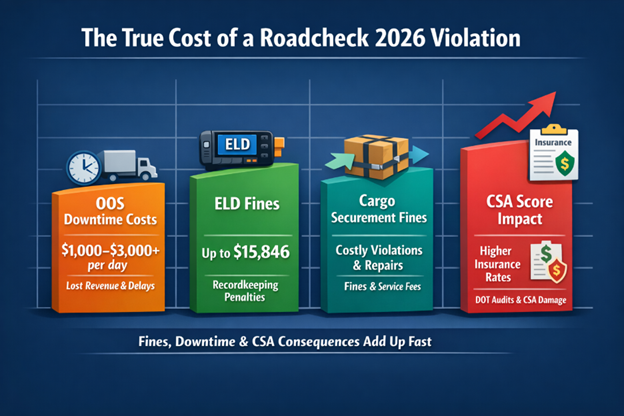
How much does a Roadcheck violation actually cost? The answer extends beyond the citation itself.
If a driver or vehicle is placed out of service during a Level I inspection, operations stop immediately.
The costs related to an OOS downtime period can include the following:
Even a single 24-hour out-of-service order can cost upwards of $3,000 in direct operational impact, not including reputational damage with shippers.
If multiple violations are discovered during a high-volume enforcement event like Roadcheck, those costs compound quickly.
For Electronic Logging Device recordkeeping failures, federal civil penalties can reach the following figures:
Beyond the monetary penalty, falsification findings may trigger
Cargo securement violations vary by jurisdiction but often include the following:
When a load must be re-secured roadside, fleets may incur:
The Compliance, Safety, Accountability (CSA) score impact may be the most expensive consequence of all.
Elevated CSA scores can lead to the following repercussions:
Even a modest CSA deterioration can raise insurance renewal costs significantly, especially for fleets already near intervention thresholds.
A single Roadcheck violation can cost far more than the ticket itself.
Between fines, downtime, CSA score damage, and insurance implications, the real financial exposure often reaches thousands (and sometimes tens of thousands) of dollars per incident.
Consider preparing for this 72-hour enforcement event by reviewing your documentation management practices. Safety managers should consider executing the following steps for ELD and log compliance:
Additionally, your operations teams should consider implementing the following actions:
Make sure that your drivers are comfortable with the hardware and requirements to reduce their stress and mitigate the chance of unnecessary citations.
The CVSA International Roadcheck runs from May 12 through May 14, 2026.
The driver focus area is ELD tampering and falsification of logs. The vehicle focus area is cargo securement.
False or inaccurate required records can carry maximum civil penalties of up to $1,584 per day, and up to $15,846 depending on the violation details.
Yes. If a load appears able to shift, leak, or fall, the vehicle can be placed out of service.
DISA Global Solutions aims to provide accurate and informative content for educational purposes only and does not constitute legal advice. The reader retains full responsibility for the use of the information contained herein. Always consult with a professional or legal expert.


