Executive Summary / Key Takeaways
- The Spotted Lanternfly (SLF) is a highly destructive invasive pest that feeds on over 70 plant species, causing devastating agricultural and economic damage.
- Since its initial discovery, the SLF has spread rapidly. As of 2026, the pest has been confirmed in 19 states and the District of Columbia, leading to massive multi-state quarantine expansions, including a recent statewide quarantine in Ohio.
- Any trucking company, shipper, or business moving equipment and goods within, into, or out of a quarantine zone must have a valid Spotted Lanternfly Permit.
- Non-compliance can result in severe consequences, including up to a $300 criminal citation and a $20,000 civil penalty per violation, supply chain delays, and shipment rejections at state borders.
The Evolution of the Spotted Lanternfly Quarantine
When the Pennsylvania Department of Agriculture first began hard enforcement of the Spotted Lanternfly (SLF) trucking permit on May 1, 2019, the quarantine was limited to just 13 counties in Eastern Pennsylvania and a handful of neighboring areas.
Fast forward to 2026: The SLF is now recognized as a national agricultural threat. Quarantines have expanded to cover massive stretches of the Northeast and Midwest, with states including New York, New Jersey, Delaware, Maryland, Ohio, Virginia, West Virginia, and Rhode Island actively enforcing containment zones. As recently as February 2026, the Ohio Department of Agriculture issued a statewide quarantine to combat the pest and protect local agriculture.
What is a Spotted Lanternfly, and Why is it Dangerous?
Native to China, India, and Vietnam, the Spotted Lanternfly is an infectious planthopper that severely damages trees and agriculture.
The pest feeds on the sap of over 70 different plant species; as it feeds, it excretes a sugary substance known as "honeydew," which promotes the growth of black sooty mold. This mold weakens the plants, destroys crop yields, and drastically reduces the quality of life in heavily infested residential areas, while the pest itself poses an existential threat to the timber, beer, and wine industries, heavily impacting grape, hop, and hardwood crops.
Economic Impact and Case Studies (2025–2026 Statistics)
To understand why state police and Departments of Agriculture take roadside enforcement so seriously, here's a look at the devastating economic toll the SLF causes:
- Pennsylvania's Ongoing Battle: The SLF has caused an estimated hundreds of millions in agricultural and economic losses each year in Pennsylvania alone.
- New York Grape Industry at Risk: A comprehensive 2025 study by the New York State Integrated Pest Management (NYSIPM) found that if left unmanaged, the SLF could cost the New York grape industry up to $8.8 million annually by year three of an infestation. The Lake Erie Region, the largest Concord grape producer globally, remains highly vulnerable.
- Protecting Ohio's Economy: Ohio's 2026 statewide quarantine was enacted specifically to safeguard its grape and wine industry, which contributes more than $6 billion in economic activity to the state every year.
Who Requires a Permit, and What are the Penalties?
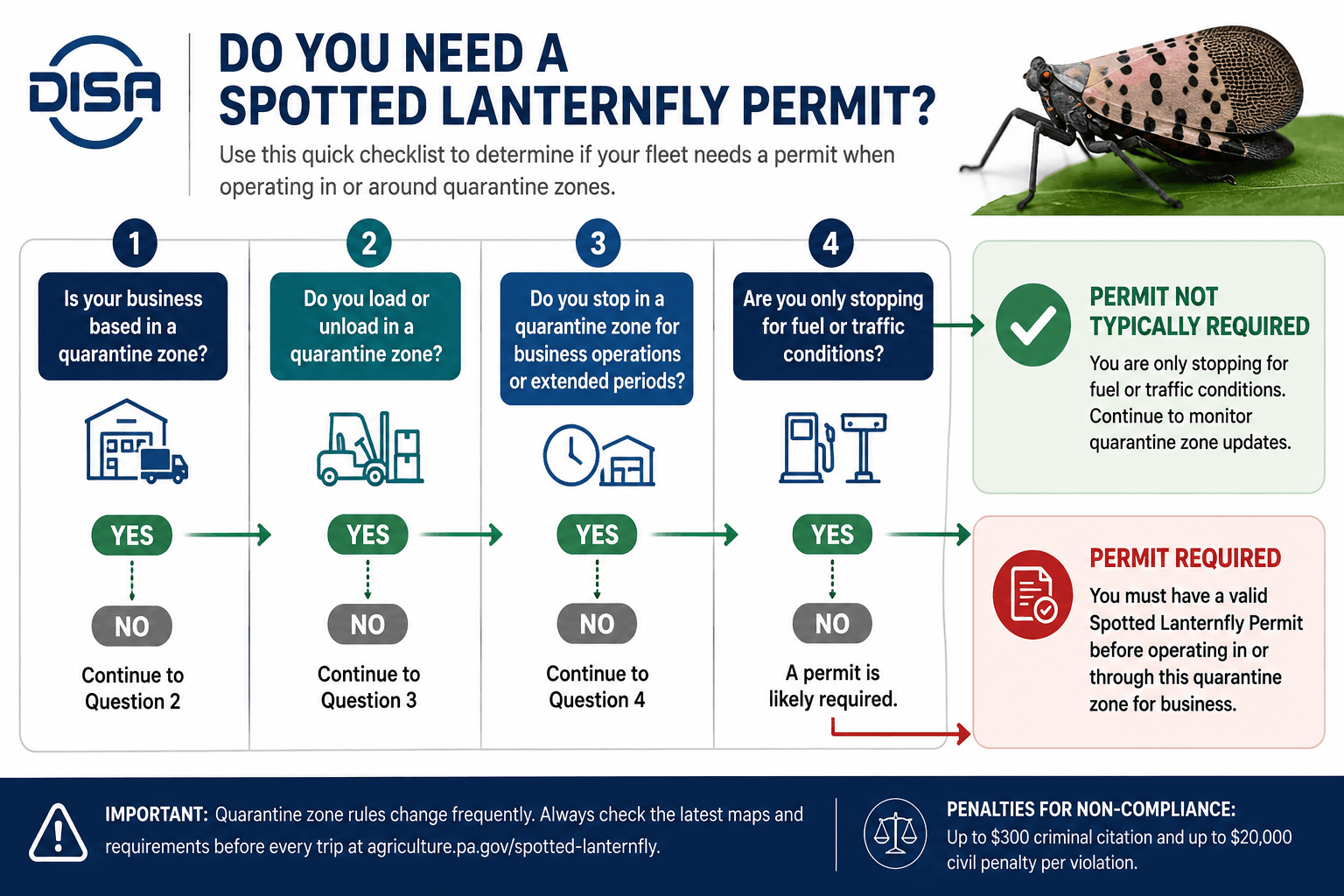
Trucks, shippers, or any businesses that move conveyances across affected zones must have a SLF permit if your operations:
- are based in a quarantine zone;
- load or unload in a quarantine zone; or
- stop for business operations or extended periods in a quarantine zone (quick stops for fueling and traffic conditions are legally exempt).
Businesses violating the quarantine can face a criminal citation of up to $300 and a civil penalty of up to $20,000 per violation.
How to Obtain an SLF Permit and Maintain Compliance
Fortunately, the permit process is standardized and reciprocal. A permit issued by the Pennsylvania Department of Agriculture is honored by New York, New Jersey, Delaware, and Virginia.
The permit utilizes a "Train-the-Trainer" model:
- Designate a Representative: A designated manager or safety supervisor must complete the free, self-paced online permit training course via Penn State Extension.
- Pass the Exam: The representative must pass the course exam with a score of 70% or higher.
- Train Your Drivers: Once certified, the manager is responsible for training all company drivers and warehouse employees on how to inspect vehicles, spot egg masses, and safely destroy the insects.
- Display the Permit: Upon completion, the company will be mailed official permits (cab stickers/mirror hangers) to distribute to their fleet. Temporary print-out certificates can be used while awaiting official mail.
- Recordkeeping: Fleets must maintain inspection and training logs for a minimum of two years.
How Can DISA Help?
While DISA Global Solutions cannot obtain these agricultural permits directly on your behalf, we are committed to helping you maintain total fleet compliance. If you are an employer with questions regarding transportation compliance, driver background screening, or ongoing risk mitigation, connect directly with DISA via our compliance portals to ensure your fleet meets all current regulatory standards.
Frequently Asked Questions (FAQ)
If you drive directly through a quarantine zone without stopping, a permit is not strictly required. However, if your driver stops for business purposes, loading, unloading, or an extended break, a permit is legally required. Quick stops strictly for fueling or navigating traffic conditions do not require a permit.
The permit and the required training course provided by the Penn State Extension are entirely free for businesses.
Drivers should conduct a visual walk-around of the vehicle before leaving a quarantine zone. Look for adult bugs, nymphs, or grey, mud-like egg masses on wheel wells, trailers, tarps, and cargo. If found, they should be scraped off and destroyed immediately.






 June 05, 2026
 5
min read
5
min read