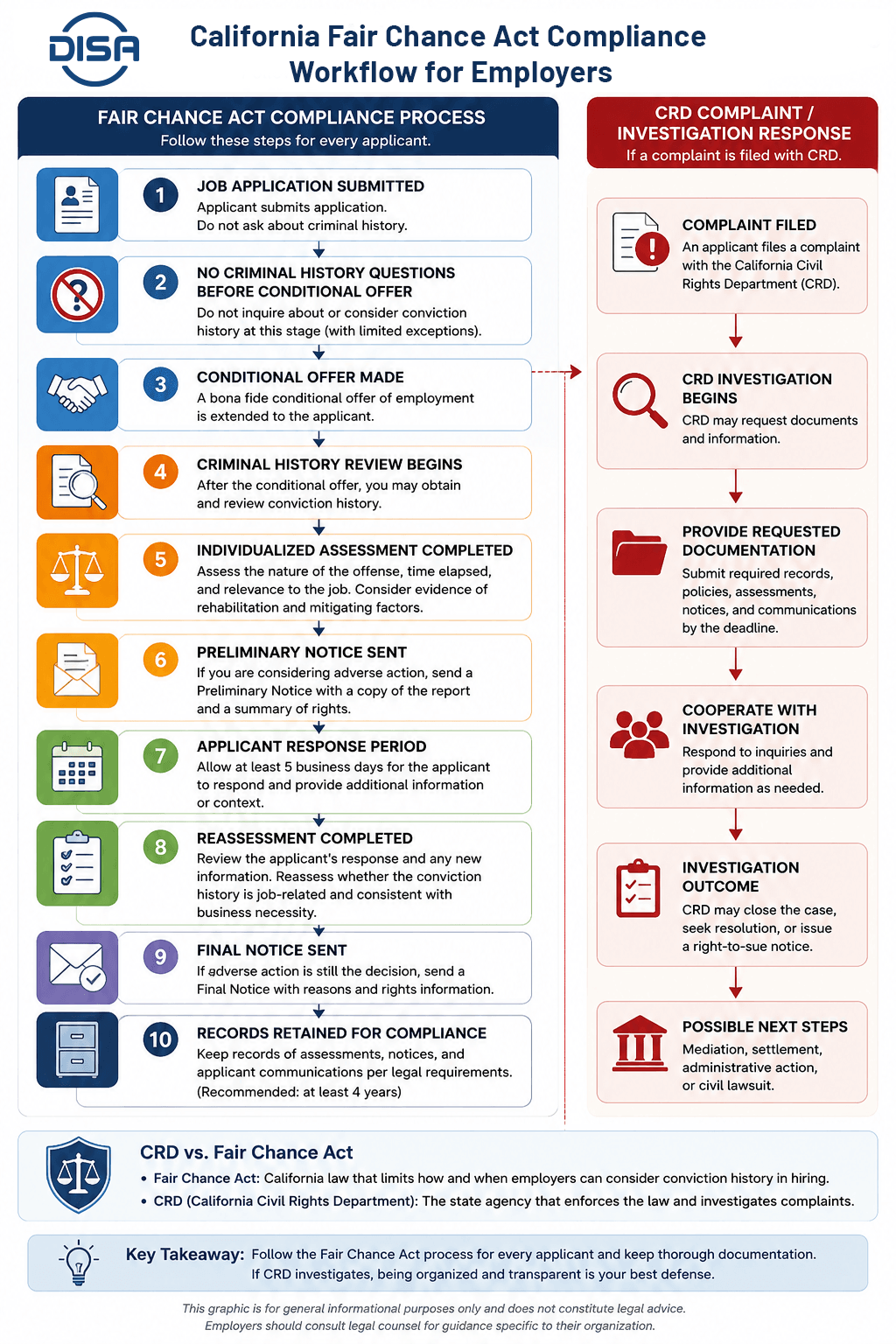
With the California Civil Rights Department (CRD) ramping up their investigations into California Fair Chance Act (FCA) violations, California employers that use criminal history in hiring now need a sound background check policy more than ever before.
In this guide, employers will learn the key steps for California Fair Chance Act compliance, including conditional offer timing, individualized assessment, notice requirements, and how to prepare for CRD investigations.
Glossary of Terms
California Fair Chance Act: A California law that limits when and how covered employers can ask about or use conviction history in employment decisions.
CRD: The California Civil Rights Department, the state agency that enforces many California civil rights laws, including employment protections.
Conditional offer: A job offer made before the employer reviews conviction history, subject to lawful screening steps.
Individualized assessment: A job-specific review of whether the applicant’s conviction history has a direct and adverse relationship with the duties of the position.
Preliminary notice: A written notice sent before a final denial based on conviction history.
Final notice: A written notice sent if the employer makes a final decision to deny employment based fully or partly on conviction history.
Adverse action: A negative employment decision tied to background report information. Federal FCRA adverse action rules and California Fair Chance Act notice rules are related, but they are not the same process.
In This Article
Why California Employers Are Facing More Scrutiny From CRD Investigations
A Brief History of CRD, FEHA, and the Fair Chance Act
California Fair Chance Act Compliance Requirements for Employers
What Changed With the 2023 California Criminal History Regulations
California Fair Chance Act Compliance Checklist
How Employers Should Respond to CRD Investigations and Complaints
FAQ
How DISA Can Help
Why California Employers Are Facing More Scrutiny From CRD Investigations
What the Fair Chance Act and CRD enforce
The California Fair Chance Act went into effect on January 1, 2018, and generally prohibits employers with five or more employees from asking about a job candidate’s conviction history before making a conditional job offer.
The California Civil Rights Department enforces many of California’s civil rights laws, which includes the Fair Chance Act and many California employment laws more broadly.
Why complaint investigations can expand beyond the original allegation
When the CRD accepts a FCA complaint for investigation (for instance, if an applicant alleges that their employer asked about criminal history before a job offer), it independently reviews the facts, legal issues, respondent responses, and evidence submitted by the parties.
In a Fair Chance Act complaint, CRD may also examine job postings, application questions, recruiter notes, interview scripts, background check timing, individualized assessment notes, preliminary notices, candidate responses, reassessment notes, and final notice language.
For employers, this element of the CRD’s process is crucial: a single complaint can put their full hiring workflow under review.
Recent settlements and enforcement signals employers should not ignore
In 2023, CRD announced an interactive Fair Chance Act guide and said it had investigated hundreds of complaints involving criminal history discrimination and secured more than 60 settlements since the law took effect. And in 2026, CRD announced a 2026 settlement involving allegations that a driving applicant was rejected based on an old and unrelated offense without required Fair Chance Act steps.
In other words, the CRD is increasing its investigations into violations of California’s ban the box regulations.
A Brief History of CRD, FEHA, and the Fair Chance Act
California’s civil rights enforcement history began with the Fair Employment Practices Commission in 1959, which was combined with the Rumford Fair Housing Act in 1980 to form the overarching Fair Employment and Housing Act (FEHA). FEHA is now the larger legal framework behind many California employment discrimination protections.
The Fair Chance Act, which covers employers with five or more employees, took effect on January 1, 2018, under the umbrella of FEHA.
California Fair Chance Act Compliance Requirements for Employers
Wait until after a conditional offer to ask about or consider conviction history
Under the FCA’s regulations, covered employers generally need to wait until after a conditional offer before asking about, searching for, or considering conviction history.
Know what criminal-history information cannot be considered
The statute also limits what criminal-history information employers may consider. Covered employers generally cannot consider arrests not followed by conviction, referral to or participation in diversion programs, or convictions that have been sealed, dismissed, expunged, statutorily eradicated, pardoned, or covered by a certificate of rehabilitation.
The 2023 regulations also address other categories, including certain juvenile matters and certain older non-felony marijuana convictions.
Conduct an individualized assessment tied to the actual job
If an employer intends to deny employment based fully or partly on conviction history, the FCA requires an individualized assessment. The employer needs to consider the nature and gravity of the offense or conduct, the time passed since the offense or completion of sentence, and the nature of the job held or sought.
Send a preliminary notice before any final decision
If the employer makes a preliminary decision to rescind the offer because of conviction history, the employer needs to send a written preliminary notice with the following elements:
An identification of the disqualifying conviction or convictions
A copy of the conviction history report if one exists
A separate explanation of the applicant’s right to respond before the decision becomes final
Allow time for the applicant to respond
The applicant generally has at least five business days to respond to the preliminary notice. If the applicant disputes the accuracy of the conviction history report and says they are taking specific steps to gather evidence, California law gives the applicant five additional business days to respond.
Send a final notice and explain CRD complaint rights
If the employer still decides to deny employment after considering the applicant’s response, the employer needs to send a final written notice that does the following:
States the final denial or disqualification, include any existing procedure to challenge the decision or request reconsideration.
Tells the applicant about the right to file a complaint with CRD.
California Fair Chance Act Compliance Checklist
Audit job postings, applications, scripts, and interview guides
Employers should consider auditing every place where criminal history could appear before a conditional offer, which includes job ads, employment applications, recruiter phone screens, interview guides, manager notes, online application questions, and ATS knockout questions.
Under no circumstance should a job posting suggest or imply automatic exclusion based on criminal history.
Review conditional offer letters and criminal-history workflows
For each job application, a conditional offer should be the clear dividing line. Criminal history screening should not begin before that point unless an exception applies.
Standardize individualized assessment and reassessment forms
The CRD offers sample forms for individualized assessment and reassessment, but consider using a written, customized job-specific form. Written documentation as a part of a defensible background check compliance process helps show what the employer reviewed, how the conviction history related to the job, what mitigating or rehabilitation evidence was considered, and why the final decision was made.
Validate preliminary and final notice templates
Review all your preliminary and final notices to ensure that they apply to California regulations specifically, as federal Fair Credit Reporting Act notice templates alone may not satisfy California Fair Chance Act compliance requirements.
Train recruiters and managers
Recruiters and hiring managers need clear instructions on what to do if an applicant volunteers criminal history before a conditional offer. More often than not, the course of action is to stop the discussion, avoid recording or considering the information as much as possible, and move the hiring conversation back to job qualifications.
Build a complaint-response file and document-retention protocol
For each adverse decision based on conviction history, consider keeping a complaint-response file that includes (for example) the job description, essential duties, conditional offer, report relied on, individualized assessment, preliminary notice, applicant response, reassessment notes, final notice, and proof of delivery.
This way, if a CRD complaint arrives, you can show the full hiring timeline rather than rebuild it from scattered emails.
Review California local ordinance overlays where hiring occurs
State compliance may not be enough. Employers should also review local rules:
For example, San Francisco’s official Fair Chance Ordinance page explains local job posting and workplace notice rules.
Los Angeles County’s Fair Chance Hiring page explains requirements for employers in unincorporated areas.
San Diego County’s Fair Chance Ordinance page lays out local enforcement and provides employer toolkit resources.
California Fair Chance Act Compliance Checklist
Confirm criminal history is not requested before a conditional offer
Review job ads, applications, interview scripts, and ATS workflows
Use a written [individualized assessment] form
Validate California-specific preliminary and final notices
Preserve documentation for each adverse hiring decision
Review local ordinance overlays where hiring occurs
How Employers Should Respond to CRD Investigations and Complaints
Preserve records immediately
Once a CRD complaint arrives, preserve all records right away, including application materials, offer letters, background check reports, notices, delivery records, emails, texts, interview notes, assessment forms, and internal decision notes.
Map the timeline of the hiring decision
Reconstruct the timeline from application to final notice, showing when the conditional offer was made, when the background check was ordered, when conviction history was reviewed, when the preliminary notice was sent, when the applicant response period ended, and when the final notice was sent.
Confirm what notices, reports, and applicant responses were sent
Have your legal team compare the actual notices sent against California requirements. They should also confirm whether the applicant submitted rehabilitation evidence, mitigating evidence, or a dispute about accuracy.
Reconstruct the individualized assessment
If the individualized assessment was written, review whether it clearly tied the conviction history to the job duties. If it was not written, you may need to reconstruct who made the decision, what information they reviewed, and how the required factors were considered.
Align legal, HR, and screening-vendor stakeholders before responding
Align your legal, HR, compliance, recruiters, hiring, and background screening teams before submitting documents or a narrative response.
Frequently Asked Questions
No. The Fair Chance Act is a California law about when and how employers may consider conviction history. The FCRA is a federal law that applies when employers use consumer reports for employment decisions. Employers using background reports may need to follow both processes.
Covered employers generally need to wait until after a conditional job offer before asking about or considering conviction history, unless a legal exception applies.
Government Code section 12952 says employers may, but are not required to, put the individualized assessment in writing. Even so, written documentation can help employers show how the decision was made if CRD later reviews the process.
Employers need to consider information submitted by the applicant before making a final decision. Relevant evidence may include work history, training, counseling, community service, rehabilitation programs, disability-related circumstances, trauma-related circumstances, and probation or parole completion.
Yes. Local ordinances may add duties beyond state law, including job posting language, notice forms, timing rules, workplace postings, and local complaint procedures.
How DISA Can Help
At DISA Global Solutions, we understand the complexity of managing background check compliance across federal, state, and local requirements. DISA’s criminal background check services help employers gather relevant screening information, while DISA’s adverse action notice solutions support FCRA notice workflows when employment decisions are based on background report information.
California Fair Chance Act compliance requires accurate reporting, right timing, clear notices, job-specific assessments, careful review of applicant responses, and records that show how the decision was made. We can help you build a screening program that supports fair, consistent, and well-documented hiring decisions.
Contact DISA today to learn how our background screening, adverse action, and compliance-focused solutions can help your team manage hiring requirements with greater confidence.
DISA Global Solutions aims to provide accurate and informative content for educational purposes only and does not constitute legal advice. The reader retains full responsibility for the use of the information contained herein. Always consult with a professional or legal expert.
Lanson Hoopai
Content Analyst II
DISA Global Solutions
Lanson Hoopai brings almost a decade of writing and editing experience to the Content Analyst II role at DISA Global Solutions.
Compare AI hiring laws by state, including Illinois, Colorado, California, and Texas rules for automated employment decision tools, notice, and bias risk....





 June 15, 2026
 8
min read
8
min read