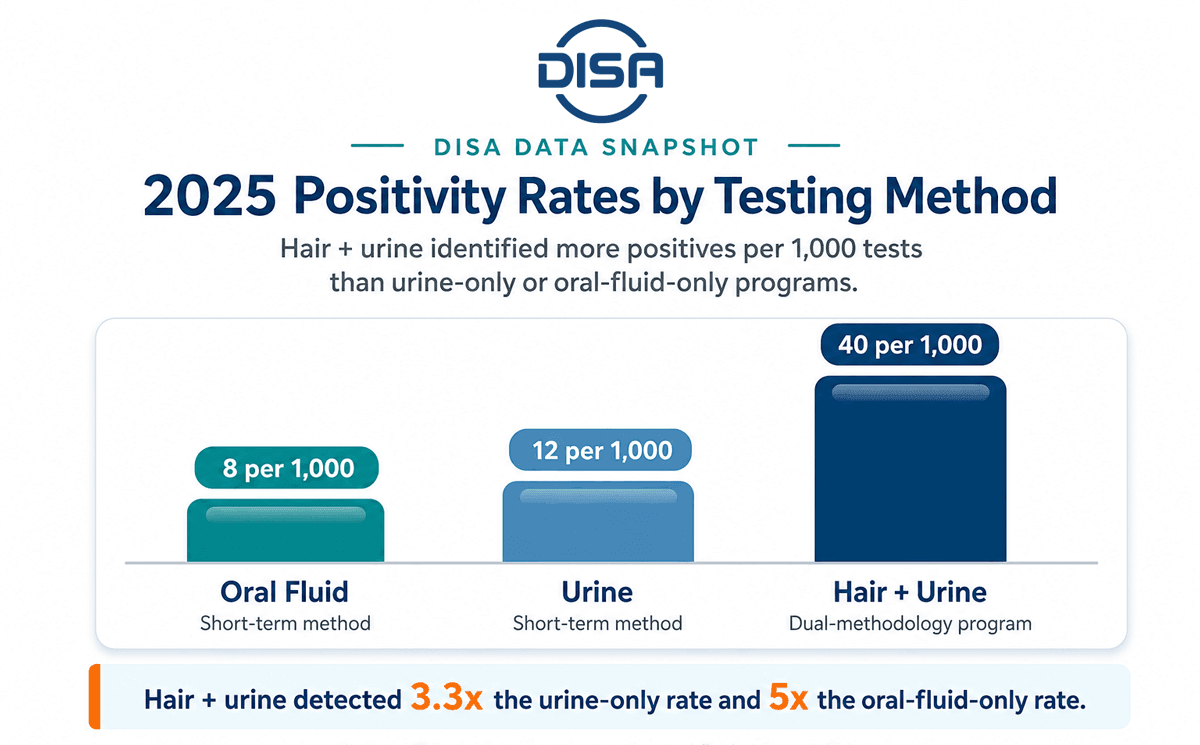
According to recent data from DISA Global Solutions, company drug testing programs that used single-methodology urine testing identified 12 positive tests out of 1,000. Programs that tested only oral fluid identified 8 out of 1,000 positive tests.
In contrast to both, policies that incorporated dual methodologies by using hair plus urine testing identified 40 positives per 1,000 tests. For safety-sensitive workforces, this figure can mean the difference between identifying a potentially higher-risk access decision before site entry or missing substance-use indicators that may be relevant to workplace safety.
In This Article
What DISA’s 2025 positivity rates show
Why hair plus urine identified more positives than urine or oral fluid alone
How drug testing detection windows affect program design
Why hair testing vs urine testing is the wrong either/or question
How dual methodologies support workplace safety drug testing
How dual-methodology testing supports safer hiring decisions
Glossary of Key Terms
Dual-methodology drug testing: A program design that uses both long-term and short-term testing methods, such as hair plus urine.
Hair testing: Drug testing with hair as the collected sample. This testing pattern has the longest window of detection, up to 90 days.
Positivity rate: The percentage of drug tests that identify a positive drug testing result within a set of drug tests.
Safety-sensitive workforce: A workforce where impairment could create serious safety, operational, environmental, or public-risk concerns.
Detection window: The period when a testing method can effectively identify evidence of substance use.
What DISA’s Positivity Rate Data Shows
Across 24 months between 2024 and 2025, dual-methodology programs identified 214% more positives than short-term methodologies alone. The gap also widened over time, from 191% higher positivity in 2023 to 225% higher positivity in 2025 for dual-methodology programs when compared against programs that only use short-term methodologies like urine and oral fluid.
To put the disparity in other terms: Hair plus urine identified more than three times the urine-only rate and five times the oral-fluid-only rate.
The Role of Short-Term Drug Testing Methods
That said, short-term methods still have an important role: Long-term methodologies alone can’t be the sole solution without risking recently impaired workers on-site. In DISA’s review of the last 100,000 workers who completed urine and hair testing on the same day, hair testing alone did not identify approximately one out of every 10 positives that were detected by the short-term methodology.
Additionally, short-term programs include expanded panels that detect drugs not included on a hair testing panel. While the additional substances tested are detected less often, they still create risk and add up to more positives than a recognized threat like opiates.
Short-term testing remains essential for post-accident and reasonable-suspicion testing because of the focus on recent use, contemporaneous safety concerns, and event-specific decision-making.
Lastly, contractors have the greatest workforce mobility by being in a DISA Contractor Consortium urine program. Urine testing is the most common methodology today and helps eligible workers move across DISA’s network of 420+ participating owner sites with less duplicate testing and less delay.
For safety-sensitive employers who are crafting a compliant drug testing program, the question shouldn’t be “hair testing vs urine testing.” The stronger question is how a program can use both methods to reduce blind spots.
Why Dual-Methodology Drug Testing Finds More Risk
Hair testing captures longer-term patterns of use
Hair testing gives employers a longer view of substance-use patterns: In a roughly 90-day behavior-pattern window, hair testing can identify drug use or abuse that may not appear in a shorter-window test.
That time period helps catch potential workers who try to use temporary abstinence to avoid detection on a short-term test. They may attempt to stay off drugs for a week to fool a short-term urine or oral fluid test, but their attempts do not erase a longer historical record in hair.
Short-term methodologies help identify recent or infrequent use
Urine and oral fluid testing, however, remain important because some use patterns are recent, infrequent, or tied to specific events. Oral fluid testing is often discussed for recent-use scenarios, including post-accident or reasonable-suspicion testing, while urine continues to be widely used in many workplace programs.
Why one method alone leaves blind spots
The best workplace safety drug testing programs should consider what each method can and cannot see. Hair supports long-term drug detection. Urine and oral fluid support short-term drug detection and a wider panel. Together, they provide broader coverage than either method can provide alone.
Drug by Drug Comparison
The 2025 substance-level findings show why detection windows in drug testing matter. Compared with urine, hair identified positives at
1.5x the urine rate for marijuana;
9x the urine rate for cocaine;
3.4x the urine rate for amphetamines; and
5x the urine rate for opioids.
Different substances behave differently across different testing methods, and a specific program design can affect what an employer can detect. Therefore, safety-sensitive hiring companies should keep an eye on substance-use trends and adjust their drug programs accordingly.
Download the Full 2026 Whitepaper
DISA’s positivity rate data shows that hair and urine drug testing can identify more risk than short-term testing alone. A single-method program can leave gaps, even when that method is valuable.
Download DISA Global Solutions' full Dual Methodology Whitepaper to see the complete analysis of dual-methodology testing in safety-sensitive workforces, including the full methodology, substance-level comparisons, deterrence findings, and implementation considerations.
Why This Matters in Safety-Sensitive Workforces
In safety-sensitive environments, drug testing positivity rates can affect site access, contractor readiness, incident risk, and daily operations. Substance use and its impacts can negatively affect workers and workplaces, while recovery-ready workplace policies can support productivity, reduce healthcare costs, reduce turnover-related costs, and reduce exposure to substance-related accidents.
Why Leading Programs Use Dual Methodologies Instead of a Single Test
A short-term method asks, “What can we detect from recent or infrequent use?” A long-term method asks, “What can we detect from a broader pattern of use?” Neither acts to the exclusion of the other, and both questions need to be answered.
That false dichotomy is why employers should not treat “which drug testing methodology” as a simple either or decision. Industry-leading companies with a focus on safety use both long-term and short-term methodologies to increase safety for their employees and facilities.
Frequently Asked Questions
In 2025, oral fluid identified 8 positives per 1,000 tests, urine identified 12 per 1,000, and hair plus urine identified 40 per 1,000.
Hair and urine drug testing identified more positives because the methods cover different timeframes. Hair provides long-term drug detection, while urine helps identify shorter-term use.
DISA’s data and the industry best practices support a “both” approach. Hair testing vs urine testing is too narrow because each method answers a different safety question.
DISA’s 2023 annual stats showed 1.25% all-test positivity for DISA’s Contractor Consortium urine testing, 0.50% for DISA’s Contractor Consortium oral fluid testing, and 3.24% for DISA’s Contractor Consortium hair testing. The 2025 data continues to show that long-term methods detect materially more positives than short-term-only methods.
In 2025, hair was 9x as effective for cocaine, 5x for opioids, 3.4x for amphetamines, and 1.5x for marijuana compared with urine.
Safety-sensitive workforces often operate around heavy equipment, hazardous materials, transportation systems, energy assets, and complex jobsite environments. Broader detection can help employers and facility owners make more informed safety decisions.
How DISA Can Help
At DISA Global Solutions, we support employers and facility owners with drug and alcohol testing, multiple testing methodologies, contractor consortium drug testing, post-accident and reasonable-suspicion testing, reporting, integrations, and program support. We help safety-sensitive organizations build drug testing programs that combine long-term visibility with recent-use detection, reduce blind spots, and support safer access decisions.
DISA Global Solutions aims to provide accurate and informative content for educational purposes only and does not constitute legal advice. The reader retains full responsibility for the use of the information contained herein. Always consult with a professional or legal expert.
Mia Hicks
Manager of Risk and Compliance
DISA Global Solutions
Mia Hicks is the Manager of Risk and Compliance at DISA Global Solutions, where she expertly leverages her extensive background in operations management and quality assurance to uphold the highest standards of compliance and risk mitigation.
This insightful wrap-up highlights significant changes, growing trends, and best practices that employers can find helpful in the employment screening and safet...
Learn the essential signs of substance abuse in the workplace and how to implement reasonable suspicion drug testing. Ensure compliance and maintain a safe work...






 June 26, 2026
 6
min read
6
min read