In this article
-
Why staffing firms keep buying speed.
-
The difference between database results and verified records.
-
How hidden costs emerge through rework, duplicate screening, and candidate fallout.
-
The impact of verifications on the true hiring timeline.
-
Compliance obligations that remain regardless of report speed.
-
Actionable strategies to balance speed, accuracy, and compliance.
-
A glossary of key terms and a helpful FAQ section.
Staffing agencies operate in a highly competitive environment where the first firm to submit a qualified candidate often wins the placement; this immense pressure can make instant background checks look incredibly appealing. After all, recruiters need candidates cleared and ready to work as quickly as possible, and any delay in the hiring background check process can mean losing a top-tier candidate to another agency or missing out on client revenue.
However, viewing speed as the sole buying criterion frequently masks downstream financial leaks.
Clients hire staffing firms to solve their immediate labor shortages, rewarding agencies that can deploy workers quickly, while simultaneously expecting workplace safety and candidate quality. If an expedited employment background check misses a crucial detail because it relied entirely on a surface-level database, then your staffing firm will assume the reputational and financial liability.
What are “Instant” Background Checks?
Database-first results versus verified record research
When a vendor advertises an "instant" result, they are typically running a “database-first search.” These aggregated databases collect millions of records from various jurisdictions, which allows software to scan them in seconds.
However, these repositories are not always updated in real-time, and they do not reflect the nuanced, up-to-the-minute data found directly at a county courthouse. Verified record research involves going to the primary source to confirm the details, which naturally takes more time but provides a much more reliable picture.
What background check results return instantly
Certain components of a pre-employment background check genuinely lend themselves to rapid results. For example, national criminal database scans, sex offender registry checks, and certain identity verification pings can return information almost immediately (though federal vetting databases often suffer from backlogs and delays).
What still requires verification, adjudication, or follow-up
The complication arises when a database search returns a potential "hit": for instance, when a name appears in a criminal background check. At this point, the initial speed of the report becomes irrelevant, because ethical and legal standards dictate that the record needs to be verified at the source. If a county court clerk needs to physically pull a file to confirm a case outcome, the staffing firm must wait.
Instant Background Checks vs Verified Background Screening
Instant Database Check vs. Verified Background Check
Data table
| Criteria |
Instant Database Check |
Verified Background Check |
|
Speed
|
Seconds to minutes for initial results
|
Hours to days depending on jurisdiction and scope
|
|
Accuracy
|
Lower, prone to outdated or partial records and same-name matches
|
Higher, based on primary source verification at courts or institutions
|
|
Compliance Risk
|
Higher, requires follow-up to meet FCRA and EEOC standards
|
Lower, supports defensible hiring decisions with verified data
|
|
Cost Over Time
|
Appears low upfront but increases due to rework, disputes, and duplicate screening
|
Higher upfront cost but reduces rework, disputes, and long-term risk
|
Where the Hidden Costs Show Up for Staffing Firms
Incorrect matches, same-name matches, and recruiter rework
Databases frequently match records based on partial identifiers, such as a first and last name without an accompanying social security number. This limitation sometimes leads to same-name matches, where a candidate is flagged for a record belonging to someone else entirely.
When matches like these happen, recruiters are forced to halt the onboarding process, inform the candidate, and wait while the individual disputes the incorrect match. This resulting rework drastically undercuts the initial speed advantage of the instant background screening for staffing companies.
Duplicate background screening costs
Many staffing firms run a basic, rapid package to get candidates into their general talent pool. However, specific clients (such as those in safety-sensitive industries) often have much more stringent requirements.
For instance: if a hospital client mandates a multi-county search and a federal healthcare sanction check, the agency's initial instant background check is insufficient. The firm must then run (and pay again for) a second, deeper employment screening service, doubling the cost and completely restarting the clock on that candidate's placement.
Candidate drop-off during disputes or follow-up documentation
The longer it takes to resolve an incorrect database flag or gather missing verification documents, the higher the likelihood of candidate fallout. In the modern gig economy, applicants rarely wait around while an agency attempts to untangle a messy, unverified report. If a fast search yields said messy data, the administrative delay needed to correct the errors can often cause the candidate to accept a job elsewhere.
Lost placements and productivity impact
Then, when a candidate falls out of the pipeline due to screening friction, the financial impact cascades. The staffing firm misses the scheduled start date and sacrifices the associated billable hours. Recruiters must pivot away from generating new business to backfill the lost placement. All this duplicated work drains overall productivity and creates a true hidden cost of relying solely on rapid database scans.
Client trust and reputational risk
But the most severe cost of incomplete background checks for employers by far is the erosion of client trust. If an agency places a worker based on a clean instant report, but the client later discovers a disqualifying offense during an annual audit, the relationship between client and agency is instantly compromised. Re-evaluating an active placement disrupts the client's operations and positions the staffing firm as an unreliable partner, potentially jeopardizing the entire contract.
Why Fast Results Do Not Always Mean Fast Hiring
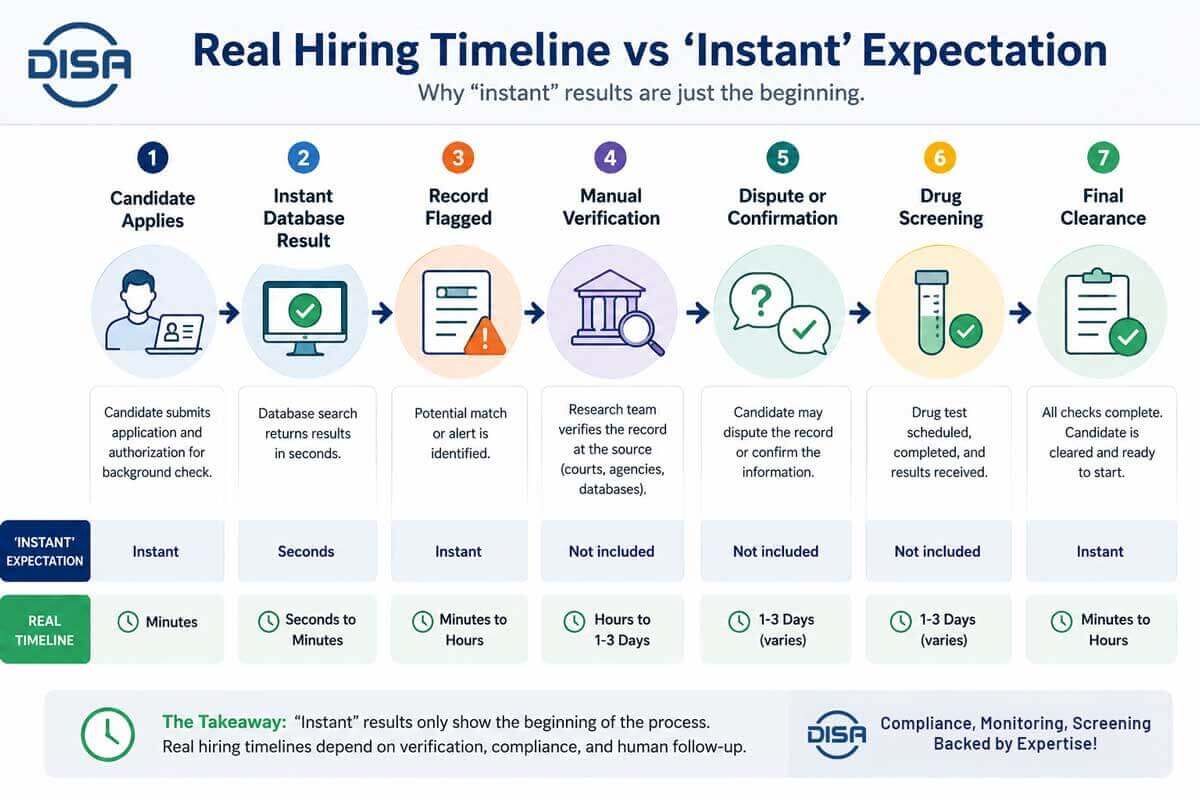
Many staffing firms expect instant results. The actual hiring timeline tells a different story.
Jurisdiction and court access delays
True background check turnaround time is dictated by the depth of the search and the accessibility of the required records, not by the software interface of your vendor. Some jurisdictions have digitized their records, allowing for rapid retrieval; others still rely on clerks manually pulling paper files.
While an initial database ping takes seconds, a comprehensive search of past residences requires a background screener to navigate multiple county court systems.
Employment and education verification timelines
Verifying past employment and educational credentials is a notoriously manual process. While some institutions use automated clearinghouses, many still require a human resources representative or school registrar to physically confirm the details. If a candidate's previous employer is unresponsive or if a university requires specialized consent forms, the hiring timeline extends significantly, regardless of how quickly the criminal database portion was completed.
Compliance Costs Staffing Firms Cannot Ignore
FCRA disclosure and authorization requirements
Faster reports do not remove a staffing firm's legal obligations. According to the Federal Trade Commission (FTC), employers using third-party background reports must provide clear, standalone disclosures and obtain written authorization from the candidate before initiating the check. Skipping or rushing this step in the name of speed invites significant litigation risk, including class-action lawsuits that can cripple a growing agency.
Pre-adverse action and adverse-action process
If an agency decides not to place a candidate based wholly or partly on the results of a consumer report, they must follow the FCRA's strict adverse-action workflow, which requires sending a pre-adverse action notice, providing a copy of the report and a summary of rights, and giving the candidate a reasonable amount of time to dispute the findings. An instant background check might flag an issue in seconds, but the legally mandated dispute period means the final hiring decision cannot be ethically or legally rushed.
EEOC and fair-hiring considerations
The Equal Employment Opportunity Commission (EEOC) actively enforces guidelines to ensure background checks do not create unlawful disparate impact. Blanket policies that deny employment based on any criminal record, without considering the nature of the offense, the time elapsed, and the nature of the specific job, invite significant regulatory scrutiny and litigation risk.
Fast, automated adjudication systems that reject candidates without individualized assessment expose staffing firms to significant regulatory scrutiny.
Why defensibility matters in high-volume staffing
As a general statement of policy, regulatory bodies have recently emphasized that third-party background dossiers and algorithmic scores remain subject to federal laws. And in high-volume staffing environments, the sheer number of applicants amplifies compliance risks.
Defensibility (the ability to prove that a hiring decision was based on accurate, verified data and followed all legal protocols) matters far more than shaving a few hours off the initial report delivery.
How Staffing Firms Can Speed Up Background Checks Without Risk
Use role-based screening packages
Rather than applying a one-size-fits-all instant check, staffing firms should consider designing screening packages tailored to the specific risk level of the role. A warehouse worker may only require a standard county criminal search, whereas a financial services contractor requires deep credit checks and extensive employment verification.
Align agency packages with client requirements upfront
The most effective way to eliminate duplicate screening costs is to meticulously map your agency's screening packages to your clients' specific Service Level Agreements (SLAs). Before a candidate is submitted for a specific requisition, the recruiter should already know exactly what depth of background screening the client will ultimately demand. This proactive alignment prevents the painful scenario of having to run a second, more expensive check just days before the scheduled start date.
Combine speed with verified criminal and identity checks
You do not have to choose strictly between speed and accuracy. The best approach involves layering fast database checks with targeted, primary-source verification. Use instant identity verification to confirm the candidate is who they say they are, use database scans to identify potential jurisdictions of interest, and then immediately dispatch researchers to verify those specific court records.
Create a clean dispute and escalation process before volume spikes
Disputes and incorrect database matches are inevitable when processing thousands of applicants. Staffing firms should establish a clear, documented escalation path for candidates who need to correct their records. A dedicated team or a specialized vendor partner can help handle these inquiries and resolve disputes quickly and compliantly, minimizing candidate drop-off during peak hiring seasons.
What to Ask a Background Screening Partner Before You Buy
How do you reduce incorrect matches?
Do not simply ask how fast a vendor is; ask what mechanisms they have in place to prevent same-name matches. A reliable partner will explain their matching criteria, detailing how they cross-reference names with dates of birth, social security numbers, and address histories before reporting a record.
What sources are verified and what is database-derived?
Demand transparency regarding the source of the data. Your vendor should clearly delineate which portions of their employment background check are pulled from aggregated databases and which are verified directly at the county or state level.
How do you handle disputes and corrections?
Investigate the vendor's candidate experience. Ask how they guide applicants through the dispute process when a record is contested. A partner that takes ownership of candidate communication reduces the administrative burden on your recruiting staff.
How do you support staffing firms with different client packages?
Finally, ensure the vendor's platform is flexible enough to accommodate multiple, client-specific screening matrices. You need a partner that makes it easy to switch from your agency's default package to a highly specific client package without generating duplicate candidate profiles.
How DISA Global Solutions and Bullhorn Can Help
At DISA Global Solutions, we understand the complexities of managing compliance and safety in the staffing and recruiting industry. DISA’s comprehensive staffing background screening solutions are designed to support your agency in its journey toward full regulatory compliance, accurate placements, and operational efficiency.
To further streamline your operations, DISA integrates directly with Bullhorn to bring these critical compliance processes right into your existing Applicant Tracking System (ATS). This partnership allows recruiters to coordinate pre-employment background checks and Form I-9 verifications from a single, unified dashboard. Candidates benefit from a secure, mobile-optimized portal where they can quickly authorize screens and review their rights, reducing candidate drop-off; recruiters, meanwhile, gain real-time visibility into report statuses and can even initiate the adverse action process without ever leaving the Bullhorn platform.
With DISA's comprehensive support and Bullhorn's automation, you can confidently navigate the complexities of talent management and protect your business from risk. Contact us today to learn more about how we can help your staffing firm achieve compliance and operational excellence.
FAQ: Instant Background Checks for Staffing Firms
Generally, no. While instant database checks are a helpful starting point, they often lack the depth and verification required by end-clients. Relying solely on fast searches can lead to inaccurate matches, compliance risks, and the need for duplicate screening later in the hiring process.
Turnaround time is heavily influenced by the specific jurisdictions being searched, as some county courts require manual record retrieval by clerks. Additionally, processes like employment verification and education history rely on the responsiveness of third parties, which naturally extends the timeline.
Different industries carry different risk profiles and regulatory demands. A client in the healthcare or financial sector may be legally required to audit contractors more thoroughly than an agency's default screening package allows, forcing a secondary round of deeper verifications.
Glossary of Key Terms
- Adjudication: The process of reviewing a background screening report against a company’s hiring criteria to determine if a candidate is eligible for employment.
- Database Search: An automated query of aggregated public records, which can return results rapidly but may lack updated or complete information.
- Disparate Impact: Employment practices that adversely affect one group of people of a protected characteristic more than another, even if the rules are formally neutral.
- FCRA (Fair Credit Reporting Act): The federal law regulating the collection, dissemination, and use of consumer information, including background checks for employment.
- Primary Source Verification: The process of checking records directly at the source, such as a county courthouse or an educational institution, to ensure accuracy and completeness.





 May 29, 2026
 12
min read
12
min read