Glossary of Terms
-
Substance Use Disorder (SUD): A medical condition defined by the ongoing use of a substance despite negative consequences.
-
Presenteeism: The act of an employee remaining physically present at work while experiencing diminished capacity or impairment, leading to decreased productivity.
-
Reasonable Suspicion Drug Testing: Testing initiated when trained supervisors document specific, observable signs of potential employee impairment.
-
Recovery-Ready Workplace: A supportive organizational environment that destigmatizes substance use disorders and encourages treatment and retention.
In This Article
-
Glossary of Key Terms
-
Why Substance Abuse in the Workplace Is a Business Issue
-
The True Cost of Substance Abuse in the Workplace
-
Workplace Substance Abuse Statistics (2024)
-
Why Employer Drug Testing Still Matters
-
Recovery-Ready Workplace Practices Reduce Risk
-
FAQ
-
How DISA Can Help
For safety-sensitive employers, workplace substance abuse in the workplace has real financial and operational consequences. According to the CDC, 30.1 million employed U.S. adults experienced a substance use disorder (SUD) in 2022, and the National Safety Council (NSC) estimates that untreated SUD costs employers an average of $8,255 per affected worker each year.
Why Substance Abuse in the Workplace Is a Business Issue
Substance abuse significantly drains overall profitability and introduces measurable employee substance use costs that impact multiple areas of the business. But the implications stretch far beyond individual health outcomes.
Drug abuse affects productivity, absenteeism, turnover, and safety
Substance abuse in the workplace drives lost productivity, absenteeism, turnover, and safety risk, as each of these factors exacts a hidden tax on a company’s budget. When employees struggle with substance use disorders that go unaddressed by workplace drug testing programs, their daily output diminishes, while their likelihood of missing shifts unexpectedly increases. Consequently, employers face mounting pressure to cover these gaps, project delays, strained resources, constant employee churn, and preventable accidents.
Why this matters beyond HR
While human resources departments handle the immediate challenges, the broader financial impacts of substance abuse can creep up the corporate ladder: High rates of substance misuse elevate organizational liability exposure, with compliance complications that can stretch into legal and financial territories.
The True Cost of Substance Abuse in the Workplace
The costs of workplace substance abuse are rarely categorized as a single line item; rather, the effects are distributed across various departmental budgets, which makes them difficult to track.
Lost productivity and presenteeism
Diminished daily performance represents one of the most subtle yet pervasive employee substance use costs in the workplace. When individuals arrive at work impaired or experiencing withdrawal, their focus and cognitive capabilities suffer.
This state, called “presenteeism,” means the employer is paying full wages for a fraction of the typical output. Employees working at a reduced capacity make more errors, require more supervisory oversight, and frequently lower the morale of surrounding team members who are forced to compensate for the lag in productivity.
Unscheduled leave and absenteeism
The more familiar absenteeism, on the other hand, creates immediate scheduling conflicts and overtime costs.
The typical worker misses 15 days per year; conversely, workers with substance use disorders miss 24.6 days per year. In addition, workers with SUDs take nearly 50% more unscheduled leave than other workers.
This unreliability forces employers to rely on temporary staffing or push existing employees to work overtime, which often results in premium pay rates and accelerated burnout.
Turnover and replacement cost
Retaining talent is a major priority for modern organizations, but untreated substance use sans robust employee screening solutions can disrupt this stability. Workers with SUDs have an annual turnover rate 44% higher than the workforce as a whole, while replacing a worker costs about 21% of that employee’s annual salary and benefits.
Accidents, liability, and downtime
And, of course, SUDs can lead to catastrophic, costly accidents: When impairment leads to an injury, the company faces immediate medical costs, potential workers' compensation claims, equipment repair expenses, and halted operations.
The CDC reported that unintentional overdose from nonmedical drug use resulted in 388 worker deaths in 2020, an increase of nearly 500% from 2012.
Workplace Substance Abuse Statistics (2024)
These workplace substance abuse statistics underscore the challenge of substance abuse in the workplace and the growing need for compliance-driven screening programs, which can help organizations make objective, data-driven decisions regarding their drug policies.
How many employed adults are affected
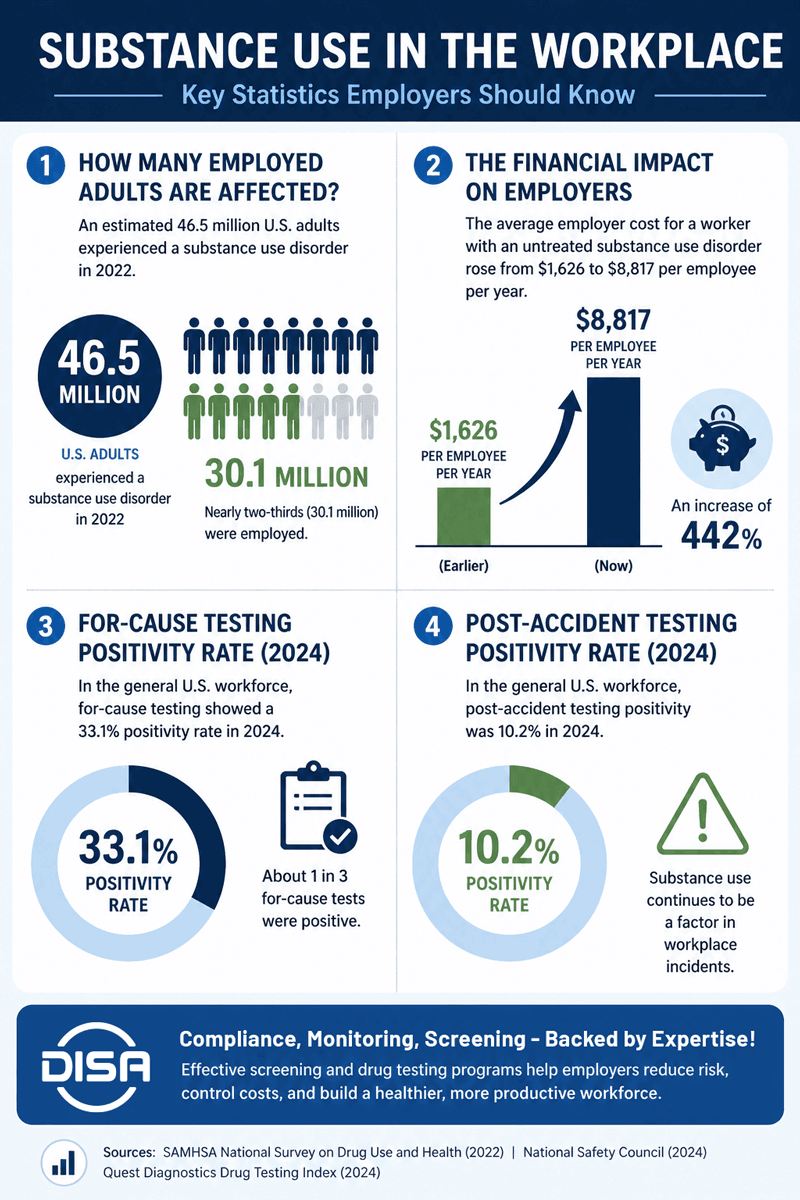
- An estimated 46.5 million U.S. adults experienced a substance use disorder in 2022, and nearly two-thirds of them, or 30.1 million people, were employed.
- The average employer cost for a worker with an untreated substance use disorder rose from $1,626 to $8,817 per employee per year.
- In the general U.S. workforce, for-cause testing showed a 33.1% positivity rate in 2024.
- Furthermore, in the general U.S. workforce, post-accident testing positivity was 10.2% in 2024.
Employers can reduce substance abuse in the workplace by implementing proactive workplace drug testing programs and clear policies.
Why Employer Drug Testing Still Matters
A robust workplace drug testing policy establishes the foundation for corporate safety and compliance; these following types of employer drug testing can deter on-the-job substance use and protect the broader workforce from the hazards associated with impairment.
- Pre-employment drug screening: Pre-employment drug screening can help employers make informed hiring or placement decisions when conducted in accordance with applicable law, employer policy, and any industry-specific requirements.
- Random drug test: Random drug testing involves selecting existing employees without advance notice to undergo substance screening at varying intervals. This unannounced approach functions as a continuous deterrent against impairment, encouraging personnel to remain compliant year-round.
- Reasonable suspicion drug testing: When trained supervisors observe clear signs of impairment, reasonable suspicion drug testing can help employers intervene before an active safety threat escalates into an accident.
- Post-accident drug testing: Post-accident testing can support an employer’s incident review process by helping determine whether substance use may have been present in connection with a workplace event.
Recovery-Ready Workplace Practices Reduce Risk
Addressing substance abuse in the workplace does not solely mean catching drug use; it also means supporting employees recovering from SUDs through structured policies and employee screening solutions.
Organizations that support rehabilitation actively reclaim their investments in human capital. A 2020 report found that the cost savings from retaining workers in recovery rose to more than $8,500 on average, and that workers in recovery miss 10.9 days per year, which is less than the typical worker.
Frequently Asked Questions
According to the National Safety Council, an untreated disorder costs employers an average of $8,255 per employee annually.
Yes. Workplace drug testing programs reduce workplace safety risk by identifying substance use early, reinforcing compliance, and lowering absenteeism and accident rates.
Reasonable suspicion testing is a targeted screening initiated only when trained supervisors observe and document specific, contemporaneous physical or behavioral signs of impairment.
Post-accident drug testing should be conducted immediately after a workplace incident to determine whether substance use contributed to the event and to support compliance requirements. Employers should consider utilizing it immediately following a significant workplace incident to determine whether substance misuse contributed to the accident.
How DISA Can Help
Workplace drug and alcohol testing requirements vary by employer policy, industry, jurisdiction, and applicable federal or state regulations. DOT-regulated testing must be conducted in accordance with the applicable DOT agency rules and 49 CFR Part 40. Non-DOT testing is governed by employer policy, contract requirements, and applicable law.
DISA supports employers with comprehensive workplace drug testing programs designed to reduce substance abuse in the workplace and improve safety outcomes. Our services include pre-employment screening, random testing, reasonable suspicion testing, and post-accident testing to help organizations maintain compliance and minimize workplace safety risk.
We provide scalable employee screening solutions that enable employers to identify risk early, reduce absenteeism, and improve workforce reliability across safety-sensitive industries.
With DISA's comprehensive support, you can confidently navigate the complexities of workforce management and protect your business from liability. Contact us today to learn more about how we can help your organization achieve compliance and operational excellence.






 June 08, 2026
 5
min read
5
min read