Employers regulated by the Department of Transportation (DOT), collection sites, and service agents have a new version of the Federal Drug Testing Custody and Control Form to know about.
The revised 2026 Federal Custody and Control Form, also called the 2026 Federal CCF, became effective on April 27, 2026. It is approved for use through April 30, 2029, and the form can be used on paper or electronically.
For most employers, this does not mean you need to change your drug testing process right away; the main changes are to the layout and wording of the form itself.
Glossary of Key Terms
Federal Drug Testing Custody and Control Form: The official form used to document a DOT drug test collection. It helps track the specimen through the testing process.
CCF: CCF stands for Custody and Control Form. It records collection, handling, and chain-of-custody details.
2026 Federal CCF: The revised Federal CCF that became effective on April 27, 2026. It can be used on paper or electronically.
MFR: MFR stands for memorandum for the record. It is a signed statement used to explain and correct certain paperwork issues.
49 CFR 40.205(b)(2): This is the DOT rule that explains how to correct certain drug testing paperwork problems when the wrong or expired form is used.
Step 1F: Step 1F is a section of the CCF. On the 2026 form, it no longer includes drug analyte checkboxes.
eCCF: An eCCF is an electronic custody and control form. It is a digital version of the paper CCF.
ODAPC: ODAPC stands for the Office of Drug and Alcohol Policy and Compliance. It is the DOT office that provides drug and alcohol testing policy guidance.
What Is the 2026 Federal Drug Testing Custody and Control Form?
The Federal Drug Testing Custody and Control Form is the official form used to document DOT drug test collections.
In what's known as the "chain of custody," the form helps track the specimen from collection through the testing process by showing who handled the specimen, when it was collected, and where it was sent.
The 2026 Federal Drug Testing Custody and Control Form is the newest approved version of this form, replacing the earlier 2023 version.
2026 Federal CCF Changes: Step 1F, Step 4, and Step 5
The 2026 CCF changes are mostly updates to the form’s layout and wording. These updates matter, but they do not change the DOT collection process.
2026 Federal CCF Changes by Form Section
Data table
Form area
2023 CCF
2026 CCF
What employers should do
Step 1F
Drug analytes and checkboxes appeared in the field.
Checkboxes are removed; field reads “Other tests to be performed (specify).”
Train collectors not to enter the DOT testing panel in Step 1F.
Step 4
Split specimen device expiration date appeared in the prior location.
Field moved to the right side of Copy 1.
Review updated form layout during collector training.
Step 5
Separate daytime/evening phone fields and prior DOB placement.
One phone field; birthdate label and placement updated.
Update job aids and QA checks for the revised layout.
A) Step 1F CCF Changes
One of the biggest changes is in Step 1F.
On the 2023 form, Step 1F included drug analytes and checkboxes. On the revised form, those checkboxes have been removed.
The new Step 1F now says:
“Other tests to be performed (specify).”
Collectors should not use this field to identify the DOT drug testing panel (according to DOT, the laboratory will know which panel to use based on the account number on the CCF).
Put simply, collectors do not need to choose or write in the DOT drug testing panel in Step 1F.
B) Step 4 Layout Update
On Copy 1, the field for “Split Specimen Device Expiration Date” has moved to the right side of the form.
This is only a layout change and does not change how collections are done.
C) Step 5 Contact and Formatting Updates
Copies 2 through 5 on the form also have a few updates:
The email address line is longer.
“Daytime Phone No.” and “Evening Phone No.” were replaced with one “Phone No.” field.
“Date of Birth” was changed to “Birthdate” and moved to a new location.
These changes are meant to make the form easier to complete and do not change DOT drug testing rules.
What Did Not Change?
The revised Federal Custody and Control Form does not change DOT collection procedures.
For employers, collectors, and service agents, this means the following:
DOT collection steps remain the same.
Collection requirements remain the same.
The 2023 Federal CCF can still be used during the transition period.
Collectors do not need to identify the DOT testing panel in Step 1F.
Laboratories use the CCF account number to determine the correct testing panel.
Once again, the 2026 Federal CCF is a form update. It is not a major rule change.
2023 Federal CCF Transition Period and MFR Deadline
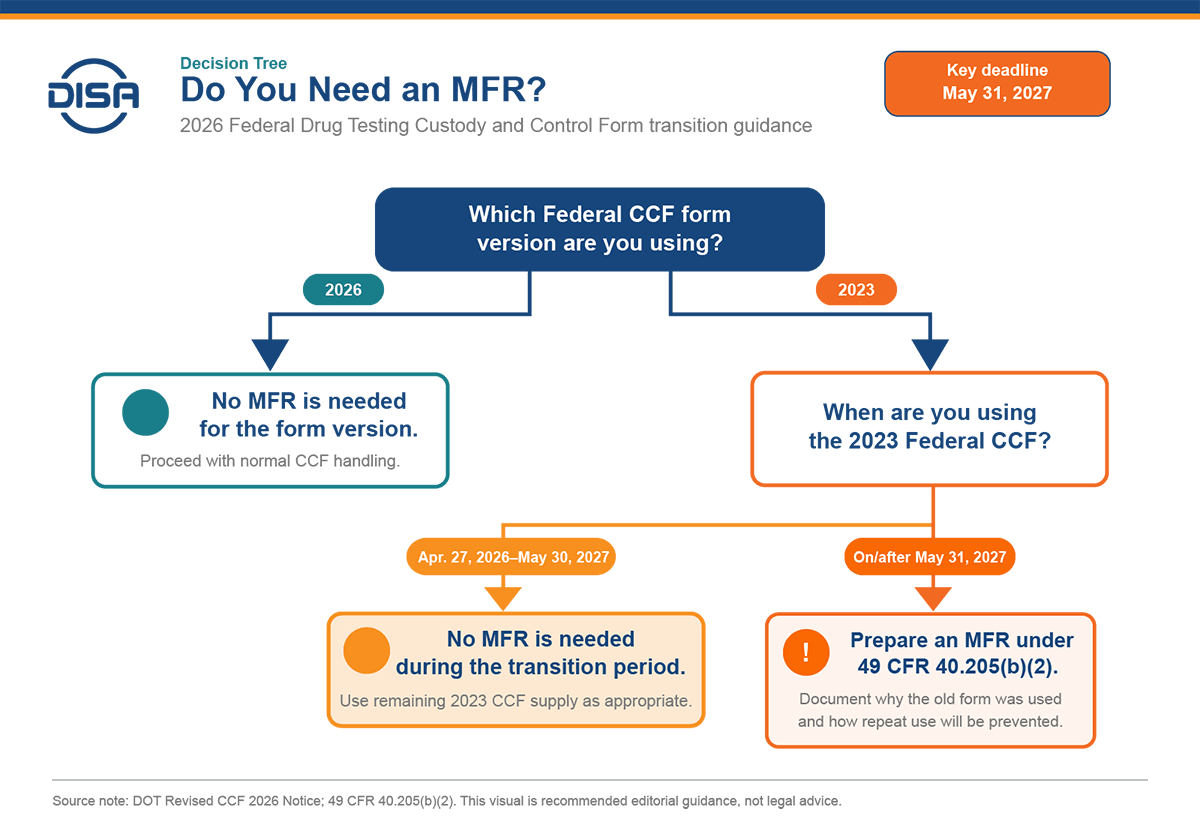
Employers and service agents can still use the 2023 Federal CCF during the transition period from the old form to the new form, which runs from April 27, 2026 through May 30, 2027. During this period, the 2023 Federal CCF can be used without a memorandum for the record (MFR).
Beginning May 31, 2027, use of the 2023 Federal CCF will require an MFR to explain the following:
That the form had the information needed for a valid DOT drug test.
Why the wrong or expired form was used.
What steps were taken to prevent the issue from happening again.
2026 CCF Transition Timeline
April 27, 2026
April 27, 2026-May 30, 2027
May 31, 2027
April 30, 2029
The revised 2026 Federal CCF became effective.
The 2023 Federal CCF can still be used without an MFR.
Using the 2023 Federal CCF requires an MFR.
The 2026 Federal CCF is OMB-approved for use through April 30, 2029, unless HHS/DOT renews, extends, revises, or replaces the form before then.
Collection sites should use this transition period to review their paper form supply, and teams should also work with their laboratories to plan when to switch to the revised form.
2026 CCF Transition Checklist for Employers and Collection Sites
The transition period gives teams time to prepare, so follow these steps before the transition deadline:
1. Review Current CCF Inventory
Collection sites should check how many 2023 Federal CCFs they still have.
If those forms are still valid during the transition period, they do not need to be thrown away; just plan to move to the 2026 Federal CCF before May 31, 2027.
2. Coordinate With Laboratories
Many laboratories help supply or support CCF workflows. Employers and collection sites should work with their lab partners to plan when to start using the revised form.
3. Update Training Materials
Collectors and operations teams should know what changed on the form.
Consider holding training sessions to explain the Step 1F update clearly; specifically, collectors should understand that they do not need to list the DOT drug testing panel in Step 1F.
4. Add the Deadline to Compliance Calendars
The May 31, 2027 deadline should be added to internal calendars, standard operating procedures, and compliance checklists. This bookmark will help teams avoid using the older form after the transition period without the required MFR.
Frequently Asked Questions About the 2026 Federal CCF
It is the revised federal form used to document DOT drug test collections. It became effective on April 27, 2026 and is approved through April 30, 2029.
The 2026 CCF effective date is April 27, 2026.
Yes. Employers can use the 2023 Federal CCF through May 30, 2027 without an MFR.
No. Employers and service agents may use remaining 2023 Federal CCFs during the transition period, but should switch before the MFR deadline.
An MFR is required beginning May 31, 2027 if the 2023 Federal CCF is used.
The revised form removes the drug analyte checkboxes. Step 1F now says “Other tests to be performed (specify).”
No. The collector does not need to identify the DOT testing panel in Step 1F. The laboratory uses the CCF account number to determine the correct panel.
Yes. The 2026 Federal CCF can be used as a paper form or an electronic form.
Collection sites should review their current form inventory, work with laboratories, train collectors on the form changes, and switch before the May 31, 2027 MFR deadline.
How DISA Can Help With 2026 Federal CCF Readiness
The 2026 Federal CCF update is manageable, but employers still need a clear plan.
DISA helps employers manage drug testing programs, support compliance, and improve paper and electronic collection workflows. For clients whose services are regulated by DOT, DISA will ensure that all provided CCFs (paper and electronic) meet part 40 updates.
If you are ready to prepare for the 2026 Federal CCF transition, talk to DISA about DOT drug-testing compliance and CCF readiness.
DISA Global Solutions aims to provide accurate and informative content for educational purposes only and does not constitute legal advice. The reader retains full responsibility for the use of the information contained herein. Always consult with a professional or legal expert.
Lanson Hoopai
Content Analyst II
DISA Global Solutions
Lanson Hoopai brings almost a decade of writing and editing experience to the Content Analyst II role at DISA Global Solutions.
Mia Hicks is the Manager of Risk and Compliance at DISA Global Solutions, where she expertly leverages her extensive background in operations management and quality assurance to uphold the highest standards of compliance and risk mitigation.
Concentra, a partner of DISA Global Solutions, now offers Electronic Custody and Control Form (eCCF) capabilities for DOT drug testing across its network of ove...
The D.C. Circuit ruled the FAA must independently review employer drug test refusals. Here's what aviation employers should do now to stay compliant. ...





 July 13, 2026
 6
min read
6
min read