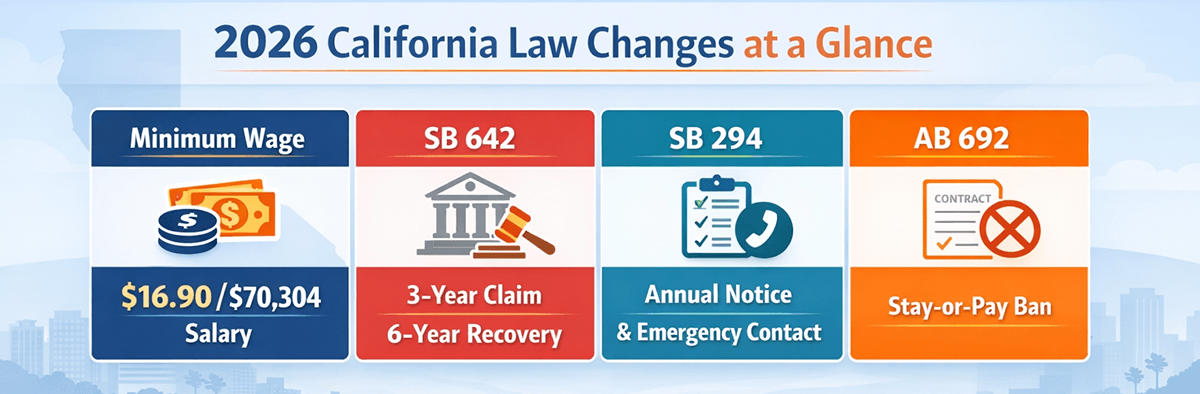
Navigating employment law updates across multiple jurisdictions requires constant vigilance, particularly when managing operations in California; recent legislative updates in the Golden State will significantly impact how organizations need to manage pay practices, workplace protections, and hiring workflows in 2026.
If you oversee teams across state lines, here are some of the most important of these structural shifts to minimize your legal exposure and maintain smooth operations.
In this article
Glossary of Key Terms
Quick summary: The biggest compliance shifts for 2026
Wage & hour updates that may affect payroll, timekeeping, and scheduling
Pay transparency & compensation practices to review before postings go live
Expanded workplace protections and what to update in policies and training
Hiring practice changes (process controls, screening workflow, documentation)
FAQs: effective dates, what to do first, and how changes impact employers
2026 California Employment Law Updates: Key Takeaways
If you need a quick overview of the upcoming changes, here are the primary legislative updates your team needs to address:
1. Minimum Wage and Salary Threshold Increases:
What changed: The state minimum wage increases to $16.90 per hour, raising the minimum exempt salary to $70,304 annually.
Who’s affected: All employers with hourly or salaried exempt staff in the state.
First action step: Audit all current employee salaries against the new minimums and adjust payroll configurations.
2. Expanded Equal Pay Act Enforcement (SB 642):
What changed: Employees can now bring an Equal Pay Act claim up to three years after an unlawful compensation decision occurs, with recovery periods extending up to six years.
Who’s affected: Talent acquisition and compensation teams managing job architectures.
First action step: Document all factors used to justify compensation differences between employees.
3. Expanded Workplace Protections and Notices (SB 294 & AB 406):
What changed: Employers must distribute an annual workplace rights notice by February 1, 2026, and expand sick leave uses for crime victims and jury duty.
Who’s affected: Managers, HR directors, and compliance officers.
First action step: Download the model notices provided by the Labor Commissioner and update your employee handbook.
4. Ban on "Stay-or-Pay" Hiring Practices (AB 692):
What changed: Employers can no longer require workers to repay expenses like relocation or training costs if they leave their employment early.
Who’s affected: Recruiting and onboarding departments utilizing repayment clauses.
First action step: Remove any financial penalty clauses tied to employee separation from your employment contracts.
1. Wage & Hour Updates That Affect Payroll and Scheduling
Tracking wage requirements across multiple jurisdictions is historically challenging, and the newest state mandates made it a bit more expensive: Effective January 1, 2026, the Department of Industrial Relations announced the California minimum wage will increase to $16.90 per hour.
This hourly increase directly impacts the minimum salary required for exempt employees. Under state labor laws, an exempt employee must earn at least twice the state minimum wage for full-time work; consequently, the minimum exempt salary will rise to $70,304 annually starting in 2026.
Keep in mind that the term “wages” has been expanded to include all forms of compensation, meaning employers must now audit disparities in bonuses, stock options, profit sharing, and travel reimbursements, not just base salary.
Action Checklist
Audit current exempt employee salaries against the new $70,304 threshold.
Update local minimum wage rates in your payroll system for specific cities with higher ordinances.
Review tip distribution policies to ensure no deductions are being made for administrative costs (for instance, employers are strictly prohibited from deducting any credit card payment processing fees from an employee's tip).
Verify your timekeeping systems accurately track unrounded meal and rest breaks.
2. Pay Transparency and Compensation Practices (What to Update)
California continues to act as a leader in pay transparency, and enforcement mechanisms are tightening. The passage of SB 642 specifically amends the Equal Pay Act, expanding how far back employees can seek restitution for unfair pay practices.
The Equal Pay Act, as amended, now gives up to three years to bring a claim challenging alleged unlawful compensation practice. The new law also establishes that employees who file a claim within the three-year window can obtain relief for up to six years of violations.
With these new rules in place, employers with workers in California should evaluate their workforce’s total compensation and strictly document the objective reasons (like experience or education) for any pay disparities.
3. Expanded Workplace Protections and Manager Expectations
The newest legislative session placed a heavy emphasis on proactive employee communication and safeguarding vulnerable workers.
As of February 2026, under the Workplace Know Your Rights Act (SB 294), employers must offer employees the opportunity to designate an emergency contact; if the employee is arrested or detained at the worksite, the employer is legally obligated to notify that contact.
These notification requirements do not just apply for worksite arrests; employers must also notify the contact if an off-site arrest occurs during work hours and the employer has "actual knowledge" of it. Violations of these emergency contact provisions carry a compounding penalty of up to $10,000 per employee.
Action Checklist
Download the Labor Commissioner’s model "Know Your Rights" notices, available in multiple languages.
Distribute the annual rights notice to all staff by February 1, 2026.
Establish a system for employees to log designated emergency contacts.
4. Changes to Hiring Law and “Stay-or-Pay” Contracts
The enactment of AB 692 effectively bans most "Stay-or-Pay" contracts: Employers are now prohibited from requiring workers to repay debts (such as training costs or relocation fees) for standard training, if the employee leaves their job before a specified time. However, employers can still require repayment for upfront discretionary payments like relocation assistance and sign-on bonuses under certain circumstances.
If your onboarding materials include these types of repayment agreements, consider removing them immediately to safeguard your organization’s compliance.
Effective January 1, 2026, the state minimum wage increases to $16.90 per hour. Consequently, the minimum salary for exempt employees rises to $70,304 annually.
Under AB 692, employers are legally prohibited from utilizing agreements that require employees to repay expenses like training costs or relocation fees if they resign before a specified date.
SB 294 requires employers to provide an annual written notice of rights to all employees by February 1, 2026. Employers must also allow employees to designate an emergency contact to be notified in the event of a worksite arrest or detention.
SB 642 expanded the statute of limitations for Equal Pay Act claims. Employees can now bring a claim up to three years after an unlawful compensation decision and can recover damages for violations stretching back up to six years.
Yes. Recent legislation (AB 406 and AB 2499) clarifies that employees can use their accrued paid sick leave for jury duty, to comply with a subpoena, or when dealing with the aftermath of being a crime victim.
How DISA Can Help
At DISA Global Solutions, we understand the complexities of managing compliance across multi-state policy management and federal employment regulations. DISA offers seamless integration with major Applicant Tracking Systems (ATS) and Human Resources Information Systems (HRIS). This consolidated approach enables real-time monitoring and unified reporting, allowing HR leaders to streamline the candidate experience and make informed decisions based on accurate data. We provide the reliable employee background checks you need to optimize your talent acquisition, reduce legal risks, and protect your company's reputation.
Whether you are navigating multi-state remote hiring compliance or auditing your pre-employment screening panels, you can confidently manage the intricacies of your workforce. Contact us today to learn more about how we can help your organization achieve compliance and operational excellence.
Glossary of Key Terms
SB 642 (Equal Pay Act Amendment): A law that expands the statute of limitations for equal pay claims to three years and allows up to six years of recovery.
SB 294 (Workplace Know Your Rights Act): Mandates an annual, written notice of employee rights and requires employers to notify a designated emergency contact if an employee is arrested or detained at work.
AB 692 (Stay-or-Pay Ban): Prohibits employment contracts that in-debt workers by forcing them to repay training costs or relocation expenses upon early resignation.
AB 406 & AB 2499 (Expanded Sick Leave): Clarifies that paid sick leave can be used for jury duty, subpoenas, and situations where an employee or family member is a crime victim.
SB 648 (Gratuity Protection) Empowers the Labor Commissioner to directly investigate and penalize employers who unlawfully withhold employee tips.
DISA Global Solutions aims to provide accurate and informative content for educational purposes only and does not constitute legal advice. The reader retains full responsibility for the use of the information contained herein. Always consult with a professional or legal expert.
Lanson Hoopai
Content Analyst II
DISA Global Solutions
Lanson Hoopai brings almost a decade of writing and editing experience to the Content Analyst II role at DISA Global Solutions.
DISA Global Solutions and OnPay have partnered to connect payroll, HR, workforce screening, and compliance solutions for small and midsize businesses....
Streamline high-volume hiring with automation while staying compliant. Learn how DISA helps balance efficiency and compliance in large-scale recruitment....
Join DISA’s 2027 HR Screening, Safety, & Strategy Conference in Houston on January 14 for expert insights, 24 sessions, networking, and CE credits....





 April 22, 2026
 9
min read
9
min read