In this article
-
Glossary of Key Terms
-
What Are Automated Employment Decision Tools in Hiring?
-
Why State Laws on AI in Hiring Matter for Employers
-
Illinois AI Hiring Law: What Employers Need to Know
-
Colorado AI Hiring Law: How the Colorado Artificial Intelligence Act Affects Employers
-
California AI Hiring Law: Automated Decision Systems and Employment Compliance
-
Texas AI Hiring Law: What Broader AI Governance Means for Employers
-
AI Hiring Laws by State: Key Differences Employers Should Track
-
AI in Hiring Compliance Checklist for Multistate Employers
-
Best Practices for Employers Using AI in Hiring
-
How DISA Can Help Employers Navigate AI Hiring Compliance
-
Frequently Asked Questions About AI Hiring Laws by State
Human resources leaders, compliance managers, and legal teams have a lot to manage as hiring technology changes. Many companies use AI resume screening, AI interview scoring, chatbot screening, and automated candidate ranking to help process job applications faster, but the use of cutting-edge software comes with inherent risks, especially as different states regulate AI automated employment decision tools differently.
What Are Automated Employment Decision Tools in Hiring?
Businesses are always looking for easier ways to hire people, and many use computer programs to help them grade applicants quickly. Automated employment decision tools are a type of software that can scan resumes for keywords, review how people answer questions, or give applicants a score, which can help HR personnel decide who moves forward in the interview process: in short, these tools can have a huge impact on recruiting and employment decisions.
Examples of AI and automated hiring tools employers use
Employers often connect these tools directly to their main hiring software to handle large numbers of job applications. Some common examples include the following:
- chat programs that ask candidates basic screening questions
- software that reads and ranks resumes
- video systems that grade a person's facial expressions or voice
Some companies also use game-like tests that check a candidate's problem-solving skills to guess how well they will do the job.
Why employers need to understand AI in hiring compliance
When a computer program scores a job applicant, that automation can directly change that person's chance of getting hired.
Consequently, though computers can make the hiring process much faster, it also means fewer humans are looking at the applications early on. If the computer program learns from bad data or small data sample, it might automatically reject highly qualified people or engage in discriminatory practices... which can break different local laws and trigger audits, penalties, and even lawsuits, to varying degrees depending on the state in question.
Why State Laws on AI in Hiring Matter for Employers
States are not regulating AI in hiring the same way: A hiring process that is perfectly legal in one state might get your company in trouble in another state.
Some states have enacted specific requirements, some apply broader anti-discrimination rules to employment, and some are still just proposing new ideas.
Here are a few of the most notable AI state laws that single- and multi-state employers should know.
Data table
| Jurisdiction |
Law or rule |
Effective date |
Covered tools |
Employer action |
|
Illinois
|
Artificial Intelligence Video Interview Act
|
January 1, 2020
|
AI analysis of applicant-submitted video interviews for Illinois-based positions.
|
Notify applicants before the interview, explain how AI works and what traits it evaluates, get consent before AI evaluation, limit sharing, and delete videos on request.
|
|
Colorado
|
Colorado Artificial Intelligence Act
|
January 1, 2027
|
Covered automated decision-making technologies that materially influence decisions for employment, housing, financial services, insurance, healthcare, or essential government services.
|
Recordkeeping for at least 3 years, notice to consumers, and disclosure to consumers after an adverse decision.
|
|
California
|
Civil Rights Council Employment Regulations Regarding Automated-Decision Systems
|
October 1, 2025
|
Automated-decision systems used in employment decisions, including resume screening, interview scoring, ranking, tests, or other selection tools.
|
Treat discriminatory ADS use as unlawful under FEHA, validate tools, review vendor systems, and retain ADS-related employment records for at least four years.
|
|
Texas
|
Texas Responsible Artificial Intelligence Governance Act, HB 149
|
January 1, 2026
|
AI systems developed or deployed in Texas, including systems with discrimination, biometric, disclosure, and governance risks.
|
Review AI tools for unlawful discrimination, biometric capture risk, transparency requirements, and Texas governance obligations.
|
Sources for table: ILGA, Colorado General Assembly, California Civil Rights Department, and Texas Legislature Online.
Illinois AI Hiring Law: What Employers Need to Know
Illinois was one of the first states to write rules about very specific hiring technology. The state focuses heavily on openness and honesty with job candidates, so instead of making a broad rule for all software, the Illinois Artificial Intelligence Video Interview Act targets a specific type of interview technology.
What the Illinois Artificial Intelligence Video Interview Act covers
The law, which only applies to the interview stage, triggers when an employer asks a person to record a video interview and then uses a computer program to grade how well the person did.
Employers using these video programs in Illinois are expected to meet strict communication rules. The law imposes these expectations on hiring teams in Illinois:
- Giving candidates a written notice that a computer program will grade their video
- Getting the applicant's clear permission before moving forward
- Explaining, in simple terms, how the software works and what traits it looks for.
How Illinois law applies to AI in video interviews
To follow this law, Illinois organizations should consider updating their job websites to show the required warnings and collect the applicant's agreement. Additionally, employers usually cannot share these video interviews with outside people who are not involved in hiring.
Colorado AI Hiring Law: How the Colorado Artificial Intelligence Act Affects Employers
Colorado’s approach, with their AI hiring law, focuses on "automated decision-making technologies (ADMTs) that [are] used to materially influence a consequential decision.”
What counts as a consequential decision in employment
Under the revised Colorado Artificial Intelligence Act (set to take effect on January 1, 2027), a “consequential decision” is an “output, including predictions, recommendations, classifications, rankings, scores, or other information that is used to make, guide, or assist a decision, judgment, or determination concerning an individual.” These outputs, under the law, are related to education, employment, housing, financial or lending services, insurance, health-care services, or essential government services.
How Colorado Defines Automated Decision-Making Technology (ADMT)
In broad terms, ADMT is technology that processes personal data and computes to generate information that materially influences a decision about an individual.
To this end, employers should:
- Assess tools to see what ools qualify as ADMTs
- Have required notices
- Be mindful of post adverse action disclosures
- Monitor Colorado Attorney General rules, which will be designed to provide clarity to obligations under the law.
California AI Hiring Law: Automated Decision Systems and Employment Compliance
California is known for having strong rules to protect workers and their privacy. The California AI hiring law makes it clear that old rules about fairness also apply to new computer programs.
How California regulates automated decision systems in employment
The state recently approved the California Civil Rights Councils’ automated decision system employment regulations. These rules took effect on October 1, 2025; under these laws, if an employer uses a computer program that unfairly filters out protected groups, it is considered illegal discrimination. These California automated decision systems employment guidelines apply to software that reads resumes, grades interviews, or gives tests.
Additionally, the regulations require employers to maintain employment records, including data used by or generated by automated-decision systems, for a minimum of four years.
What California employers should know about AI and anti-discrimination rules
These rules make one thing very clear: employers cannot just blame the software company if something goes wrong. If an outside vendor's program discriminates against people, the employer can still be in trouble under California law.
Texas AI Hiring Law: What Broader AI Governance Means for Employers
While some states write rules just for hiring, others include workplace issues in massive, general technology laws.
Texas’s AI hiring law is part of the latter group, with a wide tech law that affects how businesses operate.
How Texas is approaching artificial intelligence regulation
Texas HB 149 took effect January 1, 2026: the Responsible Artificial Intelligence Governance Act created a broad set of tech rules, focused on keeping data safe, making sure technology is easy to understand, and using computers ethically across many different industries.
AI Hiring Laws by State: Key Differences Employers Should Track
It is a mistake to think all artificial intelligence hiring laws are the same. Multi-state companies, in particular, cannot just make one simple set of rules and expect it to work in every state. Keeping track of these key differences is the only way to build hiring systems that are both fast and legal.
States with hiring-specific AI rules
Some places have written very specific laws just for hiring. For example, Illinois’s Artificial Intelligence Video Interview Act focuses completely on video interviews that use computer grading. Because this rule is so exact, employers have to build special permission steps into their hiring websites just for applicants who live in Illinois.
States applying broader AI or anti-discrimination laws to employment
Other states simply add hiring software to the rules they already have to protect workers. Colorado treats automatic resume graders as high-risk systems under its big tech law, and California uses its existing civil rights rules to cover these new computer programs. These states codified their priority of stopping unfair treatment and expect employers to test their software often.
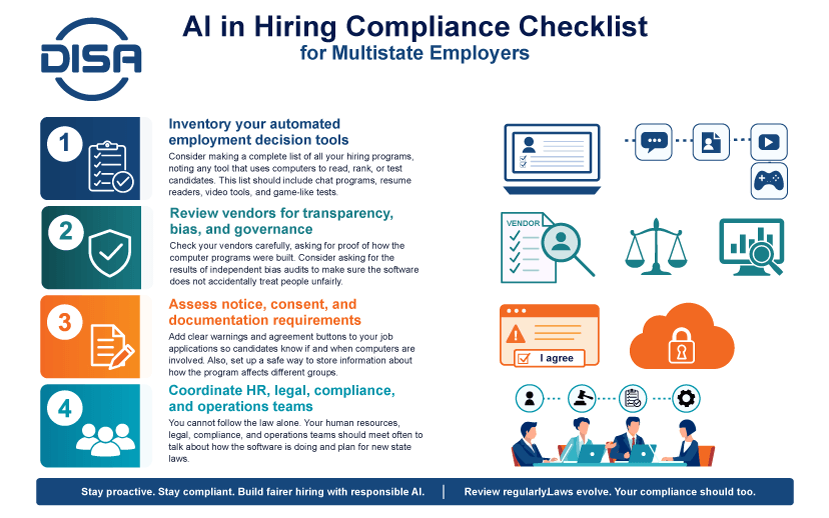
AI in Hiring Compliance Checklist for Multistate Employers
As a starting point to help bring your company into compliance with your specific state’s hiring law, use this AI recruiting compliance checklist.
Consider making a complete list of all your hiring programs, noting any tool that uses computers to read, rank, or test candidates. This list should include chat programs, resume readers, video tools, and game-like tests.
2. Review vendors for transparency, bias, and governance
Check your vendors carefully, asking for proof of how the computer programs were built. Consider asking for the results of independent bias audits to make sure the software does not accidentally treat people unfairly.
3. Assess notice, consent, and documentation requirements
Add clear warnings and agreement buttons to your job applications so candidates know if and when computers are involved. Also, set up a safe way to store information about how the program affects different groups.
4. Coordinate HR, legal, compliance, and operations teams
You cannot follow the law alone. Your human resources, legal, compliance, and operations teams should meet often to talk about how the software is doing and plan for new state laws.
Best Practices for Employers Using AI in Hiring
Following the law is the bare minimum, but using best practices ensures your technology actually helps your business without hurting people. Being careful protects your company's reputation and makes job applicants feel valued.
How to reduce AI discrimination in hiring
Lowering the risk of bias means you have to keep watching the software. Companies should consider regularly checking the backgrounds of the people who get hired to see if any groups are being left out. As a best practice, make sure that human beings still make the final, difficult decisions, so computers do not have total control.
Questions to ask vendors about AI hiring tools
When buying new software, purchasing teams need to ask tough questions.
- Ask the vendor if the computer program was trained using data from many different types of people.
- Ask them to explain exactly how they fix the software if it starts treating people unfairly.
- Ask if their program can easily change its warning messages to match different state laws.
Consider an AI hiring bias audit before you start using a new program across the whole company. As a general guideline, these tests should happen every year, or whenever the software company makes a big update to how the program works.
How DISA Can Help Employers Navigate AI Hiring Compliance
At DISA Global Solutions, we understand the complexities of managing compliance and safety in an evolving regulatory environment, especially with how fast AI systems evolve. DISA’s comprehensive services are designed to support your human resources and operations teams in their journey toward full tech regulatory compliance and operational efficiency. We provide the resources you need to optimize your hiring operations, reduce risks, and improve safety.
With DISA's comprehensive support, you can confidently navigate the complexities of emerging technology, hiring management, and liability protection. Talk with DISA about our compliant hiring, screening, and workforce risk management tools today to learn more about how we can help your organization achieve compliance and operational excellence.
Frequently Asked Questions About AI Hiring Laws by State
No, states are not regulating AI in hiring the same way. Some states have very specific rules for things like video interviews, while others just add hiring to their bigger technology or anti-discrimination laws. Employers should consider building flexible hiring steps to handle these differences.
Automated employment decision tools are computer programs that use special math and algorithms to help humans review, score, or filter job applicants. Common examples include software that reads resumes, tests that check a candidate's personality, and programs that grade interviews.
Several states have taken different actions. Illinois has a rule just for video interviews. Colorado has a law for automated decision-making technology that has a material influence on consequential decisions.. California has approved rules to stop computer programs from discriminating against workers. Texas has passed a broad tech law that covers many areas, including employment oversight.
Before using these programs, multistate employers should consider making a list of all their technology, checking their vendor safety rules, and making sure their job applications have the right warning messages. It is also highly recommended to ask vendors hard questions about fairness and ask for the results of a recent bias audit to lower the risk of discrimination.
Glossary of key terms
- Automated employment decision tools: Computer programs or software that help human resources teams review resumes, test candidates, or make hiring choices.
- Notice and consent: The process of telling a job applicant that a computer program will review their information and obtaining their permission first.
- Bias audit: An independent check of a software program to see if it treats all groups of applicants fairly.





 June 03, 2026
 11
min read
11
min read