What Are Clean Slate Laws and Why Do They Matter for Employers?
How Clean Slate Differs From Ban the Box and Fair Chance Hiring
How Clean Slate Laws Affect Background Checks for Employment
Why Clean Slate Laws Create Compliance Challenges for Employers
Common Employer Screening Policy Gaps in a Clean Slate Environment
How Employers Should Update Background Screening Policies for Clean Slate Laws
What Multi-State Employers Need to Know About Clean Slate Laws
Best Practices for Employers Navigating Clean Slate Laws
Frequently Asked Questions About Clean Slate Laws for Employers
How DISA Can Help
Glossary of key terms
Clean slate laws: State rules that automatically hide or clear certain older criminal records so people can find jobs more easily.
Ban the box: Rules that stop employers from asking about a person's criminal history too early in the hiring process.
Fair chance hiring: Broader rules that require employers to give a fair, thoughtful look at a person's background before saying no to hiring them.
Record sealing: Hiding a criminal record from public view so it usually does not show up on a standard background check.
Expungement: Erasing a criminal record from public view and standard background checks, though state and federal agencies (like the FBI) often retain restricted, confidential copies of expunged records depending on the jurisdiction.
Individualized assessment: Taking a careful look at a person's specific criminal history to see if it actually relates to the job they are applying for.
“Clean slate laws” are expanding across states, which means record access and reportability rules are becoming harder to track. Many employer screening policies were built for an older compliance environment, so employers now need a more adaptive approach to background screening, individualized decision-making, and adverse action.
What Are Clean Slate Laws and Why Do They Matter for Employers?
What clean slate laws are designed to do
Clean slate laws are designed to give people with past criminal records a second chance at employment, by sealing or clearing specific records after they stay out of trouble for a set number of years. For employers, these laws can directly affect background checks for employment and what information is legally reportable.
How clean slate laws affect criminal record visibility
When a state passes a clean slate law, it changes what information background screening companies and the general public can access. In other words, a candidate's old record, which might have appeared on standard background checks a few years ago, may no longer appear today.
Why clean slate laws matter in employment background checks
Clean slate laws matter because they change the basic facts you have when making a hiring decision. For employers, these laws mean that hiring teams cannot rely on outdated ways of looking at records. And if employers fail to update their rules around these new laws, they might accidentally base decisions on information they are no longer legally allowed to see.
How Clean Slate Laws Differs From Ban the Box and Fair Chance Hiring
What is the difference between clean slate and ban the box?
While clean slate laws affect what information shows up on the actual report, “ban the box” laws affect timing. Depending on the state, ban the box laws delay when employers can ask about criminal history, often requiring them to wait until an interview or a conditional job offer.
How fair chance hiring laws affect employer screening policies
Fair chance hiring is a broader idea, and these rules often require a personalized review. Under fair chance hiring rules, employers need to carefully consider if a specific offense is job-related and whether it actually prevents a person from performing the job safely.
Why employers should not treat these laws as the same
Treating clean slate, ban the box, and fair chance hiring as identical creates a lot of confusion. A candidate might have their record cleared under clean slate laws, but you could still break ban the box laws if you ask about their history on the first job application. Each rule changes a different part of the hiring process: what employers see, when they can ask, and how they must evaluate the information they receive.
Data table
Legal Rule
What It Changes
Employer Impact
Clean Slate
Automatically seals or hides certain older criminal records.
Changes what information employers may see on criminal background checks.
Ban the Box
Limits when criminal history questions can be asked.
Changes the timing of hiring and application questions during interviews.
Fair Chance Hiring
Requires a more individualized review of reportable records.
Changes how employers assess criminal history before adverse action.
How Clean Slate Laws Affect Background Checks for Employment
How Record Sealing vs Expungement Changes What Appears on a Report
Record sealing hides a record from public view, while expungement generally removes or clears it from standard public reporting. In practice, record sealing vs expungement can affect what appears on background checks for employment, and employers should not assume the same rules apply in every state.
Why record access rules can vary by state
Every state writes its own rules about which crimes can be hidden and how long the waiting period is. Therefore, a minor offense that is automatically hidden in one state might still show up completely in a neighboring state.
Why Clean Slate Laws Create Compliance Challenges for Employers
State-by-state compliance differences
Clean slate laws are operationally difficult for employers because managing different rules across state lines is confusing.
For instance:
Texas does not have an automated Clean Slate law. Instead, Texas’s "Ban the Box" law prohibits public and mid-to-large private employers from asking about criminal history on initial job applications.
California, by contrast, has both Fair Chance hiring laws and an automated Clean Slate law.
Outdated screening criteria and adjudication standards
Many companies use decision guides that were written years ago, with strict rules that automatically (and sometimes illegally) disqualify people for broad categories of offenses.
Inconsistent hiring decisions across locations and teams
If your rules are not clear, a manager in one office might look at a background report differently than a manager in another office, which can lead to unfair and inconsistent hiring choices across the company.
Legal, HR, and operations misalignment
Sometimes the legal team knows about new clean slate laws, but the hiring team does not. When departments are not on the same page, mistakes happen, with sometimes costly consequences.
Common Employer Screening Policy Gaps in a Clean Slate Environment
Screening policies based on outdated criminal history rules
Many employer screening policies were written when all criminal history was easy to see. If you keep using these old rules, you might accidentally turn away good candidates whose records are protected by new laws.
Weak individualized assessment processes
A weak individualized assessment process is a major risk. If an employer does not clearly write down why a specific offense is relevant to a specific job, they might violate fair chance hiring requirements and create inconsistency in adverse action decisions.
Adverse action workflows that need review
Adverse action is the legal process of declining a candidate based on information in a background check. If your company uses generic rejection letters without letting the candidate explain their side of the story, your adverse action process needs a serious review.
Insufficient recruiter and hiring manager training
Rules only work if your team knows how to use them. Without good training, recruiters might ask prohibited questions during interviews and inadvertently violate local ban the box laws.
How Employers Should Update Background Screening Policies for Clean Slate Laws
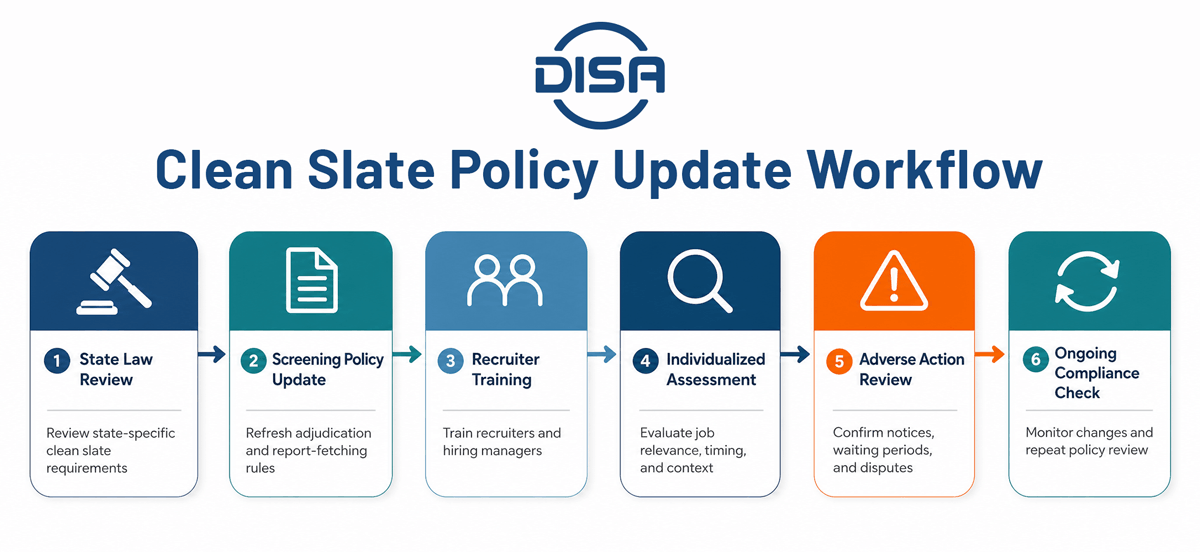
Review screening policies for state-specific requirements
Check your current background screening policy rules to make sure they match the specific clean slate laws in the states where you hire. Update adjudication guidelines and job-related criteria
Refine and tailor your rules so that any crime that disqualifies a person is directly related to the tasks they will perform at work.
Reevaluate individualized assessment and documentation practices
Set up a clear individualized assessment process that considers the age of the offense, how serious it was, the job at issue, and what the person has done since then.
Align adverse action procedures with current compliance expectations
Make sure your process for sending adverse action letters includes all the right warnings, waiting periods, and chances for the candidate to dispute the report before a final decision is made.
Improve cross-functional governance between HR, legal, and screening partners
It is a good idea to schedule regular meetings between your hiring team, your legal advisors, and the company that runs your background checks. This keeps everyone working together smoothly.
What Multi-State Employers Need to Know About Clean Slate Laws
Hiring in multiple states means employers are dealing with a complex mix of reporting, timing, and compliance rules. Multi-state employers should build a highly organized centralized system that can adapt to different state laws without creating inconsistent hiring decisions.
Consider setting one core policy that follows the strictest common rules, while allowing for small changes based on the state.
Best Practices for Employers Navigating Clean Slate Laws
To keep your hiring process running smoothly and legally, here is a practical checklist for updating your policy:
Build a repeatable policy review process: Schedule regular reviews of your background screening policy and compliance workflow to catch legal changes early, and consider using a third-party background check provider to verify your rules.
Train hiring teams on screening policy changes: Teach recruiters and hiring managers how ban the box, fair chance hiring rules, and clean slate laws affect their daily conversations with candidates.
Document decisions, exceptions, and policy ownership: Keep records showing why a decision was made, who approved it, and how the decision aligned with policy.
Frequently Asked Questions About Clean Slate Laws for Employers
Clean slate laws mean employers should adjust to seeing less criminal history, as automatic sealing changes what appears on standard reports.
No. These laws usually only apply to specific, lower-level offenses after the person has stayed out of trouble for a certain number of years. For more details on record clearing, the U.S. Department of Justice provides resources on rehabilitation.
Clean slate laws focus on hiding old public records so you never see them. Ban the box laws focus on when you are allowed to ask a candidate about their past.
Record sealing hides the record from the general public, while expungement completely destroys the record as if the crime never happened.
Yes, employers should consider updating their policies to avoid making decisions based on old rules and to stay in line with new fairness requirements.
Multi-state employers should create a strong central policy that follows the strictest rules, while making small adjustments for specific state laws.
In many cases, sealed records will no longer appear on standard background checks for employment, but the answer depends on state law and the type of record.
No. Clean slate laws vary by state, and employers should review state-specific requirements before updating screening policies.
Employers should review screening policies regularly and whenever state law, fair chance hiring requirements, or adverse action procedures change.
How DISA Can Help
At DISA Global Solutions, we understand the complexities of managing compliance and safety in the hiring industry. DISA’s comprehensive services are designed to support your human resources team in their journey toward full regulatory compliance and operational efficiency. We provide the resources you need to optimize your background screening operations, help reduce compliance risks, and improve your hiring process.
With DISA's comprehensive support, you can confidently navigate the complexities of clean slate laws and protect your business from liability. Contact us today to learn more about how we can help your organization achieve compliance and operational excellence.
DISA Global Solutions aims to provide accurate and informative content for educational purposes only and does not constitute legal advice. The reader retains full responsibility for the use of the information contained herein. Always consult with a professional or legal expert.
Lanson Hoopai
Content Analyst II
DISA Global Solutions
Lanson Hoopai brings almost a decade of writing and editing experience to the Content Analyst II role at DISA Global Solutions.
In today's competitive hiring landscape, ensuring that you onboard the right talent is more important than ever. Background checks are an essential tool in this...





 June 22, 2026
 8
min read
8
min read