New York Credit Check Ban: Employer Compliance Overview
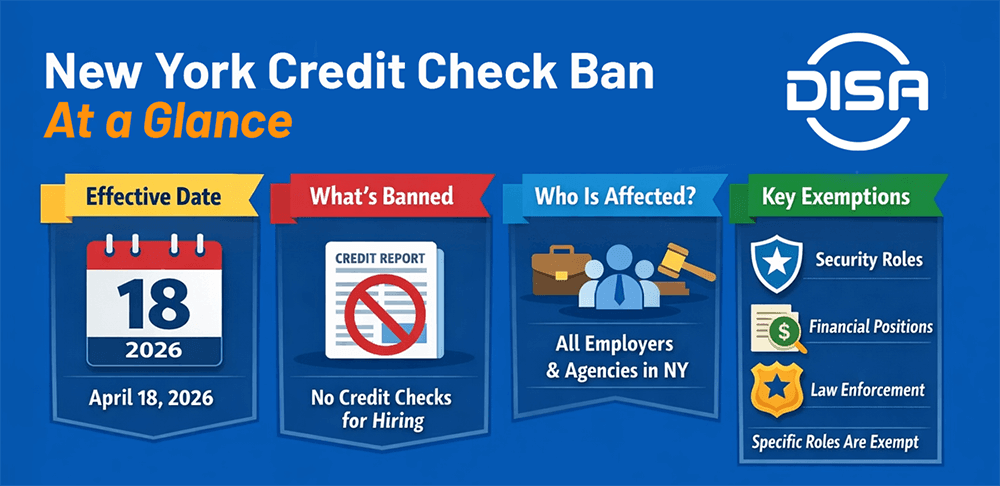
As of April 18, 2026, New York State prohibits employers from requesting or using consumer credit history for employment decisions; this legislative update expands existing workplace protections and fundamentally changes how organizations handle hiring compliance in New York.
Defining Consumer Credit History
The new amendment modifies the New York State Fair Credit Reporting Act (FCRA employment rules), a key component of employment screening laws. Under this updated framework, an employer, labor organization, or employment agency can no longer legally request or use consumer credit history under employment screening laws in numerous employment-related decisions, including
hiring;
compensation; or
the “terms, conditions or privileges of employment.”
The state law broadly defines "consumer credit history" to cover a wide variety of personal financial metrics, such as an individual's creditworthiness, credit standing, credit capacity, or payment history.
Statutory Exemptions for Specific Roles
While the ban is comprehensive, the legislation includes several narrowly tailored exemptions tied to background screening compliance and regulated hiring requirements. Some examples of when a credit check is permissible include the following:
Employers are permitted to use consumer credit history if a state or federal law already requires a credit check for the designated position.
Roles involving a fiduciary responsibility to the employer with the authority to enter financial agreements of $10,000 or more are also exempt from this ban.
Positions that require a federal or state security clearance fall outside the general prohibition.
Exemptions also apply to certain law enforcement jobs and appointed positions subject to background investigation by a state agency. If your workplace employs workers who fall under these exemptions, consider documenting any and all roles that qualify.
Evaluating Third-Party Vendor Partnerships
The state amendment also imposes strict operational limitations on consumer reporting agencies (CRAs). The new law prohibits background screening compliance providers from providing credit history information for employment purposes unless a specific statutory exemption applies to the role in question.
With the April 18, 2026, employers should consider initiating hiring compliance audits of their job applications, candidate offer letters, and interview guidelines to permanently remove financial credit-related inquiries, while ensuring that federally mandated safety background checks remain intact.
If you are an employer, you should also consider training your human resources personnel and hiring managers on the nuances of the new restrictions, which includes HR compliance training and employment policy updates to meet employment law compliance standards.
Glossary of Key Terms
Consumer Credit History: An individual's financial track record, including creditworthiness, credit standing, credit capacity, or payment history, as indicated by a consumer credit report or credit score.
Consumer Reporting Agency: An organization or business that securely compiles and provides consumer credit reports or background screening information to employers.
Fiduciary Responsibility: A legal obligation of one party to act in the best financial interest of another, often involving the management of significant business assets or contractual agreements.
Trade Secret: Confidential business information that provides an enterprise with a distinct competitive edge, typically protected from unauthorized disclosure to the public.
Frequently Asked Questions
The amendment to the New York State Fair Credit Reporting Act officially takes effect on April 18, 2026.
The rule applies to most employers, employment agencies, and labor organizations operating within New York State, though certain job-specific exemptions do exist for highly specialized roles.
Under the new legislation, employers should not ask applicants directly about their personal debts, bankruptcies, judgments, or liens, as this information clearly falls under the restricted definition of consumer credit history.
Yes, the law includes narrow, legally defined exemptions for positions requiring federal security clearances, law enforcement roles, and specific executive positions with signatory authority or fiduciary responsibility over assets of $10,000 or more.
Background screening agencies are prohibited from providing credit history information for employment purposes in New York unless the specific job role explicitly falls under one of the narrow statutory exemptions.
How DISA Can Help
At DISA Global Solutions, we understand the complexities of managing background screening compliance and safety in the hiring process. DISA’s comprehensive services are designed to support human resources teams in their journey toward full regulatory compliance and operational efficiency. We provide the resources you need to optimize your candidate evaluation operations, reduce legal risks, and improve workplace safety.
With DISA's comprehensive support, you can confidently navigate the complexities of employee screening and protect your business from liability. Contact us today to learn more about how we can help your organization achieve compliance and operational excellence.
DISA Global Solutions aims to provide accurate and informative content for educational purposes only and does not constitute legal advice. The reader retains full responsibility for the use of the information contained herein. Always consult with a professional or legal expert.
Eden Hutchinson
Compliance Investigation Manager
DISA Global Solutions
Eden has a strong passion for quality, compliance, and background screening.
Chad Ascar is the Director of Compliance Integration at DISA Global Solutions and holds a Juris Doctorate from the University of Illinois, bringing over 15 years of experience in legal research and service delivery management.
In an insightful session at the Day with DISA 2024 conference, Adam Rosenthal, an Employment Law Partner at Shepard Mullen, delved into the complexities of Cali...
Nevada reported a widespread “network security incident” discovered on Sunday, prompting office closures, website and phone outages, and a staged recovery effor...





 April 29, 2026
 6
min read
6
min read