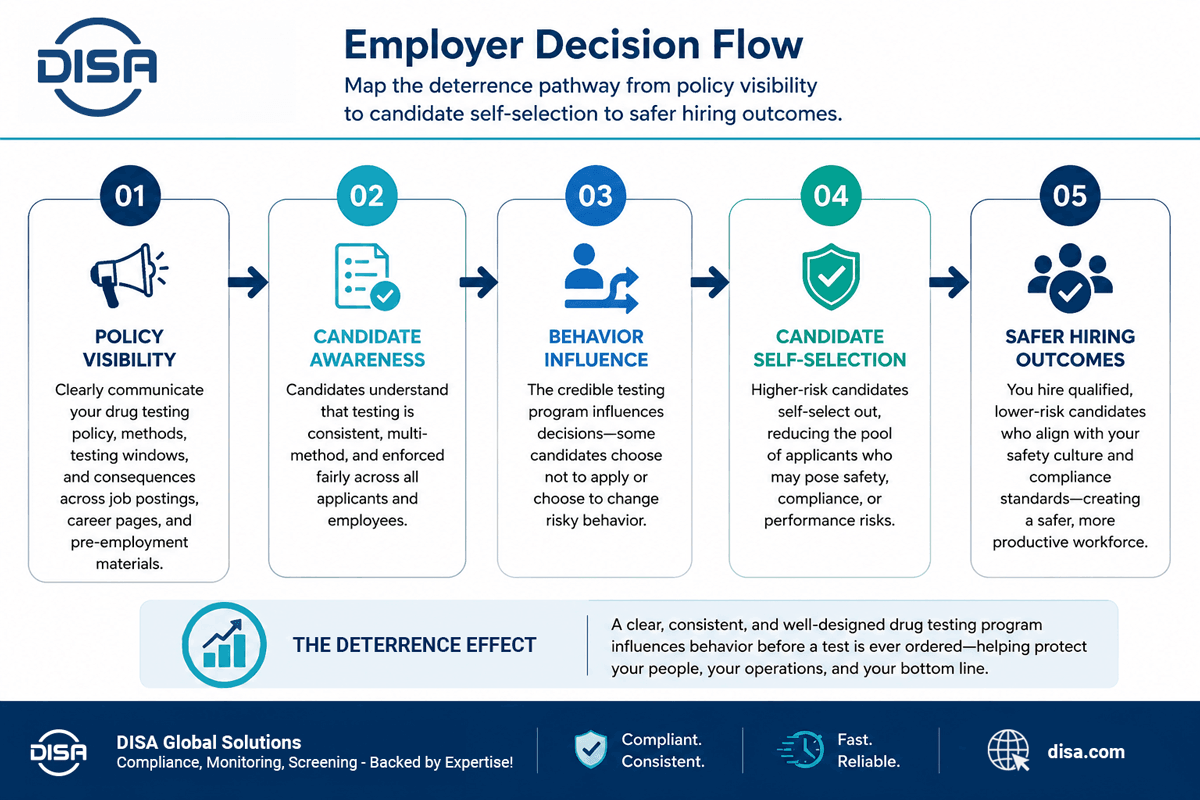
In plain terms, the "deterrence effect" in drug testing is the behavior change that can happen when applicants and workers know a company uses a clear, consistent, and effective screening program.*
For employers building a workplace drug testing policy, the deterrence effect matters because a strong program can influence candidate choices before hiring, before site access, and before a safety incident occurs.
In This Article
This article explains what the deterrence effect is, how it differs from detection, why it matters in safety-sensitive drug testing, how an effective drug testing program can change behavior, and how employers can build deterrence into a comprehensive screening policy.
Glossary of Key Terms
Deterrence effect: The way a visible and consistently enforced drug testing program can discourage risky behavior before it reaches the workplace.
Detection: The process of identifying drug use through a testing method, specimen type, and lab process.
Short-term drug testing: Drug testing and screening methods designed to detect recent drug or alcohol use, typically within the past few minutes up to a few days.
Long-term drug testing: Drug testing and screening methods used to detect ongoing, repetitive, or historical drug use over an extended period (typically several weeks to months).
Dual-methodology drug testing: A program design that uses both long-term and short-term testing methods, such as hair plus urine.
Safety-sensitive workforce: A workforce where impairment could create serious safety, operational, environmental, or public-risk concerns.
What Does the Deterrence Effect in Drug Testing Mean for Employers?
A simple definition employers can use
The deterrence effect is the practical impact of a testing program on behavior. When applicants and workers know a company conducts its drug screens consistently, applies its policy fairly, and uses methods that are harder to plan around, some people may change their behavior or choose not to pursue the role.
For instance, consider a chronically drug-using but otherwise-qualified candidate who accesses your job posting on a job board online. If you operate within safety-sensitive industries, you may also have your drug testing policy and schedule posted publicly (perhaps on the job notice itself), along with consequences for a failed test.
In these instances, the candidate may opt to look elsewhere for a position to save themselves from failing the test; this decision can preemptively reduce the likelihood that policy-prohibited drug use enters your safety-sensitive workforce.
This is the deterrence effect: The test itself matters, but the signal around the test also matters.
A visible, credible drug testing program can influence behavior before a test is ever ordered, helping employers reduce workforce risk earlier in the hiring process.
Deterrence vs. detection: what is the difference?
Detection answers one question: “Did the test identify evidence of drug use under this program’s rules?”
Deterrence answers a different question: “Did the program reduce the chance that higher-risk behavior reaches the workplace in the first place?”
Detection helps employers respond to a result. Deterrence supports workforce risk reduction before the result is even necessary.
Both matter.
How Dual Methodology Drug Testing Strengthens the Deterrence Effect
A stronger, more comprehensive drug testing program that employs dual methodologies (i.e., that uses short-term and long-term methods of testing) likely strengthens the effectiveness of drug testing policies.
Short-term drug testing (such as via urine or oral fluid) helps employer evaluate their job candidates for recent drug use. However, a short-term-only approach creates a narrower screening signal because it focuses on a shorter look-back period.
Long-term drug testing (such as hair testing), on the other hand, provides a longer detection window than urine or oral fluid testing, often up to 90 days. The issue, of course, is that hair testing might fail to capture any recent use that urine or oral fluid would generally detect.
Why dual-methodology drug testing creates a stronger screening signal
The table below shows how urine, hair, and dual-methodology drug testing differ in the screening signal they send to applicants and workers.
Urine vs. Hair vs. Dual-Methodology Drug Testing
Data table
Testing method
Best suited for
Screening signal
Key limitation
Deterrence value
Urine drug testing
More recent use
Short-term signal
Narrower look-back period
Supports deterrence, but a short-term-only approach may be easier to plan around.
Hair drug testing
Longer-term patterns of use
Longer-term signal
May miss very recent use
Expands the look-back period and strengthens the screening signal, but still leaves gaps when used alone.
Oral fluid drug testing
More recent use
Short-term signal
Shortest detection window; often best paired with a longer-window method for broader coverage
Can support deterrence as part of a recent-use screening approach
Dual-methodology drug testing
More recent use plus longer-term patterns
Broader signal across both windows
Requires two testing methods
Creates a broader screening signal, reduces single-method gaps, and can strengthen the deterrence effect.
Dual-methodology drug testing combines two views of risk. Put another way, hair and urine drug testing together can help employers evaluate both longer-term patterns and more recent use, which reduces the gaps that may exist when either method is used alone.
All told, a drug testing program that covers both short-term and long-term detection windows means that more applicants who may not meet policy requirements will likely be screened out during the application process. But the real value of dual-methodology screening comes when employers offer clear applicant notices and policy disclosures consistent with the law.
In these instances, candidates who struggle with drug addiction (and may therefore pose a danger to themselves or others in the workforce) are more likely to self-select out of the selection process, out of a desire to avoid a positive test.
In fact, programs with dual-methodology testing saw 30% lower short-term test positivity vs. programs with only short-term testing, which correlates with a strong deterrent effect when donors know they'll be dual tested.
How Employers Can Build a More Effective Deterrence Strategy
Communicate the policy clearly
A policy cannot influence behavior if people do not understand it. Employers should clearly explain who is covered, when testing may occur, what methods may be used, what substances are included, and what happens after a policy violation.
Enforce the program predictably
Consistency is central to drug testing deterrence. Enforce your drug testing program equally and regularly, to avoid the perception that your program is uncertain or avoidable. Consider random testing to strengthen deterrence, so workers cannot count on temporary abstinence to dodge short-term tests.
Match testing methods to workforce risk
Employers should consider the risks tied to each role, site, and contract before choosing a method. A low-risk office role may not call for the same approach as would a refinery, fleet, mine, or manufacturing site, where one impaired decision can create serious consequences.
Review program design regularly
Testing laws, drug trends, workforce needs, and contract requirements can change. Consider self-auditing your employee drug screening programs on a set schedule and when major business changes occur.
Deterrence Is Part of Prevention
The deterrence effect is not a separate test; rather, it's the intended, beneficial result of a clear, consistent, and well-designed program. When applicants and workers understand that a company takes screening seriously, the program can influence behavior before a positive result, a hiring decision, or an incident.
FAQs
The deterrence effect is the behavioral change that can occur when applicants and workers know that an employer uses a visible and consistently enforced drug testing program. It can discourage risky behavior before it reaches the workplace.
The effect works by making the testing policy well-communicated and credible. When people know testing may occur and understand the methods used, the program can influence decisions before a test is ever ordered.
Programs are often more deterrent when they are visible, predictably enforced, and harder to plan around. Testing methodology also matters because different methods have different detection windows.
Hair and urine drug testing can support each other because hair testing generally offers a longer look-back period, while urine testing is commonly used to evaluate more recent use. Together, they create a broader screening signal.
No. Deterrence supports prevention, but it does not replace legal, regulatory, contract, or site-specific compliance requirements. Employers should review applicable rules before changing a policy.
How DISA Can Help
At DISA Global Solutions, we help employers design and manage drug testing programs that support safer, more consistent workforce decisions. DISA’s drug testing solutions include multiple testing methodologies, random pool management, online scheduling, tracking, reporting, chain-of-custody support, MRO services, and compliance resources for DOT and non-DOT programs. DISA also provides guidance on types of drug tests, policy support, supervisor training, and safety-sensitive workforce programs, helping employers align screening strategy with real workplace risk.
With DISA’s comprehensive support, employers can build a practical screening strategy that strengthens prevention, supports workforce risk reduction, and helps protect people, worksites, and operations. Contact DISA to learn how a dual-methodology drug testing strategy can support your safety-sensitive workforce.
* DOT programs must follow 49 CFR Part 40 and applicable modal rules. Dual-methodology strategies may be relevant for non-DOT policies but cannot be described as universally available or compliant for federally regulated tests.
DISA Global Solutions aims to provide accurate and informative content for educational purposes only and does not constitute legal advice. The reader retains full responsibility for the use of the information contained herein. Always consult with a professional or legal expert.
Mia Hicks
Manager of Risk and Compliance
DISA Global Solutions
Mia Hicks is the Manager of Risk and Compliance at DISA Global Solutions, where she expertly leverages her extensive background in operations management and quality assurance to uphold the highest standards of compliance and risk mitigation.
Connecticut legalized recreational cannabis on June 22, 2021, allowing adults 21 and over to possess up to 1.5 ounces starting July 1, 2021, with retail sales e...
Learn the essential signs of substance abuse in the workplace and how to implement reasonable suspicion drug testing. Ensure compliance and maintain a safe work...






 July 08, 2026
 8
min read
8
min read