Why FMCSA Driver Qualification File Violations Matter in 2026
Violation #1: Missing or Expired Medical Certificates
Violation #2: No Valid Operator’s License for the CMV Being Operated
Violation #3: Missing Required CDL Endorsements or Violating License Restrictions
Violation #4: Driving While Disqualified
Violation #5: Failing to Maintain Required Driver Records
Summary Table of Violations
Driver Qualification File Checklist for 2026
Frequently Asked Questions About FMCSA Driver Qualification File Violations
How DISA Can Help
Navigating FMCSA driver qualification file violations in 2026 requires constant vigilance; for employers concerned with Federal Motor Carrier Safety Administration (FMCSA) compliance, one of the most critical aspects of these regulations is keeping and maintaining current driver qualification (DQ) files. The FMCSA uses these files to ensure that applicable operators of commercial motor vehicles (CMVs) are properly licensed, medically fit, and legally permitted to drive, though strict codified exemptions exist for certain farm custom operations, apiarian industries, and pipeline welding trucks. These DQ file compliance risks invite unnecessary enforcement actions, regulatory fines, and heightened operational risks.
Here are some of the most common driver qualification violations that FMCSA employers face, and how to correct them.
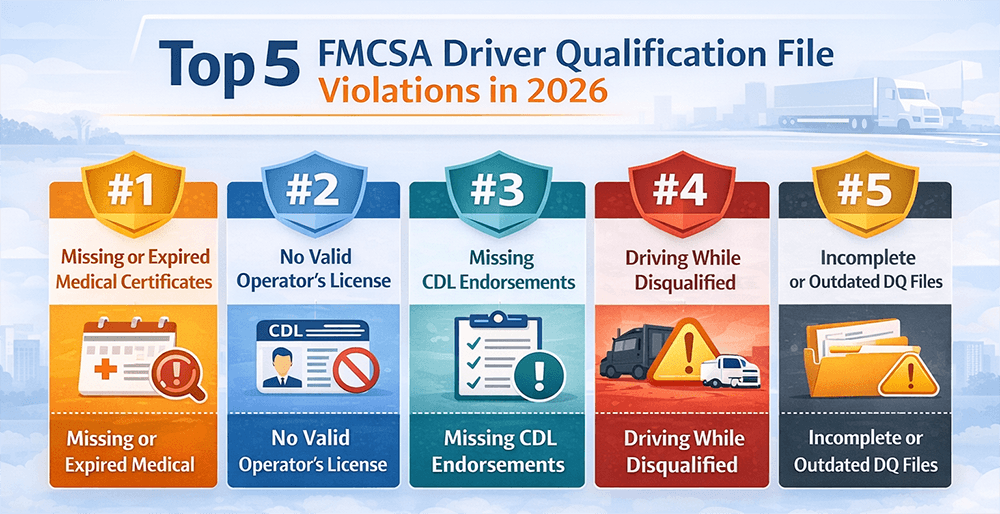
Top FMCSA Driver Qualification File Violations
Missing or expired medical certificates
Invalid or mismatched CDL licenses
Missing endorsements or restriction violations
Driving while disqualified
Incomplete or missing DQ file records
What Is an FMCSA Driver Qualification File?
A driver qualification file is a continuous, chronological record that proves a motor carrier has verified a driver’s eligibility to operate a commercial vehicle safely; these files usually include a documented timeline of an employee's application, medical health, and driving history. The FMCSA’s driver qualification file requirements establish a baseline of driver fitness and to hold carriers accountable for the personnel they put behind the wheel.
What documents belong in a driver qualification file?
Federal regulations outline exact requirements for what these folders must contain, which includes the following:
the initial employment application
initial motor vehicle records (MVRs) from every state where the driver held a license in the past three years
ongoing MVR
ongoing medical certification records to confirm physical fitness
licensing and endorsement documentation for the driver’s specific vehicle classes
annual review-related records, including the yearly MVR pull and the carrier's documented review of the driver's record
Who is responsible for maintaining a driver qualification file?
Maintaining these records is ultimately the responsibility of the motor carrier, regardless of the tools or vendors used to streamline the process. Third-party administrators can provide valuable software and screening services to assist with compliance, but the legal obligation and liability remains firmly with the employing carrier. firmly with the employing carrier.
Why FMCSA Driver Qualification File Violations Matter in 2026
Regulatory enforcement is becoming increasingly data-driven, meaning that missing or expired records are easier for authorities to identify during routine interventions. These records are central to reducing FMCSA audit risks and proving that a company’s drivers are properly licensed, medically fit, and legally permitted to operate commercial motor vehicles (CMVs). Minor clerical oversights can rapidly accumulate, and simple administrative errors can morph into serious compliance liabilities.
How violations can affect audits and enforcement
Incomplete or inaccurate driver files are often the first issues uncovered during a federal or state compliance review. These gaps increase FMCSA audit risks by signaling weak internal controls, which can expand the scope of an audit and lead to additional scrutiny across the organization.
How driver qualification issues can affect CSA and driver fitness risk
The FMCSA utilizes the Compliance, Safety, Accountability (CSA) program to prioritize carriers for intervention, and DQ file gaps directly impact these scores. Violations found during roadside inspections feed directly into a carrier's Driver Fitness Compliance Category: When a carrier accrues Driver Fitness violations, it signals to regulators that the company struggles with foundational safety oversight, increasing the likelihood of targeted compliance audits.
Violation #1: Missing or Expired Medical Certificates
A driver's physical health is central to safe CMV operation, which makes a DOT medical examiner's certificate a cornerstone of the DQ file. Under federal rules, an operator must be medically examined and certified by a professional listed on the National Registry of Certified Medical Examiners. An employer’s failure to secure or update this documentation is one of the most frequently cited compliance failures in the industry.
What counts as a medical certificate violation?
A medical certificate violation occurs whenever a carrier fails to maintain current, valid proof of a driver’s medical fitness. This category includes situations where there is no valid medical certificate on file, which usually indicates that the driver was never properly examined.
This violation could also trigger because of an expired medical examiner certificate, where a previously valid card lapsed without renewal.
Additionally, if the employer does not have the proper documentation available during an audit, they will also incur a violation.
How to prevent medical certificate violations
To eliminate these errors, consider establishing reliable methods to track expiration dates well in advance. Compliance teams should implement standardized reminders, notifying both the driver and the terminal manager at 90, 60, and 30-day intervals before expiration. Fleet safety managers for CDL holders must verify that the driver's medical certification has been electronically transmitted and successfully posted to their Commercial Driver's License Information System (CDLIS) motor vehicle record, which serves as the official proof of certification.
Violation #2: No Valid Operator’s License for the CMV Being Operated
Possessing a generic driver's license can be insufficient: Only federal CDL requirements are nationwide, and each state may additionally require different licensure if the CMV is under outside of CDL requirements. If an employer allows one of their drivers to operate a CMV without the proper state specific license credentials, they breach federal safety protocols.
What makes a CDL invalid for a specific vehicle or role?
CDL compliance violations can involve a class mismatch, such as holding a Class B license while operating a Class A combination vehicle, inactive license statuses, state-issued suspensions for unpaid tickets or child support, or other eligibility issues that revoke a driver’s commercial driving privileges.
How to reduce invalid CDL violations
Preventing these violations requires consistent, recurring verification workflows that track license validity throughout the employee's tenure. Organizations should consider robust MVR monitoring programs that alert management to suspensions or downgrades in near real-time. Employers should also conduct documented reviews of their drivers’ license statuses annually (at a minimum).
Violation #3: Missing Required CDL Endorsements or Violating License Restrictions
A CDL endorsements violation occurs when an individual drives a vehicle that requires special authorization (like a tanker or a vehicle hauling hazardous materials) without having that specific endorsement on their license.
Similarly, restriction violations occur when a driver operates contrary to legal limitations, such as driving a manual transmission CMV when their license restricts them to automatic transmissions only.
Both scenarios represent a regulatory failure on the part of the employer to align the driver's legal qualifications with their daily assignments.
How carriers can verify endorsements and restrictions more effectively
FMCSA organizations should conduct regular, meticulous, role-by-role reviews of their equipment assignments versus their drivers’ credentials, as well as periodic file audits specifically targeted at cross-referencing endorsements with recent dispatch logs.
Violation #4: Driving While Disqualified
Driving while disqualified FMCSA violations occur when an individual operates a commercial vehicle after their privileges have been legally suspended, revoked, or canceled; these suspensions, revocations, or cancellations of CMV driving privileges can result from severe criminal offenses, a positive test for prohibited substances, or a critical mass of serious traffic violations.
By law, a disqualified employee is strictly forbidden from performing safety-sensitive functions, and allowing their workers to operate CMVs regardless is one of the most severe violations that employers can trigger.
How to prevent disqualified-driver issues before they become violations
Prevention relies heavily on proactive status monitoring and robust internal communication; carriers should establish clear internal escalation procedures for when a driver is flagged by the FMCSA Clearinghouse or state MVR systems, to give dispatchers an immediate notification to pull a disqualified driver off the road before a violation can occur.
Violation #5: Failing to Maintain Required Driver Records
The FMCSA explicitly requires an annual inquiry and review of the driving record (MVR).
Under 49 CFR § 391.25, a motor carrier must obtain a motor vehicle record covering the preceding 12 months for each driver at least once every 12 months. Then, the carrier must review this record to verify the driver still meets minimum safe driving requirements.
Crucially, the file must contain a note indicating the date of the review and the name of the person who performed it.
Summary Table of Violations
Data table
Violation Category
What It Is
Risk to Carrier
Prevention Strategy
Missing/Expired Medical Certificates
Driver lacks a current DOT medical card proving physical fitness.
Fines, penalties, liability risk.
Track expiration dates 60 days out; confirm file updates immediately.
Invalid Operator’s License
Driving a CMV with an incorrect class, suspended, or inactive CDL.
Immediate out-of-service orders, severe audit penalties.
Implement continuous MVR monitoring and document annual
Endorsement/Restriction Issues
Operating without required endorsements (e.g., Hazmat) or violating restrictions (e.g., manual transmission).
Utilize internal escalation protocols and strict driver status monitoring.
Failing to Maintain Records
Missing motor vehicle records covering the preceding 12 months.
Compounds other errors, triggers comprehensive compliance reviews.
Standardize file review intervals and assign clear ownership of records.
Driver Qualification File Checklist for 2026
To streamline audit preparedness, fleets should utilize a structured DOT compliance checklist to prepare for FMCSA audits and reduce DQ file violations. Use this checklist to help verify the health of your compliance files:
Verify medical certificate status and log upcoming expiration dates.
Verify CDL validity, ensuring the class matches the assigned vehicle.
Confirm endorsements and restrictions align with current dispatch duties.
Review disqualification status through state MVRs and federal databases.
Confirm the annual MVR review has been completed within the last 12 months.
Ensure required qualification records (applications, past employer checks) are current.
At a minimum, federal regulations mandate an annual review of a driver's record. However, safety managers should consider reviewing these and the other records within the files more frequently, ideally quarterly, to catch upcoming expirations.
Frequently Asked Questions About FMCSA Driver Qualification File Violations
What is required in a driver qualification file?
Among other documents, an FMCSA driver qualification file must contain the driver's application for employment, initial and annual MVRs, certificate of road test (or equivalent), and proof of valid medical certification.
What happens if a DOT medical card expires?
If an expired DOT medical card is not renewed, the driver is no longer physically qualified to operate a commercial motor vehicle. The driver must be removed from safety-sensitive duties immediately until a new, valid medical certificate is obtained and placed in their file.
Can a driver operate a CMV without the right endorsements?
No, a driver cannot legally operate a CMV that requires specific endorsements (such as Hazmat, Tanker, or Double/Triple trailers) unless those endorsements are active and listed on their current commercial driver's license.
What is the difference between a DQ file issue and a CSA driver fitness issue?
A DQ file issue refers to the physical absence or expiration of required paperwork within the carrier's records. Conversely, a CSA driver fitness issue is the resulting penalty applied to the carrier's safety profile when inspectors discover those paperwork violations during interventions.
Glossary of Key Terms
DQ File (Driver Qualification File): A federally mandated recordkeeping requirement that contains specific documents proving a commercial driver is legally and medically qualified to operate a commercial motor vehicle.
FMCSA (Federal Motor Carrier Safety Administration): The primary federal government agency responsible for regulating and providing safety oversight of commercial motor vehicles in the United States.
CDL (Commercial Driver's License): A specialized driver's license required to operate large, heavy, or placarded hazardous material vehicles in commerce.
MVR (Motor Vehicle Record): A comprehensive report detailing a driver's driving history, including violations, suspensions, and license status.
DOT Medical Card: A certificate issued by a certified medical examiner verifying that a driver meets the physical qualification standards to operate a commercial motor vehicle safely.
How DISA Can Help
At DISA Global Solutions, we understand the complexities of managing compliance and safety in the transportation industry. DISA’s comprehensive services are designed to support trucking fleets in their journey toward full regulatory compliance and operational efficiency. We provide the resources you need to optimize your operations, reduce risks, and improve safety. These services can be fed into our electronic Driver Qualification product. That product has compliance evaluation and automated reporting to help keep your company audit ready.
With DISA's comprehensive support, you can confidently navigate the complexities of fleet management and protect your business from liability. Contact us today to learn more about how we can help your fleet achieve compliance and operational excellence.
DISA Global Solutions aims to provide accurate and informative content for educational purposes only and does not constitute legal advice. The reader retains full responsibility for the use of the information contained herein. Always consult with a professional or legal expert.
Lanson Hoopai
Content Analyst II
DISA Global Solutions
Lanson Hoopai brings almost a decade of writing and editing experience to the Content Analyst II role at DISA Global Solutions.
Understand FMCSA English proficiency enforcement, 49 CFR 391.11, roadside inspections, and steps fleets can take to manage driver qualification risk....





 April 28, 2026
 10
min read
10
min read