How the Ames Supreme Court Ruling Changes Title VII Discrimination Claims
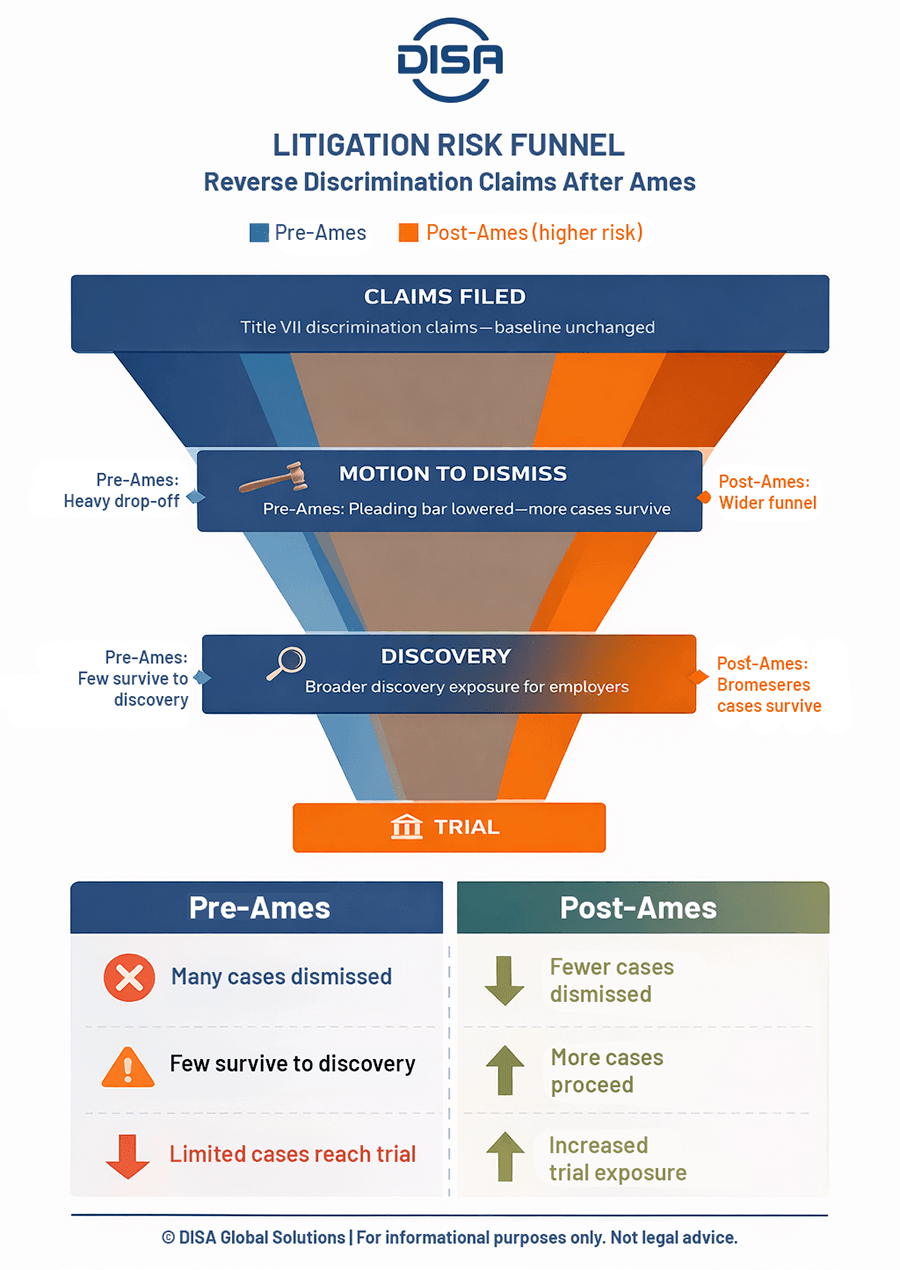
The Supreme Court’s Ames v. Ohio Department of Youth Services decision did not rewrite Title VII... but it did make it harder for employers to dismiss so-called “reverse discrimination” claims. Practically speaking, the ruling will fundamentally impact employment discrimination burden of proof standards in the Sixth, Seventh, Eighth, Tenth, and D.C. Circuits.
Before vs After Ames: How Title VII Discrimination Claims Changed
Data table
Pre-Ames (Before Ruling)
Post-Ames (After Ruling)
⚖️ Background circumstances test required
⚖️ No additional burden
⬆️ Higher burden for majority-group plaintiffs
⚖️ Equal standard under Title VII
🚫 More cases dismissed early
📈 More cases proceed to trial
In This Article
Glossary of Key Terms: Essential definitions for navigating the new legal landscape.
What the Supreme Court Decided in Ames: An overview of the June 2025 ruling and the elimination of the background circumstances test.
What “Reverse Discrimination” Means After Ames: A look at why the term is a misnomer and how the prima facie burden has shifted.
What Employers Need to Know Now: Practical implications for hiring, promotion, and documentation.
Why the EEOC Angle Matters: Understanding the Equal Employment Opportunity Commission’s current enforcement posture.
What the Ruling Does Not Mean: Clarifications on DEI initiatives and plaintiff success rates.
Employer Action Steps: Strategic measures HR and legal teams should consider implementing.
FAQ: Quick answers to common questions about the Supreme Court reverse discrimination ruling.
How DISA Can Help: Resources and solutions for comprehensive compliance.
Glossary of Key Terms
Title VII: A foundational section of the Civil Rights Act of 1964 that prohibits employment discrimination based on race, color, religion, sex, and national origin.
DEI: Stands for “Diversity, Equity, and Inclusion,” a framework designed to promote the fair treatment and full participation of all people, particularly groups historically underrepresented or discriminated against.
Prima Facie: A legal term meaning "at first sight," referring to the initial burden of proof a plaintiff faces to proceed with a discrimination claim.
Ames v. Ohio Department of Youth Services: The U.S. Supreme Court case decided on June 5, 2025, which clarified the standard of proof for majority-group plaintiffs in discrimination lawsuits.
Background Circumstances Test: An extra evidentiary hurdle previously used by some appellate courts that required majority-group plaintiffs to prove unusual circumstances to suggest the employer discriminates against majority ethnic groups.
What Did the Supreme Court Decide in Ames?
On June 5, 2025, the U.S. Supreme Court issued its ruling in Ames v. Ohio Department of Youth Services; in its decision, the Court rejected the extra "background circumstances" hurdle that some lower courts had historically applied to majority-group plaintiffs under Title VII.
The safest framing of the ruling is that the court did not create a new cause of action or eliminate discrimination law categories; rather, it clearly established that Title VII protects every "individual" equally. Furthermore, majority-group plaintiffs no longer face a special prima facie burden in those judicial circuits that had previously imposed one.
The “background circumstances” rule some courts used
Prior to this Supreme Court reverse discrimination ruling, certain regional appellate courts utilized the “background circumstances test,” which required a majority-group plaintiff alleging workplace discrimination to present additional evidence (beyond what a minority-group plaintiff would need to show) to suggest that the employer was engaging in discriminatory behavior against the majority.
The Supreme Court unanimously rejected this extra “background circumstances” requirement applied by some lower courts to majority-group plaintiffs, thereby resolving a circuit split and standardizing the employment discrimination burden of proof.
Why the Court said Title VII protects every individual equally
Title VII prohibits discrimination based on race, color, religion, sex, and national origin. In its decision, the court said Title VII establishes the same protections for every “individual,” without regard to minority or majority status. Because the statutory text of Title VII focuses on the individual employee's rights, the Court found no textual basis in the Civil Rights Act to justify a higher burden of proof for one demographic group over another.
What is Reverse Discrimination Under Title VII?
The term "reverse discrimination" is frequently used in media and corporate discussions; however, in reality, Title VII reverse discrimination is technically just discrimination. In other words, the law does not recognize "reverse" as a separate legal category, just disparate treatment based on protected characteristics.
How the Ames Decision Impacts Employers
Because the background circumstances test has been eliminated, majority group employment discrimination claims will now proceed similarly to any other Title VII claim. Plaintiffs claiming majority group discrimination simply need to meet the traditional initial burden of showing
that the action occurred under circumstances giving rise to an inference of discrimination.
Why that matters in litigation
This shift changes the earliest stages of legal disputes: employers will now find it more difficult to have these cases dismissed at the summary judgment phase. Because plaintiffs no longer have to prove the employer is acting unusually in discriminating against a majority (or, as the court put it, to prove that their employer is the “unusual employer”), more reverse discrimination in the workplace claims will likely proceed to discovery and trial.
Title VII Compliance Risks After Ames
Employers must ensure that workplace discrimination policies and DEI programs do not rely on protected characteristics in employment decisions. Documentation, consistency, and clear business justification are critical to reducing risk.
What the Ruling Does Not Mean
It does not ban lawful DEI efforts categorically
The ruling does not ban lawful DEI efforts categorically; programs focused on expanding applicant pools, mitigating unconscious bias, and fostering an inclusive workplace culture remain legally permissible when executed correctly. The legal risk primarily arises when protected characteristics become a motivating factor in a tangible employment action.
It does not guarantee majority-group plaintiffs will win
Removing the background circumstances test merely allows majority-group plaintiffs to enter the courtroom through the same door as minority-group plaintiffs. It does not guarantee majority-group plaintiffs will win.
It does not replace fact-specific analysis
While the majority opinion did not replace the fact-specific analysis laid out initially in McDonnell Douglas Corp. v. Green, employers should not assume long-term procedural stability. In a concurring opinion, Justices Thomas and Gorsuch explicitly attacked the McDonnell Douglas framework as a 'judge-made' doctrine lacking a textual basis in Title VII, practically inviting future litigation to dismantle the burden-shifting standard entirely. Employers must maintain robust documentation, but should prepare for future appellate challenges to traditional summary judgment defenses.
What Employers Need to Know Now
Employer Action Steps Checklist
Audit hiring and promotion processes for Title VII compliance
Review DEI programs for legal risk
Strengthen documentation practices
Ensure consistency across employment decisions
Hiring and promotion decisions
Employers should review hiring, promotion, discipline, and DEI-related decision-making with the understanding that majority-group plaintiffs no longer face the extra hurdle that some courts had required. Organizations should consider reevaluating their talent acquisition processes to ensure they rely on objective, skills-based criteria, with an emphasis on applying neutral standards consistently.
DEI-related programs and decision-making
Diversity, Equity, and Inclusion (DEI) initiatives remain under intense legal scrutiny. The EEOC’s current DEI-related discrimination materials state that Title VII protections apply equally to all workers and that DEI-related initiatives can create unlawful disparate treatment if they use protected characteristics in employment decisions. Consider reviewing your DEI charters to ensure they promote broad outreach and inclusivity rather than imposing quotas or protected-class preferences in actual selection decisions.
Documentation, consistency, and complaint handling
Consistent documentation is the strongest defense against any discrimination claim. Every adverse employment action should be supported by clear, contemporaneous, and objective business reasoning.
If you use automated Applicant Tracking Systems (ATS) for hiring, you must immediately review how these tools weigh candidate data. For transportation employers, algorithms managing FMCSA safety-qualification filtering must be strictly firewalled from demographic data or DEI-weighted screening. Because the background circumstances test has been eliminated, any intermingling of safety disqualifications and demographic weighting can expose carriers to severe Title VII disparate treatment liability from disqualified majority-group candidates.
Frequently Asked Questions
"Reverse discrimination" is a common, though legally imprecise, term used to describe employment discrimination against members of a majority group (such as white or male employees). Under Title VII, it is simply evaluated as discrimination, as the law protects any individual from disparate treatment based on protected characteristics.
In Ames v. Ohio Department of Youth Services, the Supreme Court unanimously ruled that majority-group plaintiffs do not need to meet a heightened "background circumstances" test to establish a prima facie case of discrimination under Title VII. The Court affirmed that the law's protections apply equally to all individuals.
No. The Supreme Court's decision eliminated the extra hurdle some lower courts had imposed. Majority-group plaintiffs now face the same standard initial burden of proof as any other plaintiff bringing a Title VII discrimination claim.
The ruling underscores the importance of ensuring DEI programs focus on broad inclusion and equal opportunity, rather than using protected characteristics as a factor in specific employment decisions like hiring or promotions. Employers should consider reviewing their DEI materials to ensure compliance with this evenhanded application of the law.
How DISA Can Help
At DISA Global Solutions, we understand the complexities of managing compliance and safety in an evolving legal landscape. DISA helps employers navigate Title VII compliance, build more consistent, background screening and compliance processes; from fair hiring practices to documentation and policy support, DISA can help your team strengthen decision-making in a more complex enforcement environment.
We provide the resources you need to optimize your operations, reduce risks, and improve safety. With DISA's comprehensive support, you can confidently navigate the complexities of talent management and protect your business from liability.
DISA Global Solutions aims to provide accurate and informative content for educational purposes only and does not constitute legal advice. The reader retains full responsibility for the use of the information contained herein. Always consult with a professional or legal expert.
Lanson Hoopai
Content Analyst II
DISA Global Solutions
Lanson Hoopai brings almost a decade of writing and editing experience to the Content Analyst II role at DISA Global Solutions.
When a company's information is trapped in separate departments instead of being shared, this isolation creates what is known as a "data silo"... and it slows e...
As far as compliance and safety is concerned, employees who feel appreciated generally engage more with compliance protocols, report concerns more thoroughly, c...
Join DISA’s 2027 HR Screening, Safety, & Strategy Conference in Houston on January 14 for expert insights, 24 sessions, networking, and CE credits....






 May 01, 2026
 9
min read
9
min read