Many healthcare organizations already perform background screening to evaluate their workforce, which is a good first step. But this ubiquity introduces another issue: whether each employer’s program is consistent, role-based, documented, and ongoing.
Fragmented workflows can easily leave healthcare screening gaps across employees, contractors, and credentialing processes, which can directly impact audit defensibility, compliance exposure, and (most importantly) patient safety.
In this article
A clear definition of healthcare screening gaps.
An explanation of why comprehensive screening is critical for patient safety and organizational compliance.
A detailed breakdown of 8 common healthcare screening gaps.
Actionable steps to build a stronger, more reliable screening program.
Key compliance considerations for healthcare employers.
How integrated services streamline workflows and reduce blind spots.
Glossary of Key Terms
Healthcare background screening: The comprehensive process of evaluating a candidate's or employee's criminal history, credentials, and regulatory standing to ensure they are safe to work in a healthcare setting.
Healthcare screening gaps: Any weakness in a screening program's process, policy, verification, timing, or monitoring that allows relevant risk to be missed
OIG exclusion screening: The process of checking whether an individual or entity is prohibited from participating in federal healthcare programs.
LEIE: The List of Excluded Individuals/Entities, a database maintained by the Department of Health and Human Services (HHS) Office of Inspector General (OIG).
What Are Healthcare Screening Gaps?
A healthcare screening gap is any weakness in process, policy, verification, timing, or monitoring that enables staff to overlook a relevant risk. These weaknesses can occur at any stage of the workforce lifecycle: during the initial candidate evaluation, immediately before hire, or after onboarding.
Several issues can introduce these screening gaps:
“One-size-fits-all" screening approach
Weak or nonexistent policy for re-screening existing staff
Poor contractor oversight
Missing crucial exclusions checks
To maintain a secure and compliant healthcare work environment, employers must identify and fill these gaps.
Why Healthcare Screening Gaps Matter
Healthcare organizations often work closely with vulnerable populations and also operate within highly regulated reimbursement environments; therefore, any workforce decisions may significantly affect patient safety, community trust, and regulatory compliance. Put another way: a gap in a retail setting might lead to inventory loss, but a gap in healthcare can result in direct harm to patients.
8 Healthcare Screening Gaps Employers Should Look For
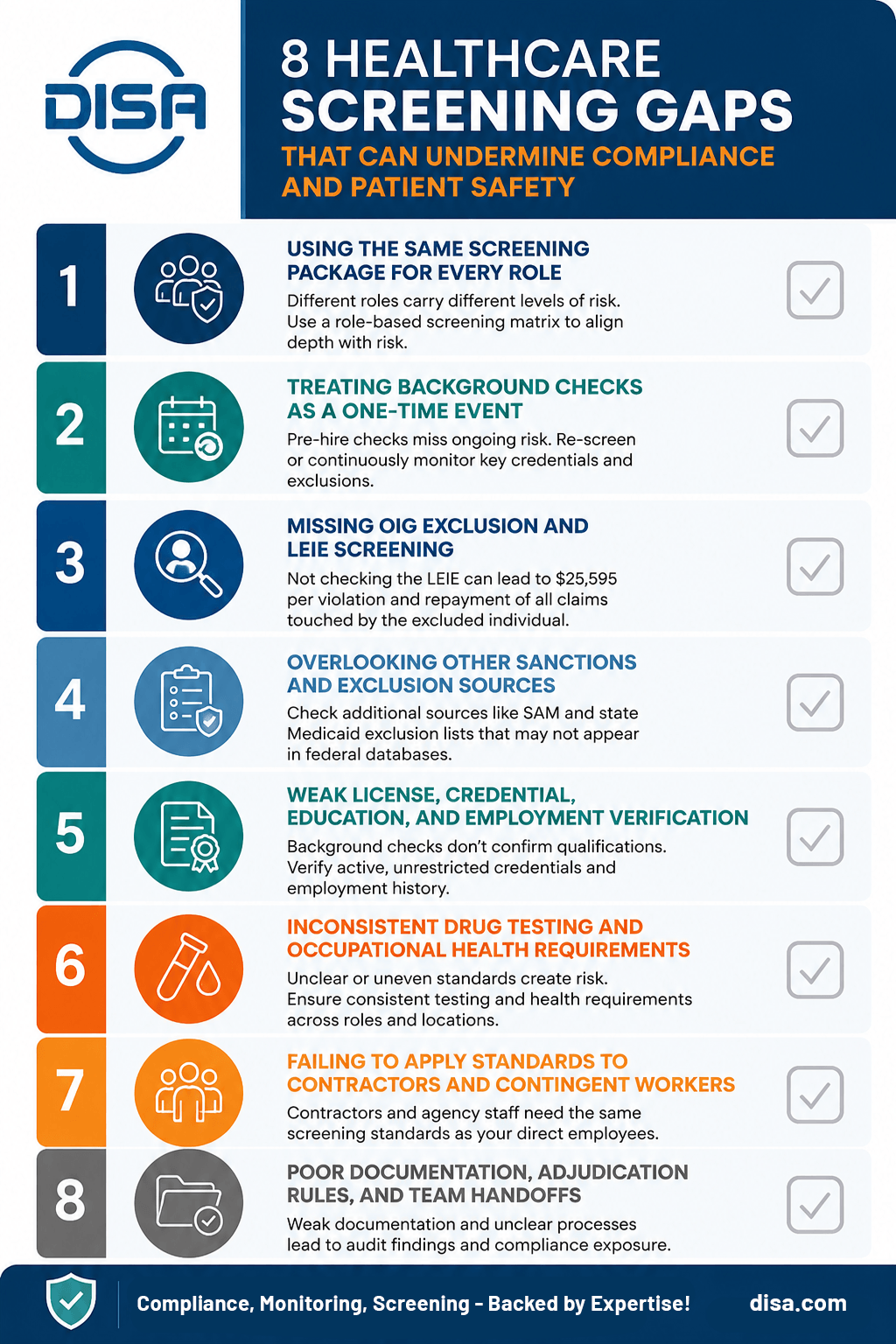
Here are eight specific areas where programs frequently break down.
1. Using the same screening package for every role
Clinical, non-clinical, administrative, licensed, contractor, and support roles present distinctly different levels of risk. For instance, a physician requires a vastly different level of scrutiny compared to an entry-level administrative assistant.
Therefore, a role-based screening matrix is more defensible and efficient than a rigid, one-size-fits-all process. Differentiate your screening protocols across nurses, physicians, billing staff, IT staff with Protected Health Information (PHI) access, transport staff, and agency clinicians. If you tailor your screening depth to the role, you can spend your resources appropriately while accurately capturing the relevant risks.
2. Treating background checks as a one-time event
Pre-hire checks alone may not catch ongoing workforce risk, and a clean background check at the time of hire does not guarantee that an employee will remain in good standing years later. Life changes, and new compliance risks can arise long after onboarding is complete.
Re-screening or continuous monitoring can help reduce blind spots, especially in large or geographically distributed healthcare workforces. Indeed, while Joint Commission standards require verification at the time of hire and when credentials are renewed, updated National Committee for Quality Assurance (NCQA) standards now mandate monthly ongoing monitoring of key credentials and exclusion status.
3. Missing Office of Inspector General (OIG) exclusion and List of Excluded Individuals and Entities (LEIE) screening
The List of Excluded Individuals and Entities (LEIE) is an official database maintained by the U.S. Department of Health and Human Services (HHS) Office of Inspector General (OIG); this list helps healthcare employers identify individuals or entities excluded from participating in federal healthcare programs.
Checking the LEIE is critical because employing an excluded individual can lead to civil monetary penalties of up to $25,595 per violation, alongside total overpayment liability requiring the repayment of all claims touched by the excluded person.
4. Overlooking other sanctions and exclusion sources
While the LEIE is a critical database, it is not the only source a healthcare organization should review. Depending on the specific organization, employers may need to reference the System for Award Management (SAM) and relevant state-level Medicaid exclusion lists, as many state-level exclusions do not automatically or immediately populate from federal databases.
5. Licensure, credential, education, and employment verification
Background screening alone does not confirm an individual's professional qualifications, nor does a clean criminal record equate to a valid medical license or a verified degree. Healthcare applicants need to meet both quality of care and compliance standards.
This is why integrated credentialing, which connects standard criminal checks with healthcare credentialing and screening, matters. Every practicing professional should hold the active, unrestricted credentials required for their specific role, along with confidence that they will act with the best interests of their patients in mind.
6. Inconsistent drug testing and occupational health requirements
Some healthcare organizations require more than criminal and identity checks to ensure a safe environment. Drug testing and occupational health workflows, for instance, may vary significantly by role, physical location, and the safety sensitivity of the position.
Gaps appear when those standards are unclear, inconsistently enforced, or poorly communicated to staff. All testing, regardless of role or location, should meet all minimum organizational policy and relevant regulations to reduce risk.
7. Failing to apply standards to contractors and contingent workers
Healthcare organizations often rely heavily on staffing agencies, external vendors, and contingent clinicians to maintain operational capacity. However, screening standards can easily break down when outside laborers are supervised differently than direct employees.
Organizations should ensure consistency and detailed documentation across all worker categories; temporary nurses or allied health professionals should meet the exact same safety standards as full-time staff members.
8. Poor documentation, adjudication rules, and team handoffs
Even fully completed checks can create risk if subsequent hiring decisions are inconsistent or poorly documented. Human Resources, compliance departments, credentialing staff, and onboarding teams need shared rules, clear audit trails, and visible, transparent workflows.
What A Stronger Healthcare Background Screening Program Should Include
A strong, modern healthcare background screening program should include several core elements to ensure comprehensive coverage:
A role-based screening matrix that aligns criminal background checks directly to specific job risks
A dedicated OIG exclusion screening and LEIE process, supplemented by broader sanctions reviews where appropriate
Thorough license and certification verification, alongside tailored drug testing and occupational health requirement
Contractor policy coverage that aligns with full-time employee requirements
Re-screening or monitoring policies
Documented adjudication procedures
Tight credentialing and onboarding integration
How DISA Can Help
At DISA Global Solutions, we understand the complexities of managing compliance and safety in the healthcare industry. DISA’s comprehensive services are designed to support healthcare employers in their journey toward full regulatory compliance and operational efficiency. We provide the resources you need to optimize your operations, reduce risks, and improve patient safety.
With DISA's comprehensive support, you can confidently navigate the complexities of workforce management and protect your organization from liability. Talk to DISA about building a more consistent healthcare background screening program today.
Frequently Asked Questions
A healthcare screening gap is a weakness in screening scope, timing, verification, or monitoring that can allow relevant risk to go undetected.
A strong program may include role-based background checks, exclusions screening, credential verification, drug testing where appropriate, contractor coverage, and defined re-screening or monitoring practices.
OIG exclusion screening is the process of checking whether an individual or entity appears on the HHS Office of Inspector General’s exclusions list, commonly referenced through the LEIE.
LEIE screening refers to checking the List of Excluded Individuals/Entities maintained by HHS OIG.
Many organizations consider re-screening or continuous monitoring as part of a broader workforce risk strategy, especially for exclusions and other ongoing risk areas.
DISA Global Solutions aims to provide accurate and informative content for educational purposes only and does not constitute legal advice. The reader retains full responsibility for the use of the information contained herein. Always consult with a professional or legal expert.
Lanson Hoopai
Content Analyst II
DISA Global Solutions
Lanson Hoopai brings almost a decade of writing and editing experience to the Content Analyst II role at DISA Global Solutions.
Director of Client and Provider Services and Nurse Practitioner
DISA Global Solutions
Dr. Kim Olszewski is an ANCC board-certified adult nurse practitioner and is a Certified Occupational Health Nurse Specialist and Case Manager from the American Board of Occupational Health Nurses.
As states across the U.S. implement reopening plans, employers are wondering how to phase back into their normal day-to-day operations safely. COVID-19 cases ar...






 June 29, 2026
 7
min read
7
min read