





 May 20, 2026
 9
min read
9
min read



Occupational Health
Employer Health Services for Workplace Safety
Read More...
Celebrating 40 Years of Compliance Leadership
Many employers mistakenly treat personal protective equipment (PPE) like the ultimate safety solution, and it’s true that tools like hard hats, safety glasses, and earplugs are essential. But organizations create hidden risks when they issue PPE without first addressing hazard assessment or higher-order controls; in other words, rather than being the first step, PPE and PPE training is actually the final layer in the comprehensive hierarchy of controls.
To build a robust safety culture, safety managers should consider integrating a formalized control structure as their primary workplace framework, which is then supported (but not co-opted) by rigorous PPE training and thorough fit testing protocols.
PPE is essential for worker safety, but it is unequivocally the last line of defense. Hard hats and ear plugs are heavily reliant on human behavior, requiring correct selection, proper fitting, and consistent wear throughout a shift; if a respirator or a pair of earplugs fails without any other safeguards in place, the worker is immediately exposed to the hazard because there is no remaining barrier between them and the danger.
The concept of the hierarchy of controls is defined simply and visually through five distinct stages: is defined simply and visually through five distinct stages:
The table below shows why higher-order controls should come first and why PPE should be used as the final protective layer.
| Hierarchy of Control | Example | Why It Is More Effective Than PPE |
|---|---|---|
| Elimination | Remove the hazard entirely | Removes the risk at the source so workers are no longer exposed |
| Substitution | Replace a hazardous chemical with a safer one | Reduces the underlying danger before worker exposure occurs |
| Engineering Controls | Ventilation systems, machine guards, acoustic enclosures | Isolates workers from the hazard through physical changes to the environment |
| Administrative Controls | Rotate schedules, limit exposure time, change work procedures | Reduces how often and how long workers are exposed to the hazard |
| PPE | Respirators, hard hats, safety glasses, earplugs | Protects the worker only when it is selected correctly, fitted properly, worn consistently, and maintained over time |
By focusing first on eliminating a hazard or substituting a dangerous chemical for a safer one, the risk is removed entirely. When elimination is not possible, engineering controls (such as installing ventilation systems or acoustic enclosures) physically isolate people from the hazard. If the hazard persists, administrative controls, like rotating worker schedules to reduce exposure times, are implemented. Only after these higher-order strategies have been exhausted should employers lean on PPE to manage the residual risk.
Employers should prioritize this exact order, as the sequence reflects actual effectiveness in risk mitigation.
OSHA requires employers to train workers on exactly when PPE is needed, how to properly wear it, and its inherent limitations. Though OSHA requires that employers provide PPE free of charge to employees, it is not enough to simply hand an employee a piece of equipment; workers need comprehensive personal protective equipment training that covers the specific types of gear required for their tasks.
Furthermore, OSHA expects workers to understand the care, maintenance, and disposal procedures for their equipment.
Merely distributing safety gear is inadequate and creates an illusion of security. For instance, if a company issues equipment without first conducting a thorough hazard assessment, the employer runs the risk of providing the wrong type of protection entirely.
To effectively safeguard a workforce in manufacturing, construction, energy, or transportation, safety leaders should continually verify real-world fit and use long after the gear is issued. Without continuous PPE training and program auditing, equipment can degrade, fit can change, and protective value can be lost, ultimately leaving the worker exposed to preventable harm.
As a matter of both OSHA requirements and safety, fit testing for all respirators must happen before the employee's initial use of the equipment. Furthermore, an updated respirator fit testing procedure is necessary whenever the make, model, style, or size of the facepiece changes.
Before any fit testing can occur or an employee can be required to wear a respirator in the workplace, they must undergo a formal medical evaluation to determine if they are physiologically capable of wearing the device (with the exception of filtering facepiece respirators, such as N95 masks, and loose-fitting powered air-purifying respirators). A physician or other licensed health care professional conducts this review to issue workplace respirator clearance, and only after this medical evaluation phase is successfully completed can an organization proceed with ensuring the physical seal through fit testing.
All environment, health, and safety (EHS) directors and managers must understand the difference between “qualitative” and “quantitative” fit tests.
Occupational hearing loss is a pervasive, yet entirely preventable, workplace hazard. A common misconception among employers is that the labeled noise reduction rating (NRR) on protective equipment equates to the actual acoustic protection every worker receives on the floor.
In reality, the labeled NRR is derived from highly controlled laboratory settings and frequently overstates real-world hearing protection. Because individual ear canal shapes and insertion techniques vary drastically, the real-world attenuation often falls short of the package rating, which can leave workers exposed to damaging noise levels despite wearing their issued gear.
A proactive hearing conservation program is heavily regulated and requires multiple integrated components to be effective. OSHA mandates several core elements to prevent acoustic trauma:
While OSHA does not directly require hearing protector fit testing under the current federal noise standard, it does specifically note that fit testing is a highly valuable training tool and an industry best practice for verifying protector adequacy.
Taking safety a step further, the National Institute for Occupational Safety and Health (NIOSH) NIOSH now recommends individual quantitative fit testing for hearing protection devices to combat occupational hearing loss more effectively.
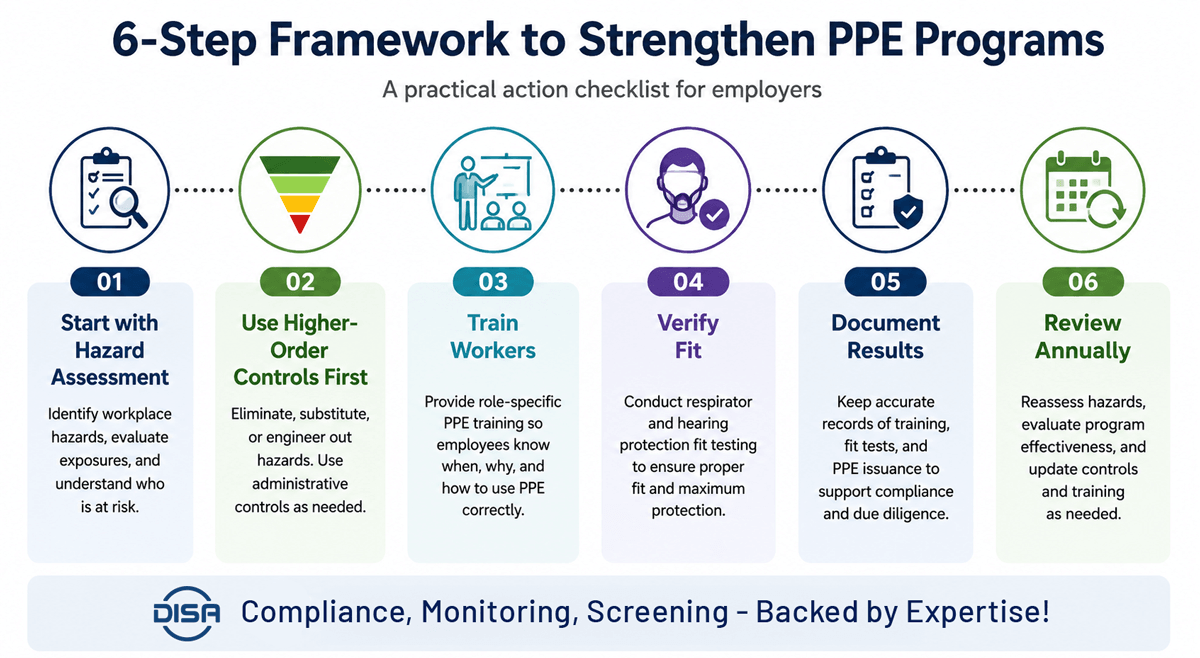
Transitioning from safety theory to active execution requires an actionable checklist. Operations leaders can utilize the following framework to close compliance gaps.
Before purchasing any equipment, conduct a detailed hazard assessment to understand the exact nature, severity, and duration of your workplace’s risks. When you identify the specific environmental dangers, you can make data-driven decisions rather than reactive purchases.
Always apply higher-order controls first. Attempt to eliminate the hazard, substitute materials, or deploy engineering controls, like better ventilation or machinery guarding. When those options are exhausted, apply administrative controls to minimize employee exposure time before finally implementing PPE.
When protective gear is ultimately deployed, ensure rigorous PPE training requirements are met. Train workers on limitations and usage, then actively verify fit through standardized respirator fit testing or hearing protection fit testing. Document all medical clearances and test results meticulously to reduce compliance risk. Finally, revisit the program annually, or whenever operational processes change, to verify the effectiveness of your established controls.
No, personal protective equipment is essential, but it is only the last line of defense. Safer programs use elimination, substitution, engineering controls, and administrative controls before relying on PPE as the final protective layer.
Fit testing applies to all tight-fitting facepiece respirators and must happen before the employee's initial use of the equipment. It is also required when the make, model, style, or size of the facepiece changes, and at least annually thereafter.
No, OSHA does not directly require hearing protector fit testing under the federal noise standard. However, OSHA treats it as a highly valuable training tool and a best practice. Furthermore, NIOSH actively recommends individual quantitative fit testing to ensure accurate protection.
A qualitative fit test is a pass/fail method that relies on the wearer's ability to taste or smell a test agent. A quantitative fit test uses a specialized instrument to objectively measure the exact amount of leakage into the facepiece, without relying on the wearer's subjective senses.
A compliant program must include measuring workplace noise levels, providing annual hearing exams, supplying adequate hearing protection, delivering continuous safety training, and systematically evaluating protector adequacy.
At DISA Global Solutions, we understand the complexities of managing compliance and occupational safety across demanding industries like manufacturing, construction, energy, utilities, warehousing, and transportation. DISA’s comprehensive services, such as respirator fit testing, audiometric testing, and occupational health program support, allow safety managers to make informed decisions based on accurate data.
With DISA's comprehensive support, you can confidently navigate hazard assessment, PPE program management, and occupational health workflows to help maintain regulatory compliance, establish accurate data tracking, and enhance workplace safety. Connect with DISA to build a safer, more consistent occupational health program today.
DISA Global Solutions aims to provide accurate and informative content for educational purposes only and does not constitute legal advice. The reader retains full responsibility for the use of the information contained herein. Always consult with a professional or legal expert.


