






Why is pre-employment screening important in recruitment and hiring?
Imagine hiring a new Finance Director without conducting pre-employment screening, only to later discover a history of financial misconduct. Situations like this can be avoided by carrying out thorough checks before making a hiring decision.
A recruitment process often starts with a CV – but can you really trust everything it says? According to the Stockholm Chamber of Commerce, 43% of employers have encountered candidates who provided incorrect information or withheld important details. In the staffing sector, that figure rises to 73%.
At the same time, our own research shows that it is common for candidates to embellish their CVs, for example by overstating experience or skills.
For those involved in recruitment, this presents a clear challenge: making decisions based on information you can trust. Pre-employment screening helps reduce risk, improve hiring quality and create confidence in both recruitment and hiring decisions.
When should pre-employment screening be conducted?
Pre-employment screening is typically carried out in the final stage of the recruitment process, once one or more final candidates have been identified and before a hiring decision is made.
By waiting until this stage, you can focus your resources on the most relevant candidates while ensuring that the information used to make the decision is accurate and verified.
In some cases, such as roles with higher risk or specific regulatory requirements, parts of the pre-employment screening process may be conducted earlier in the recruitment process.

Six key steps to get started with pre-employment screening in recruitment and hiring
1. Define the purpose of your pre-employment screening
Before getting started, it is important to clearly define what you want to achieve. This may include verifying the accuracy of a candidate’s CV, understanding their previous performance, or checking for any criminal history.
Having a clear purpose ensures that you carry out the right checks for each role, helping you hire individuals who not only meet the requirements but also align with your organisational culture.
2. Should you conduct pre-employment screening in-house or outsource it?
Before deciding to handle pre-employment screening internally, consider whether you have the capacity and resources required. This includes verifying personal data, contacting references, and managing sensitive information in line with GDPR.
You may also need to consult multiple sources to obtain records, credit information, and verify education and qualifications. This can be time-consuming compared to using a single platform that consolidates all checks.
Ultimately, the decision to conduct pre-employment screening in-house or to partner with a specialist provider depends on several factors, including resources, complexity and compliance requirements.

Conducting pre-employment screening in-house
Handling pre-employment screening internally can be cost-effective if you have the right resources and expertise in place. It also gives you full control over the process. However, it means taking full responsibility for compliance with applicable laws and regulations, which can be both time-consuming and complex.

Outsourcing to a specialist provider
Outsourcing pre-employment screening to a specialist provider offers several advantages. These organisations have the expertise, access to extensive data sources, and the ability to deliver results more efficiently. They also ensure compliance with current laws and regulations, helping to reduce legal risk and administrative burden.
Considering outsourcing your pre-employment screening? Get in touch.
Do you have any questions or need guidance? We’re here to help. Fill in the form and our team will get back to you as soon as possible.
3. Evaluate pre-employment screening providers that fit your organisation
Once you have decided to outsource, the next step is to evaluate different pre-employment screening providers. To find the right partner, consider the following:
- Read reviews and testimonials
- Compare pricing and service models
- Ask for recommendations from industry peers
- Assess the provider’s experience, technology, and scope of services
- Review their data protection and security practices
- Ensure the provider holds relevant certifications (such as ISO 27001 and ISO 9001), has an independent Data Protection Officer (DPO), and is a member of relevant industry associations
- Where applicable, check the provider with the Swedish Authority for Privacy Protection (IMY)

4. Choose the type of pre-employment screening that fits your organisation’s needs
What does pre-employment screening include? It depends on the role, the industry, and the specific requirements of the recruitment or hiring process. Different roles carry different levels of risk, which determines which checks are relevant.
Common types of pre-employment screening include:
- Identity verification – Verification of personal data at a national or international level
- Employment history and reference checks – Validation of CV details through references from previous employers
- Education and qualification verification – Confirmation of degrees, certificates, and educational background
- Criminal record checks – Screening to identify any criminal history, where legally permitted
- Credit checks – Assessment of the candidate’s financial reliability, where relevant to the role
Pre-employment screening should always be tailored to the specific requirements of the role and the organisation.
5. Register candidate details and initiate pre-employment screening
Once you have selected the type of pre-employment screening that fits your organisation, the next step is to register the candidate’s details in DISA’s system. This is a secure, web-based environment where both you as the employer and the candidate have individual accounts.
When a screening is initiated, the candidate receives an email from DISA with instructions on how to provide the required information. Once the information has been submitted, the verification process begins.
6. Receive notification when the screening report is ready
Once the candidate has provided the required information, pre-employment screening is typically completed within 1–3 business days. Please note that international checks may take slightly longer.
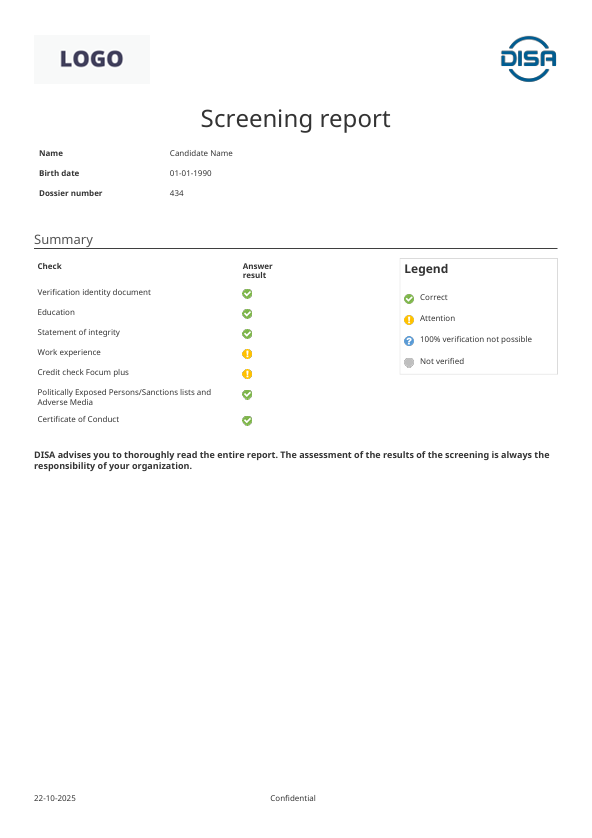
When all parts of the screening have been finalised, a report is generated and made available to both you as the employer and the candidate. You will receive a notification when the report is ready to download, allowing you to track the progress of the screening in real time.

What does a screening report look like?
What does working with DISA as your pre-employment screening provider look like?
Here’s how the pre-employment screening process works:
- Create an account by contacting us or booking a meeting to discuss your needs
- Register your candidates in the platform and select the types of pre-employment screening required
- DISA notifies the candidate, who can activate their account and follow the instructions
Depending on the checks selected, the candidate may need to:
- Upload ID or a passport photo for identity verification
- Provide contact details for referees for reference checks
- Upload documents for education and qualification verification
- Provide personal identity numbers for criminal record checks (where applicable)
- Provide personal identity numbers for credit checks (where relevant)
What happens next?
- DISA verifies the information provided by the candidate and ensures its accuracy.
- As each part of the screening is completed, both you and the candidate can access the results and track the status of the process 24/7.
- We support you every step of the way – before, during, and after the pre-employment screening process.
Checklist before getting started with pre-employment screening
To ensure you are well prepared when implementing pre-employment screening, it’s helpful to consider the following:
- What types of roles are you planning to hire for this year?
- How many hires are you expecting to make?
- Identify which types of pre-employment screening you require
- Are you hiring nationally and/or internationally?
- What is your budget?
- Decide whether to conduct pre-employment screening in-house or outsource it
- Ensure you have a clear and transparent screening process in place before you begin
- Inform candidates about pre-employment screening early in the recruitment process
- Familiarise yourself with relevant laws and regulations to avoid legal risks

How can we help?
Want to learn more about how our pre-employment screening platform works? Book a demo with our team to see how it can support your recruitment process.