






What is pre-employment screening?
Pre-employment screening is the verification of a potential employee’s relevant data that relates to the execution of the candidate’s job. The screening provides certainty about the candidate’s information shared and allows you to make better informed hiring decisions based on facts. Are you moving forward with the potential employee?
Here you can read everything you need to know about pre-employment screening:
- Why conduct pre-employment screening?
- Download the basis of employment screening
- Key components of pre-employment screening
- Is pre-employment screening obligated?
- Rules for background checks
- Example of the pre-employment screening procedure
- The rights of candidates during pre-employment screening
- The cost of pre-employment screening
- Pre-employment screening services of DISA
- Pre-employment screening software of DISA
- Example of the pre-employment screening report
- Pre-employment screening background checks
- A negative pre-employment screening?
- Pre-employment screening and the GDPR
- The combination of pre- and in-employment screening
- Frequently Asked Questions
Why conduct pre-employment screening?
- Risk management: Investing in the screening of applicants in advance, offers great added value in the long term. By objectively checking the relevant personal data, you know for sure who you are hiring and potential risks come to light.
- Mis-hire, or bad hire: In today’s labour market it is often a matter of acting quickly to become the best in the market, but perhaps you have also experienced the other side of the coin: an employee who got through the job interview flawlessly, but in reality is not suitable for the role. This is something you want to avoid at all times.
- Quality management: Job interviews remain the most important way to gain an impression of whether a candidate fits in well with your company culture. However, by adding screening to the recruitment process, you guarantee that the quality and integrity within your organisation remains intact.
- (Increasing) Laws and regulations: The laws and regulations regarding (hiring) personnel are increasing rapidly. It can be a complex process to comply with these regulations, especially because you do not want to lose focus on your core business. Outsourcing to a professional screening party ensures that you always comply with relevant laws and regulations and that you use an experienced party in this field.
- Remote working: Since working from home has become increasingly common, the way in which organisations recruit new employees has also changed. Many recruitment and onboarding processes have been digitised and therefore take place online. It remains important that the right candidates are chosen for a job. By screening you take thorough precautions.
- Internationalisation: If you decide to expand internationally as a company, you automatically have to deal with different countries of residence, different laws and regulations, cultures and personal data. Screening is then a proper solution to convey a uniform policy regarding integrity and quality.
The basis of employment screening

Key components of pre-employment screening
The components of a pre-employment screening vary by industry and depend on the role a candidate will perform. A retail employee, for example, typically requires a less extensive screening than the director of a financial institution.
Some of the checks that DISA commonly includes in a pre-employment screening are:
Depending on the industry and role, additional checks may be included as part of the screening process.
We work closely with organisations to design a screening profile that aligns with their specific requirements, risk profile and regulatory obligations.
Is pre-employment screening obligated?
Specific industries have particular requirements when hiring employees:
- Financial services: Screening is a regulatory requirement under financial services legislation and supervisory guidelines. Employees with access to financial assets or customer data are typically subject to screening.
- Healthcare: Verification of professional registration is mandatory for regulated healthcare professionals. Additional screening may be required for roles involving vulnerable individuals.
- Other sectors: While not legally required, screening is strongly recommended, particularly for positions with access to sensitive data, financial resources or critical systems.
Above all, pre-employment screening helps build trust in the people you hire. The greater that trust, the lower the risk of incidents, financial loss and reputational damage.
Rules for background checks
When carrying out a background check, employers must comply with several legal and regulatory requirements:
- Duty to inform: Employers must inform prospective candidates about the screening process and obtain their consent in advance.
- Identity verification requirement: In the Netherlands, employers are legally required to verify identity documents when hiring a new employee.
- GDPR compliance: When screening candidates, employers must comply with all applicable GDPR requirements. For example, they may only collect information that is relevant to the role and must ensure that personal data is stored securely.
Example of the pre-employment screening procedure
Candidate rights during pre-employment screening
Under the GDPR, candidates have several rights that employers must respect throughout the screening process:
- Right to be informed: You have the right to know which personal data is being collected, why it is being processed and how long it will be retained.
- Consent requirement: An employer may only conduct a screening after obtaining your explicit consent. Without consent, the screening is not valid.
- Right of access: You have the right to review the screening report. DISA makes the report available to both the candidate and the employer at the same time.
- Right to rectification: If any information is inaccurate, you have the right to have it corrected before a decision is made.
- Right to provide context: If a discrepancy or adverse finding is identified, you have the opportunity to explain the circumstances. Employers should give candidates the chance to respond before making a final decision.
What does pre-employment screening cost?
The cost of pre-employment screening depends on several factors:
- The type and number of checks required: For example, criminal record, qualification, reference and identity checks.
- National or international screening: Whether the candidate has lived, worked or studied outside the Netherlands.
- The risk profile of the role: Higher-risk positions typically require more extensive screening.
- Volume and automation: At higher volumes, the cost per screening decreases. Standardising and automating processes helps reduce inefficiencies and avoid delays in recruitment.
Request a no-obligation quote to receive pricing tailored to your organisation's screening requirements.
Pre-employment screening services of DISA
The screening of candidates can be a complex, sensitive, and also a labour-intensive process. To facilitate this data verification, you would need the help of various data suppliers and must also maintain the contact with the applicant. Outsourcing the screening process means that an organisation does not need to engage in these partnerships and that this data is stored in one central place. With DISA's pre-employment screening services you are unburdened and can be sure that data is verified as efficiently as possible.

Pre-employment screening software van DISA
DISA has developed a software for pre-employment screening that ensures an efficient screening process where your data is always secure.
Our software makes the screening process fast and efficient due to, amongst other factors, a user-friendly design.
The results of the screening are simultaneously offered to both the employer and the employee. By doing so, we try to offer a process that is as transparent and fair as possible.
The security of our software is perhaps the most important precondition for our existence. DISA uses strict frameworks that are periodically tested by independent parties. In addition, DISA employs a DPO, who ensures that our services, and thus your screenings, always comply with the guidelines of the GDPR.
The software is designed for mobile use. This gives employees more freedom to go through their screening when and where it suits them. This flexibility ultimately benefits the turnaround time.
Through our API it is possible to integrate employment screening into your existing workflow and collect reports and data from within your existing ATS-/HR-tool, in one central place.
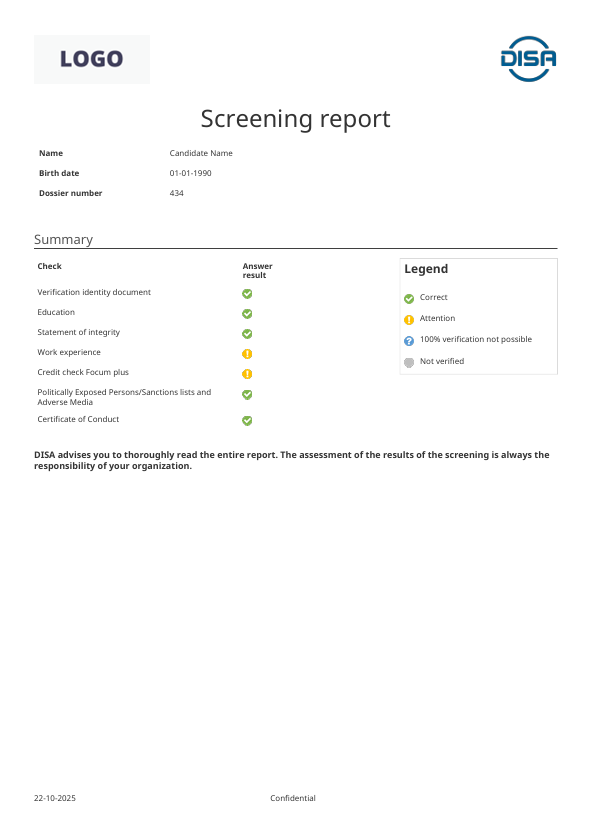
Example of the pre-employment screening report
Once all of the candidate’s data has been verified, DISA delivers a screening report containing the results. At that time, both employer and candidate are notified and can download it directly from our secure application. This report presents the objective findings per screening check.

Pre-employment screening background checks
The background checks within a pre-employment screening vary per sector and depend on the position a candidate will hold. For example, a retail employee should be screened less extensively than the director of a financial institution.
Some of the checks that DISA typically includes in a pre-employment screening include:
- Identity check
- Education check
- Statement of integrity
- VOG check (certificate of conduct)
- Work experience check
In addition, depending on the sector and position, a pre-employment screening can always be extended to include other background checks. We would be happy to think along with you and ensure that you have a screening profile that meets your organisation’s needs.
A negative pre-employment screening?
A negative result does not automatically mean that a candidate will be rejected. DISA presents objective findings only. A discrepancy in the report may simply be the result of an unintentional error, such as an incorrect employment start or end date.
Our recommendation is to always discuss any discrepancies with the candidate before making a decision. This gives the candidate the opportunity to provide context and helps prevent individuals from being unfairly rejected.

Pre-employment screening and the GDPR
During a pre-employment screening, relevant personal data is collected and processed. The GDPR requires companies to be more aware of how they process and store data. Privacy and screening are thus inextricably linked.

Secure software
For the development of our secure environment, we have taken technical and organisational measures to safeguard personal data against loss or any other form of unlawful processing.

Data Protection Officer (DPO) at your disposal
DISA employs a dedicated DPO who advises on the correct processing of personal data and ensures that we comply with all (inter)national privacy laws and regulations.

ISO certified
DISA is ISO certified (2700 & 9001). This guarantees high quality management and information security.
The combination of pre- and in-employment screening
After an employee has been recruited, changes can occur and situations can arise that an employee, but certainly also the employer, did not foresee. However, these situations can increase the risk for an organisation. How do you manage risks resulting from changes or unexpected situations?
After a period of time, certain pre-employment screening results are no longer valid. It is therefore smart to combine pre- and in-employment screening. If your organisation already uses pre-employment screening, the subsequent in-employment screening will automatically consist of fewer background checks.

Frequently Asked Questions about pre-employment screening
A pre-employment screening involves verifying certain information about a potential employee before they actually start working for you. The data screened must relate to the applicant’s job performance. For example, the BIG registration of a health care provider must be checked when hiring.
After the candidate has provided the required data, the average turnaround time of a screening at DISA is 5 working days. Elements that have a longer turnaround time are the certificate of conduct (VOG) and the verification of foreign diplomas.
When you as a candidate have completed a screening, you will receive your screening report with the results. This contains the objective findings per screening check.
We also offer the option for freelancers to request a screening report for themselves. Does your new employer request that you be screened?